Showing posts with label Orange Tip. Show all posts

Monday, 4 June 2018

Butterfly Transect Update.


After quite a long blogging absence I felt it was time to provide an update on my fourth year of undertaking butterfly monitoring on the northern boundary of Ashtead Common NNR, managed by the City of London Corporation. 
The transect, covering a distance of 1770 meters, follows tracks and footpaths through deciduous woodland, with many ancient oaks, and open grassy glades .


As in previous years the predominant early species on the wing has been the Brimstone.


The second most common species during the last six visits has been the Speckled Wood with the highest weekly count of nine yesterday.

At Flag Pond, probably a former clay pit (hence the water colour) linked to the nearby Roman villa complex, I tend to stop for a while to check out the wildlife. On the 4th May I recorded the first Large Red Damselfly and from mid May the numbers of Broad-bodied Chasers has steadily increased with White-legged Damselflies appearing in the grassland nearby. I have also seen Common Blue Damselfly and Beautiful Demoiselle here in the last two weeks.

While watching the pond life yesterday I heard the begging calls of young Blue Tits (below) from a tree behind me and turned round to find four hungry individuals squashed together in the cleft of the tree waiting for the parents to return with food. [Unfortunately I didn't have a long lens with me so these images are heavily cropped].

I have also recorded 22 bird species so far this year whilst walking the transect and two weeks ago heard my first ever Cuckoo calling on the common from woodland south of the Roman earthwork complex.

Other species of butterfly recorded so far this season, albeit in very low numbers, include Small and Large White, Green-veined White, Comma, Common Blue, Holly Blue and Orange-Tip (below).

Orange-Tip (female)
About a hundred yards away from the transect I saw my first Large Skipper of the year yesterday so hopefully they and a few other species will provide some photo opportunities in the coming weeks.

During yesterdays walk I watched masses of micro-moths, Green Oak Tortrix (Tortrix viridana). On two trees I estimated there were at least 300 fluttering and feeding. One individual dropped onto the bracken below allowing me to grab a quick snap. 
Below are just a few of the wild flowers that have finally emerged in the last two weeks.


Linking to:
Nature Notes

Friday, 5 May 2017

Patch Wildlife.

Just a few images of the varied wildlife seen on my patch walks during the past six weeks.


Strangely Mute Swan is a rare sighting on Epsom Great Pond. It didn't stay very long!


Two pairs of Tufted Ducks have appeared on the ponds. Once again it will be interesting to see if they stick around to breed.

I didn't carry out my weekly transect walk from mid to end of April due to the colder, windy conditions so only six Speckled Wood recorded in the past six weeks.


A female Orange Tip with its very distinctive under-wing pattern.

I didn't record any of this species on the Ashtead Common transect last year but this female was spotted on the 10 April this year and a male was recorded on 2 May. Brimstone's have been the most common species recorded this season but no photo opportunities so date.


Chiffchaff. Just one of many heard and seen around the common. There will be some more images on my FABirding blog shortly.


Willow Warbler singing from a typically high perch.

I nearly stepped on this Adder a week ago. It was basking on an open path but decided to slip into the nearby undergrowth.

Hopefully in a week or so I will have something totally different to post when I return from a trip to Northern Greece. FAB.

Saturday, 19 April 2014

Orange Tip.


Warmer weather over the past few weeks has produced far more sightings of butterflies compared to the same period last year when it was wet and cold. One little charmer that wanders the countryside, along hedgerows and through our gardens is the Orange Tip (Anthocharis cardamines). The males emerge about a week before the females and this male one was visiting Green Alkanet.


Now if you thought the upper-wing colour is distinctive then just check out the elaborate under-wing pattern below.


Linking to SATURDAYS CRITTERS.

Monday, 20 May 2013

Garden Delights.


After an early morning visit to the local recycling depot to dispose of numerous bags of unwanted hedge trimmings I decided to sit for a while on the low retaining wall beneath the lilac that is just coming into flower and snap whatever came within my field of view. The low growing Dicentra behind the shed is slowly loosing its colour. Over the past few days the stems of the Alliums have been getting taller and taller all around the garden and now some of the heads are just starting to pop open and will shortly reveal their spherical blooms.

Over the years, Aquilegia vulgaris 'William Guiness' has freely spread to many areas of the garden, often appearing from tiny cracks in the concrete path, but it can take anything from 2 - 5 years to achieve its ultimate height of 75cm.

A few avian visitors, Blue Tit, Magpie, Starling and House Sparrow, dropped in to check out the feeders. Others that failed to get within focus range included Goldfinch, Coal Tit, Blackbird and Robin.

One visitor that I initially failed to notice, until I stood up, was resting only two feet away .... a female Orange Tip with its very distinctive under-wing pattern.

Despite stroking her wing very gently with my finger she wouldn't move from her perch.   FAB.

Friday, 20 April 2012

Songsters and Flutters.

The early morning sunshine didn't last very long today before the rain clouds drifted through producing localised heavy downpours and even hail! I took a gamble and headed over to Bookham Common mid morning and was rewarded with plenty of bird song and my first sighting this year of several newly arrived Common Whitethroats.
The most common songsters where Chiffchaffs but every time I raised the camera they stopped singing!

 A male Chaffinch showed off his fresh colours as the sun peeked through the clouds.

 As soon as the clouds rolled in again the little Jenny Wren also stopped singing.
The other songster that eluded the camera (so what's new!) was the Nightingale but I did locate three separate territories around the common. While listening to the glorious outpourings of one male for over 20 minutes  I had a close shave with a Sparrowhawk that dashed past my shoulder and dived into the tangled mass of undergrowth and silenced everything for quite some time. I didn't see the Sprawk exit but the Nightingale wasn't harmed as it had moved to another hidden perch and continued to sing until the next rain shower dampend every ones efforts. You can follow this link to listen to a recording of this beautiful songster.

Once again with the changeable weather the only flutters I saw were this single Speckled Wood plus a high flying Holly Blue while trying to chase down one of the many Orange Tips that were on the wing today.
Eventually one male Orange Tip alighted for a lengthy rest but would only sit with its wings closed as usual. The image above was taken with my compact Canon Powershot and provided a much clearer outcome than the image below taken with the 70-300 lens!
Wherever you are I hope you have a glorious wildlife watching weekend ..... FAB.

Saturday, 7 April 2012

Recent Butterfly Sightings.

Like many other wildlife watchers, here in the UK, the mild and dry late winter and early spring weather has prompted the early first flights of various butterfly species. Here are just a few that I have seen fluttering both through my garden and during various walks over the past few weeks. 

 The Brimstone (Gonepterys rhamni) resting just above the leaf litter.

 The Comma (Polygonia c-album) collecting some moisture from a muddy patch close to a stream.

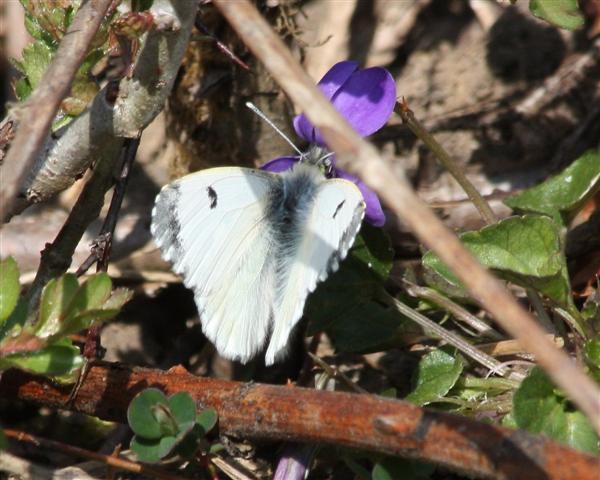
I have been seeing lots of male Orange Tip (Anthocharis cardamines) in the past few days but they were constantly patrolling their territories and rarely stopped to rest. The females are generally much more secretive but I located one hunting for some nectar from the few Violets blooming in a hedgerow and whilst it was difficult to get an uninterrupted view she did perch just long enough for a couple of quick snaps.

 The above image does at least show some of the beautiful green-marbled under wing pattern.

And last, but not least, the Peacock (Inachis io) who for some reason can often be found sunning itself on an old piece of a discarded plastic bag.

During a recent patch walk I spotted another small winged object fluttering around the vegetation surrounding a small stagnant pool. I gained the impression that it reminded me of a Skipper due to its orange-brown underwing but was obviously a day flying Moth ..... but which one?
It settled briefly on the leaves of reed mace just a few inches above the water but constantly moved its location and I had a devil of a job to relocate it but eventually managed a passable  shot. 
Thanks to Dean I now know this is a Light Orange Underwing (Archiearis notha) which flies from March to April and favours Aspen in open woodland, of which there is some nearby.     FAB.

Sunday, 8 May 2011

Bookham Common Sights and Sounds.

Over the last two days I have made two visits to Bookham Common. The first on Friday was to meet up with two ex RHS colleagues and give them a guided birding tour around the various habitats which produced a tally of 35 species although many were heard but not seen. Yesterday Anita and I joined a Surrey Bird Club (SBC) field trip led by Alan Prowse whose knowledge of the common, its resident and migrant species is second to none.  
During both visits the most conspicuous specie was the Common Whitethroat singing from their perches and during their brief display flights. We also caught up with the rattling 'tell-tell-tell-tell-tell' song of the Lesser Whitethroat and were fortunate to get some glimpses but not sufficient for the camera.

 Song Thrush (Turdus philomelos) singing its repeated phrases.

Yesterday two male Cuckoos were seen in flight and we were able to confirm that they were indeed separate individuals from the different length of the second part of their calls. At one moment in time we were watching a Cuckoo while one of three Nightingales provided a background soundtrack with both Blackcap, Garden Warbler and Whitethroat also singing close by. As someone else commented "That experience has definitely gladdened my heart". Other songsters included Chiffchaff, Willow Warbler, Wren, Blackbird, Goldfinch and Greenfinch. Overhead we logged Cormorant, Grey Heron, Buzzard and Kestrel plus the usual corvids.

 Cardinal Beetle.

The overnight rain certainly made everything look fresh and a few species of Butterflies found themselves in front of the lens.
 Green-veined Whites lining up for mating.

 Orange-tip (Anthocharis cardamines)

 The distinctive under wing pattern.

The ponds which have undergone a major clearance programme are slowly producing more sightings. Ours included Mute Swan, Canada Geese, Little Grebe, Mallard, Coot, Moorhen and a pair of Tufted Ducks.I have no doubt that one day a passing wader will drop in.

 One of a number of young Coot asking to be fed.

 Just a few of the Mallard ducklings totally ignoring their parents.

Broad-bodied Chaser (Libellula depressa).
As the months go by the pond margins should produce a decent list of Dragons and Damsels. Our sightings on the second visit also included Swallow, House Martin and the first arrival of Swifts to give me a total of 42 species which has also helped to bump up my year list.  FAB.

Sunday, 24 April 2011

A Day with Friends.

Today we met up with Tony and Jean early this morning for a stroll around Bookham Common.

Initially the most prominent songsters as we wandered through the wooded areas were numerous male Blackcaps while we also spied nesting Jackdaw and Song Thrush plus Mallard on the pond. The most prolific wild flower was Ramsons plus one of the largest bracket fungi (Pycnoporus sp.) I have seen in a while at the base of a very old mossy tree stump..

Out onto 'The Plains' we spotted a pair of Bullfinch, the male looked just like a bright red ball hidden in the shrubbery while overhead a few Long-tailed Tits flitted silently through the branches.

A Great Spotted Woodpecker tried to be inconspicuous as it perched in a tangle of Blackthorn. 

A distant calling Cuckoo was heard as we listened to Song Thrush, Chiffchaff, lots of Common Whitethroats and then picked up our first Nightingale singing strongly from within its dense nesting territory. A little later on at 'Nightingale Corner ( see the sign someone had scratched on a log slice in the top collage) we heard our second Nightingale although somewhat less vocal than the first. Jay, Wren, Blackbird, Mistle Thrush, Grey Heron, Blue and Great Tits and a single Willow Warbler were also logged.

After a relaxing alfresco light lunch in our friend's garden we took a mid afternoon stroll around their local fields. Unfortunately very little bird life but plenty of other things to admire. A very large Oak Gall, seed from Goat Willow being dispersed by the very welcome afternoon breeze, bird cherry blossom in the hedgerow and Yellow archangel flowering a bit earlier than usual. Quite a few flutters rapidly flew past us including the following:

 Orange Tip.

 Speckled Wood.

Peacock.

Tomorrow we are heading south-eastwards into Kent to meet up with some other friends so I guess I had better turn in a little earlier than usual and remember to set the alarm!   FAB.

LinkWithin

Related Posts with Thumbnails