Showing posts with label Long-tailed Tit. Show all posts

Tuesday, 3 May 2016

Check out FABirding.


For this week's editions of Nature Notes and Wild Bird Wednesday you will need to switch over to my photo blog FABirding where I am featuring images of five local species from the Tit family. 

Please feel free to browse through some of my other work on FABirding and let me know what you think of my efforts. (Recent posts are also shown in the link on my sidebar). FAB.

Saturday, 23 April 2016

Friday Flutters and Patch Birds.

During my patch walks this week the most obvious LBJ was the Chiffchaff with several pairs chasing one another while other singletons were either singing or busily searching for insects.


I have also completed my third weekly butterfly transect walk through the oak woodland on the north of Ashtead Common, hence the return of 'Friday Flutters'.
Due to the lower temperatures the variety and number of each species recorded was very low. Just three Brimstone, including this image of a resting female attempting to soak up as much warmth as possible from the limited sunshine.


The only nectar sources available have been the early flowering Bluebells and Lesser Celandine but this week the woodland floor was starting to come alive with large patches of Wood Anemone. The only other flutter recorded this week on the transect was the Peacock (below).


A Kestrel patiently surveys its surroundings in one of the large open woodland glades.

I always encounter a few of the very acrobatic Long-tailed Tits during my walks and have watched several still collecting nesting material.

Once again this week the three pairs of Lapwing on the fields at Rushett Farm were very vocal as they endeavoured to chase off any of the Carrion Crows that entered their territorial airspace.

Linking to:
Saturday's Critters
Nature Notes

Saturday, 31 January 2015

January Patch Birds.

My wildlife watching got off to a slow start this year due to a virus contracted over the Christmas period that laid me low for a couple of weeks. Local patch water fowl sightings have been thin on the ground due to the pond freezing over a week ago and everything appeared to be in hiding.

Fortunately four Northern Shoveler present on the pond since early December were still around prior to the water freezing up and one male in full breeding plumage was close enough during one patch visit to provide an opportunity for a few images.
Other sightings have included up to six Teal; with four males displaying to two females; and two pairs of Mandarin Duck plus the resident Mallard and Moorhens.


Northern Shoveler

Moorhen

At this time of year it is not unusual to see large parties of Long-tailed Tits foraging through the woodland but obtaining a clear shot as they flit from perch to to perch is another challenge! On a few occasions the flocks have included one or two Goldcrests but I have still to capture a decent image of this tiny species.


Long-tailed Tit.


One species that rarely allows a close approach is the Jay but I was fortunate recently to catch one searching through the leaf litter and totally oblivious to me creeping close enough for this cropped shot.

During this continued cold and wet weather raptor sightings have included Kestrel, a Sparrowhawk darting through a large flock of Redwing, Common Buzzard and an over flying Red Kite. 


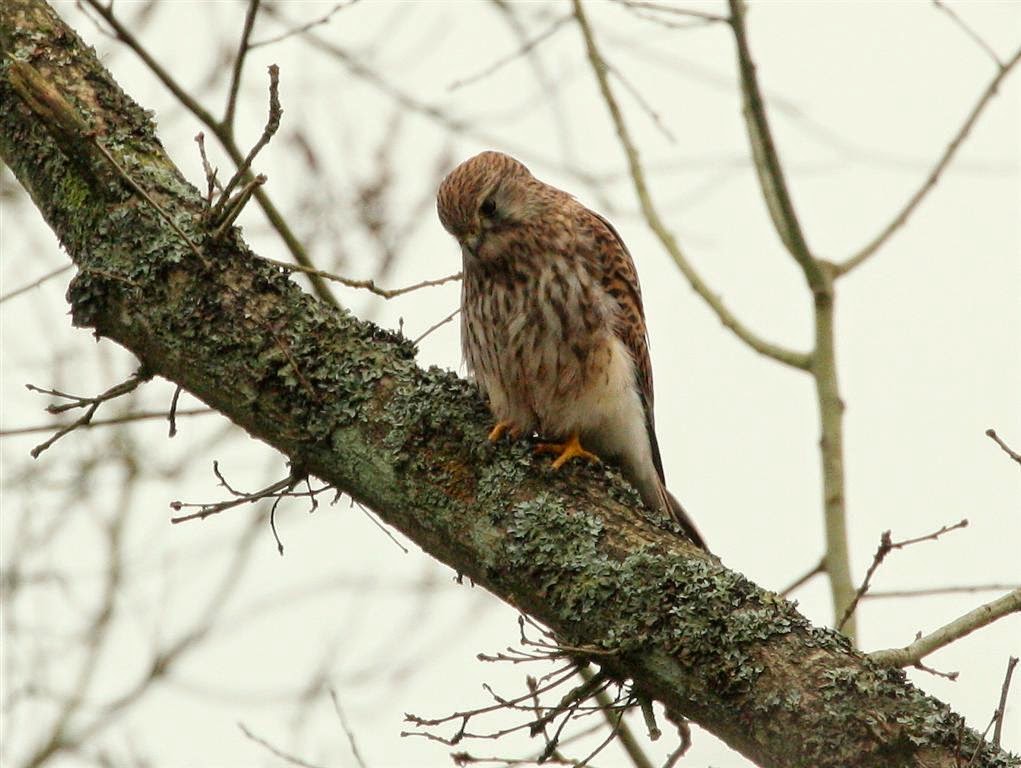
I spotted this (juvenile or female) Kestrel perched in a tree close to one of the main paths and watched it surveying the ground below for a possible meal. After a few minutes it flew to another perch to continue its vigil before eventually flying away.


One Black-headed Gull has taken up residence on the main pond and regularly takes flight when another interloper flies in and chases off any competition!


My patch tally for January has now reached 40 species and you can view the full list on my Bird Sightings page. FAB.

Linking to Saturday's Critters hosted by Eileen.

Friday, 30 March 2012

Patch Update

As is often the case the first bird I usually encounter during my local patch walks at Epsom Common is the 'Bottle' Tit. It rarely perches in one place for long so it always pays to have the camera ready .... how many times have I missed a decent shot because I haven't immediately taken the gear out of the bag!

Long-tailed Tit (Aegithalos caudatus)

During the past few months the most obvious call has been the rich repertoire of the Great Tit including its seesawing ditty 'ti-ta .. ti-ta .. ti-ta' or 'ti-ti-ta .. ti-ti-ta .. ti-ti-ta' ( often described as sounding like 'teacher .. teacher .. teacher') but now that Spring is here my ears have to listen out for a somewhat similar song from a returning migrant .......

Great Tit (Parus major)

.... AND it wasn't long before I located a Chiffchaff who had just returned from its southern wintering home in Africa although, of course, many now overwinter in the south of England and southern Europe. This individual was constantly moving from perch to perch high in the canopy while calling out its name (most field guides describe its forceful monosyllabic song as 'silt sult sult sult silt silt sult sult sult silt etc') with frequent pauses when it reverted to its softly whistled 'hweet' call. 

(Common) Chiffchaff (Phylloscopus collybita)


A little later I caught up with another singing Chiffy in a more open location ..... but he didn't always want to show me his best profile. I'm sure Dave (Birds from Behind) will appreciate the bottom two shots!

During my early years of birding my mentors would often remind me to listen out for the scolding calls of Corvids when walking through woodland as this could often lead to finding them harassing an Owl or a much larger predator. Well last week this method paid off as I followed the ever increasing sounds of Magpies and Carrion Crows obviously unhappy at the presence of something within their woodland territory and I just caught a glimpse of a large raptor lazily flying through the trees to escape this noisy tirade. I hurried along the  pathways and just managed a single shot of a perched juvenile Common Buzzard (blotched streaked markings on  the breast) before it decided to move on to find a more camouflaged and peaceful location to rest.

Common Buzzard (Buteo buteo)

With sightings of Teal, Yellowhammer and Linnet in the last two days this years patch total is now up to 54 species.

Wherever you are .... have an enjoyable wildlife watching weekend.     FAB.

Saturday, 3 March 2012

Local Patch YTD Update.

It has been a while since I posted anything about my local patch walks, mainly around Epsom Common Ponds and the surrounding woodlands, so here is an update including images of some of the regular winter species.

The woodland area around the car park has so far produced Robin, Wren, Blackbird, Song Thrush, Mistle Thrush, Jay, Magpie, Carrion Crow, Jackdaw, Chaffinch, Dunnock, Collared Dove, Rose-ringed Parakeet, Starling, Nuthatch, Treecreeper, Goldcrest, Lesser Redpoll, Great Spotted Woodpecker, Blue Tit, Great Tit, Long-tailed Tit, Coal Tit plus one sighting of a Marsh Tit. On 16 February I was very fortunate to find a single Firecrest (a patch tick) but no sightings of Lesser Spotted Woodpecker so far this year.
 Long-tailed Tit (Aegithalos caudatus) taking a brief rest from feeding.

Long-tailed Tit enjoying the sunshine.

Treecreeper (Certhia familiaris) starting its upward climb.

The other main inhabitants around the woodland edge during the winter are the visiting thrushes, Redwing and Fieldfare. Throughout January the numbers for each species were around 50 - 80 but in the last two weeks the numbers have fallen dramatically as they have stripped the berries from the ivy and probably moved on to a better feeding area.

Fieldfare (Turdus pilaris) keeping a watchful eye out for predators

During the last month Woodpigeon numbers have increased dramatically and I estimate a minimum of 250 in and around the woodland. They are pretty skittish and fly into the air at the slightest disturbance and are providing a welcome daily meal for the resident Sparrowhawks which regularly glide over the treetops. The Crows get their daily exercise by mobbing the local Common Buzzards or chasing off a hunting Kestrel.

The main inhabitants of the small Stew Pond are the Mallard and Moorhens.
One of the resident Grey Herons (Ardea cinerea) can be found at one of their favourite fishing locations and usually tease me by allowing me to just get within range of the lens before flying over to the other side!
You will know from previous posts that I can usually find a Cormorant (Phalacrocorax carboresting on the Great Pond. This individual is an older adult in courtship plumage (evidenced by a white thigh patch ... hidden by its wing in this shot and the extensive white on the head and neck).
Or occasionally flying overhead.

Canada Geese numbers fluctuate throughout the year but at least two or three pairs will probably stay to breed. I like the way that one adult always stands on guard while its companion is feeding or takes a rest. A male Tufted Duck made an appearance in early January but hasn't stayed. (A pair did stop and breed last year so maybe they will return now that the water is unfrozen.)

On 31 January, 15 male Mandarin Ducks (Aix galericulata) circled the pond and briefly dropped into an unfrozen area before flying away again. The following week I counted 5 males and 1 female but last week I could only spot one pair lurking in the shade of the main island. Hopefully they will stay to breed as in previous years.

Another infrequent winter visitor to the Great Pond is the Northern Shoveler (Anus clypeata). Two males and a female turned up on 23 February but I don't anticipate that they will stay much longer. Other species seen are Stock Doves, Goldfinch, House Sparrow, Green Woodpecker and Black-headed Gull plus on the 28 February I located 13 Lapwing on the fields at Rushett Farm (Last year for the same week the count was 14!).

During the last two weeks as I skirted the farm fields I have listened to the beautiful song of the Skylarks (Alauda arvensis) that have returned to breed. This photo is one from the archives.    FAB.

Tuesday, 17 January 2012

Winter Ducks.

On Monday I drove over the county boundary to Wraysbury Gravel Pits in the hope of seeking out a few of the migrant species that often frequent the various large lakes formed after the extraction of gravel to build the M25 motorway.

As I climbed over the style to access the footpath that would take me alongside the New Hythe Pit I was initially greeted with a flurry of activity as various species including Blue Tit, Great Tit, Chaffinch,  Blackbird and Redwing dived for cover while overhead I could hear the distinctive chattering 'shack-shack-shack' calls from a number of Fieldfare. Both the Redwing and Fieldfare are winter visiting Thrushes and typically vary wary of any intruders so I had to wait patiently for them to settle high above me in order to snap a cropped record shot of both in the frame together.


Moving on I scanned the open water only to find that most of the ducks were typically too far away for the lens on the farthest side of he pit but I was delighted to spot that my quarry including 3 drake Smew and 8 Goosanders plus a number of Goldeneye were in fact on site together with the usual Mallard, Coot, Tufted Duck, Pochard, Grey Heron, Cormorants, Mute Swans, and Great Crested Grebes.  

I eventually managed to capture a male Goosander (Mergus merganser) which had been drifting close to the bank but out of my sight and promptly decided to swim away to join its distant companions. The next two species, Goldeneye and Pochard were fortunately a little more obliging.

Male Common Goldeneye (Bucephala clangula)

Male Common Pochard (Aythya ferina)

A few other species kept me company during my stroll including a small flock of Long-tailed Tits, Great Tits (constantly uttering their scolding call as I walked by) and the very noisy Rose-ringed Parakeets whose piercing screams nearly drowned out the constant background sounds from the nearby motorway!

My final quarry was the extremely shy and one of the smallest sawbills, the Smew. The males are often referred to as the 'White Nun' due to their distinctive white and black streaked plumage.
Male Smew (Mergellus albellus).
Every winter this dainty species migrates southwards from its northern boreal breeding grounds in Finland, Sweden and Russia. Small numbers can usually be found at regular overwintering sites from December until March throughout the southern counties of the UK. Unfortunately I couldn't get any decent views so had to dig out an image taken during a visit to this site from just a year ago.  FAB.

Click here to link to WORLD BIRD WEDNESDAY for more images from around the globe.

Tuesday, 19 July 2011

Long-tailed Tits.

With the sky brightening late morning today I was thinking about going out when movement outside the window caught my attention ..... a number of very small bundles with long tails had descended upon one of the feeders .... unusually for me, the camera was not to hand so I had to go upstairs to recover it .... but would these tiny and infrequent visitors to the garden hang around .....

With camera in hand I gently opened the back door and quietly crept out to the edge of the patio while listening to the numerous twittering 'tsee..tsee..tsee' contact calls emanating from various leafy locations around the garden and estimated that around ten Long-tailed Tits (Aegithalos caudatus) had decided to bless me with their presence.

As far as I could determine most of them were juveniles and they constantly flitted from one perch to another as they sought out tiny insects from the foliage in the pittosporum, lilac and hawthorn.

With so much greenery at this time of year they weren't going to make it easy for me to capture their antics but time seemed to stand still as I turned first in one direction and then the other in an attempt to focus on the different individuals.


After feeding they all seemed to spend ages preening their shaggy coats.

To put their diminutive size into perspective they are only 13-15cm in length including their 7-9cm tails. Their normal habitat is both deciduous and mixed woodland with a well developed shrub layer plus farmland and heathland with scattered trees, bushes etc. Unlike many species the young don't leave the parents' territory at the end of the breeding season so it is quite usual to see a mixed flock of adults and their progeny together with unattached blood relatives of the adult male. As the season progresses it is usually just the females that defect to neighbouring flocks.

This young fluffy pair decided to perch high up in the open obviously enjoying the brief period of sunshine.


The youngsters will undergo a complete moult into adult plumage before their first winter and eventually look like their parents (see image above that I took on 1st April 2011) with their distinctive black, white, grey and variable pink colours.   FAB.

Please check out WORLD BIRD WEDNESDAY for more glorious images from around the globe.

Sunday, 24 April 2011

A Day with Friends.

Today we met up with Tony and Jean early this morning for a stroll around Bookham Common.

Initially the most prominent songsters as we wandered through the wooded areas were numerous male Blackcaps while we also spied nesting Jackdaw and Song Thrush plus Mallard on the pond. The most prolific wild flower was Ramsons plus one of the largest bracket fungi (Pycnoporus sp.) I have seen in a while at the base of a very old mossy tree stump..

Out onto 'The Plains' we spotted a pair of Bullfinch, the male looked just like a bright red ball hidden in the shrubbery while overhead a few Long-tailed Tits flitted silently through the branches.

A Great Spotted Woodpecker tried to be inconspicuous as it perched in a tangle of Blackthorn. 

A distant calling Cuckoo was heard as we listened to Song Thrush, Chiffchaff, lots of Common Whitethroats and then picked up our first Nightingale singing strongly from within its dense nesting territory. A little later on at 'Nightingale Corner ( see the sign someone had scratched on a log slice in the top collage) we heard our second Nightingale although somewhat less vocal than the first. Jay, Wren, Blackbird, Mistle Thrush, Grey Heron, Blue and Great Tits and a single Willow Warbler were also logged.

After a relaxing alfresco light lunch in our friend's garden we took a mid afternoon stroll around their local fields. Unfortunately very little bird life but plenty of other things to admire. A very large Oak Gall, seed from Goat Willow being dispersed by the very welcome afternoon breeze, bird cherry blossom in the hedgerow and Yellow archangel flowering a bit earlier than usual. Quite a few flutters rapidly flew past us including the following:

 Orange Tip.

 Speckled Wood.

Peacock.

Tomorrow we are heading south-eastwards into Kent to meet up with some other friends so I guess I had better turn in a little earlier than usual and remember to set the alarm!   FAB.

LinkWithin

Related Posts with Thumbnails