Showing posts with label Large Skipper. Show all posts

Saturday, 14 July 2018

Transect Update for Weeks 14 and 15.

My butterfly transect walk for week 14 was undertaken with temperatures around 25 deg.C and just before a short camping holiday in Kent when it soared well above 30 deg.C. On my walk last Monday (Week 15) the temperature was a more comfortable 23 deg.C.
Week 14 produced the highest count of 11 Large Skipper (above) so far this year.


Whilst I logged sightings of 9 Small/Essex Skippers I was only able to clearly identify 4 individuals as Essex Skippers (above).

As expected the most prominent species seen were Ringlets (above) with a total of 171 recorded over the two visits and Week 15 saw the emergence of the Gatekeepers (below). 


I recorded Large, Small and Green-veined Whites on both walks with the former producing 14 sightings and was also the only species that stopped long enough to be captured by the lens.

Large White.

I also recorded my highest count of 26 Purple Hairstreaks in Week 14 and the highest overall annual total so far of 39 easily exceeding any of the previous three years records. The White Admiral tally for this season stands at 40 to date and is double the sightings recorded over the last four years, 


Conversely sightings of Silver-washed Fritillary has so far been much lower than last year.

Three new species for this season were seen in the last two weeks:

Holly Blue.

Peacock.

A female Brown Argus. This is only the second time in four years that I have recorded this species on the transect.

Linking to:

Friday, 22 June 2018

Transect Update - Week 12.


When I commence my weekly transect there is always a feeling of hope and anticipation about the species that might be seen. Having previously reviewed last years sightings and numbers plus reasonable weather conditions; 20 deg. C but a little cooler in the shade with some cloud cover being pushed along by a fairly brisk westerly wind; there was the prospect of a decent recording session. 

Section 1 produced 5 different species starting with this Large Skipper (above) plus Speckled Wood (2), Meadow Brown (3), Ringlet (2) and White Admiral (6).

White Admiral (above) would eventually feature in 7 out of the 8 sections on the transect producing a total of 14 individuals seen and the highest count for any of the four years I have carried out this survey.


Flag Pond produced the usual Broad-bodied Chaser (above) and Large Red Damselfly (below) with Meadow Brown and Ringlet being the main flutters in this section.


Section 3 produced five species (previously recorded) but not an anticipated Silver-washed Fritillary,  however a pair of White-legged Damselflies [male above and female below] put in an appearance.

Section 4, the largest open area of grassland that is slowly being swamped by bracken, produced one new species, a Small Skipper and a total of 25 Meadow Browns.


Meadow Browns eventually appeared in every section of the transect with a total of 44 individuals recorded. 

So my initial anticipation was rewarded with 8 species logged including Large White and Green-veined White culminating in an overall total of 77 individual sightings; again the highest 'Week 12' for the past four years.

Linking to:

Wednesday, 13 June 2018

Transect Update - Week 11.


The first two weeks of June are known as the 'June Gap' when spring butterfly species are going over and before the main summer fliers emerge.

I carried out my 'Week 11' transect walk on Ashtead Common last Sunday and was therefore not surprised that a Brimstone failed to appear but recorded 12 Speckled Wood, the highest weekly count for this species this season so far. 


Three of only four other species logged were all new sightings for this season.

A female Large Skipper.

One of nine Meadow Brown.

White Admiral. Just three individuals logged.

White Admiral (Underwing pattern)

A few days later during a stroll on Epsom Common I spotted at least a dozen White Admirals in the space of 30 minutes and also photographed my first Small Heath (below) for the year.


Friday, 15 July 2016

Recent Forays on Ashtead Common.

During the past week I have made three separate forays onto different parts of Ashtead Common and on each occasion whilst the temperature was more or less favourable the strong breezes and cloudy skies have conspired against me seeing and getting photos of some of the expected species. Nevertheless here are images of some of the species seen.

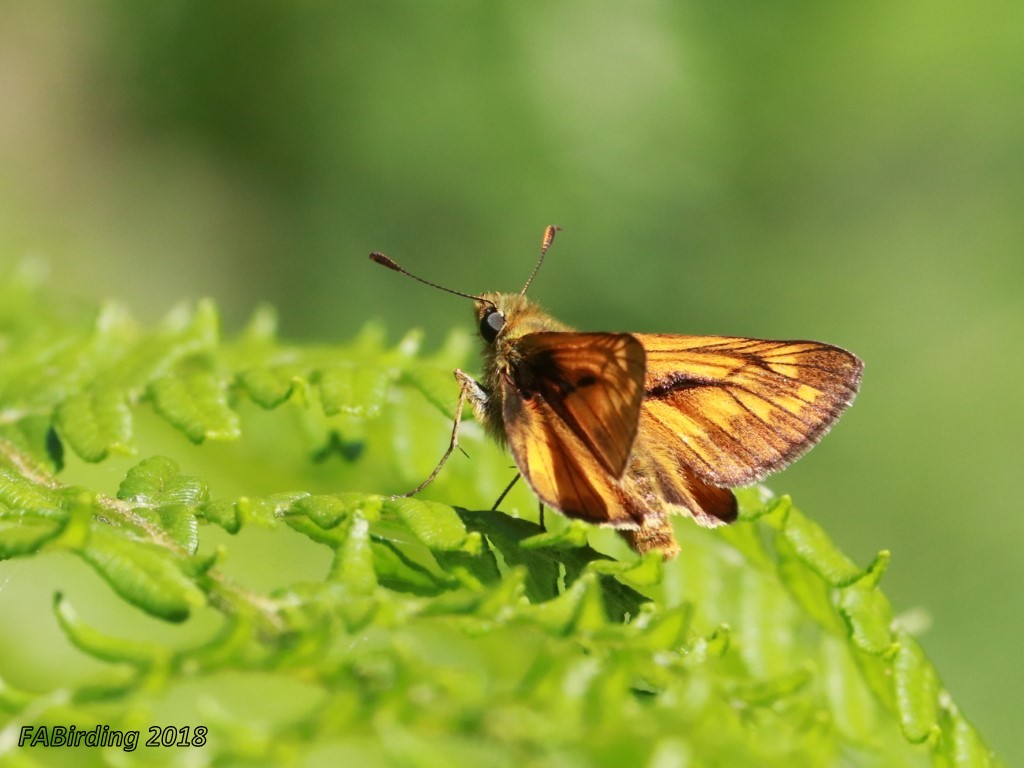
Large Skipper (Ochlodes venata). Of the three Skipper species this one is the easiest to find and identify and has been the most common on my transect walks from late June to date.

However the Small Skipper (Thymelicus sylvestris) has so far been less obvious than the same period last year and I have yet to find and clearly identify its close relative the Essex Skipper on my transect visits.

This mating pair of Small Skipper were spotted during a walk that I led for the local branch of Butterfly Conservation on Thursday when a total of 17 species was recorded including many Purple Hairstreak and Purple Emperor (c20) flying high above the Oak canopies. One Purple Emperor tantalisingly fluttered around a few of us at head height for a few minutes but failed to land!

Small White (Pieris rapae).

Comma (Polygonia c-album).

Red Admiral(Vanessa atalanta).

The most numerous species both on my woodland transect and other walks on the common at the moment is the Ringlet (Aphantopus hyperantus) which is happy to fly providing there is a little warmth even on the dullest of days.

The BC walk on Thursday also provided my first local sighting of a fresh male Gatekeeper (Pyronia tithonus).

Finally this Beautiful Demoiselle (Calopteryx virgo) below was seen as I wandered alongside the stream on my return to the car and was certainly aware of my presence.


Saturday, 25 June 2016

Ashtead Common Transect.

After the torrential storms on Thursday which flooded our rear garden I anticipated that even beneath a partially sunny sky late on Friday morning the underfoot conditions for my planned butterfly transect walk at Ashtead Common would require waterproof footwear. All the ditches were brimming full of water that was still seeping off the hillside and the main rides were very boggy so the Muck Boots were definitely the right choice.

The dominant species recorded was Meadow Brown (17) plus Speckled Wood (2), Large Skipper (5) and a single Red Admiral. As expected, due to the weather conditions, the overall numbers for the last 13 weeks of the survey period are down by at least 15% compared to last year.

Fortunately during my walk there were a few other interesting encounters mainly centered around the very muddy Flag Pond including more sightings of several male White-legged Damselflies, an Emperor dragonfly ovipositing, two male and one female Broad-bodied Chaser plus Blue and Large Red Damselflies.

 A female Large Red Damselfly (Phrrhosoma nymphula).


The largest open woodland pasture now has a few clumps of foxgloves but is quickly being dominated by the overbearing bracken but the time I spent here produced a few day flying moth species.


Brown Silver-line (Petrophora chlorosata).


One of the varied number of micro Grass Moths (Crambidae family).


I also disturbed at least half a dozen Silver Y (Autographa gamma) but getting a clear focus deep within their grassy hideaway was a real challenge!

The most unexpected find was this immature Black-tailed Skimmer (above) probably displaced by the windy weather. Below is just one of the five Large Skipper recorded throughout the transect.

Wednesday, 22 June 2016

A Skipper at long last.


My first Skipper sighting for this year was recorded last Sunday some 100 yards before the start of my Ashtead Common transect. I watched two male Large Skipper (Ochlodes sylvanus) nectaring on a patch of bramble flowers constantly being disturbed by a couple of Meadow Brown.


With much better weather forecast for this coming weekend I will be hoping to record Skippers during my planned transect walk.


I did record two Meadow Brown (Maniola jurtina) on the transect last Sunday under a cloudy sky and again I am anticipating that larger numbers will be on the wing this coming weekend together with Ringlet and a few other emerging species.


Monday, 13 July 2015

Large Skipper.


On the wing from late May to mid August it is rare for me not to encounter the robust and our brightest 'orange' skipper, the Large Skipper (Ochlodes sylvanus) during my local walks. Whilst this is the most widespread skipper species, here in Surrey it is generally less numerous than the Small Skipper. 

The distinctive wing coloured patches plus the strong dark sex brand on the male's upper forewings make it relatively easy to identify.


Unlike other skippers the male Large Skipper adopts a perching strategy to await a passing female and even after disappearing to defend its territory it will often return to exactly the same location thus providing easier opportunities for the 'watcher' to get these images.

I'll find some comparison shots of a Small Skipper for a forthcoming post.  FAB.

Linking to:
Macro Monday 2
Wordless Wednesday (on Tuesday) @ image-in-ing 

LinkWithin

Related Posts with Thumbnails