Showing posts with label Farlington Marshes. Show all posts

Friday, 25 May 2018

Farlington Marshes - Winter Birding.


Earlier this year I made three visits to Farlington Marshes, one of my favourite sites on the south coast, to enjoy the spectacle of winter birding.

 
One of the main attractions being the thousands of Dark-bellied Brent Geese that migrate southwards from their arctic breeding grounds in late September to spend the winter months in and around Langstone Harbour.


The reserve and surrounding harbour attracts large numbers of waders, including Dunlin, Knot, Grey Plover and Oystercatchers (above) plus Ringed Plover, Turnstone and Black-tailed Godwit (below) in their drab grey winter plumage.


Wildfowl increase through the winter months with particularly high numbers of Teal and Northern Pintail (above) plus Shelduck (below).

During these winter visits I have logged 64 species including Avocet, Marsh Harrier, Peregrine, Water Rail, Water Pipit, Short-eared Owl, Bearded Reedling and one of several Spoonbill (below) that irregularly visit this site.

I will be revisiting this area throughout the year and hope to share the diversity of species that can be seen here.  FAB.

Linking to:
Saturday's Critters
I'D-Rather-B-Birdin'

Tuesday, 14 March 2017

Farlington Marshes Fieldtrip.

On Sunday I drove southwards to lead a Surrey Bird Club field trip at Farlington Marshes.

The weather forecast was not promising with heavy rain predicted for most of the morning but fortunately this failed to materialize with any significance. Under an overcast sky and light drizzle just two members, Trevor and Victoria, joined me at 9am for the planned walk around the reserve.

High tide was due at around 11.30 so we started by scanning the extensive mudflats locating numerous Dark-bellied Brent Geese plus good numbers of Shelduck that traditionally overwinter around Langstone Harbour. Small groups of Northern Pintail with the elegant males in their full finery were spotted together with a few waders; Dunlin, Grey Plover, Redshank, Black-tailed Godwit, Oystercatcher and Curlew.

As the tide rises the Brent Geese leave the harbour to fly into the grazing marsh.

Heading inland towards the stream the first of several Cetti’s Warblers boldly called from the nearby vegetation, typically moving ahead of us out of sight! Amongst a small group of gulls we found two Mediterranean Gulls enabling a clear comparison with their Black-headed companions. A few Lapwing briefly appeared in the sky above the reed bed. Due to the damp conditions, not surprisingly, we failed to see any Bearded Reedlings near the information building where we sheltered briefly from the constant drizzle. At this point Victoria unfortunately decided it was time to return home.

The sun eventually tried to make an appearance and the drizzle finally abated so under a lightening sky and hopeful for an interesting afternoon Trevor and I walked out to rejoin the sea wall path.

Oystercatchers flying across the harbour. This image was taken just a week earlier under better lighting conditions.

With flat calm waters on the falling tide we finally spotted a small flotilla of Red-breasted Merganser, a single female Goldeneye and Great Crested Grebe. An LBJ flitting through the field edge shrubbery was eventually identified as a Chiffchaff. Walking towards The Deeps we added Wigeon, Shoveler plus a distant perched Kestrel eating its prey.

Another image shot a week earlier shows a collection of waders; Dunlin, Grey Plover, Turnstone and Knot: taking refuge on a tiny reducing island at high tide.

At the Deeps, a winnowing Little Grebe failed to make an appearance but a pair of Reed Buntings and Tufted Duck were added to our day list. Several more Skylarks were seen and heard. Having earlier heard a Meadow Pipit calling in flight we located 2 Rock Pipits feeding in and out of the grass margins on the sea wall path.

At around 1.30pm while watching various flocks of waders moving out across the harbour I turned around only to find a Short-eared Owl hunting over the Point and then disappearing out of view. We retraced our steps and relocated this individual sitting on a fence post before it eventually flew of east towards North Binness Island.

Chatting to another birder helped us to get scoped views of a preening Spoonbill at the back of the distant reed bed. A definite rarity for this site and an excellent addition to the trip list. Shamefully I had previously spotted and discounted an unmoving white blob well-hidden way out in the grass as probably a plastic bag!!

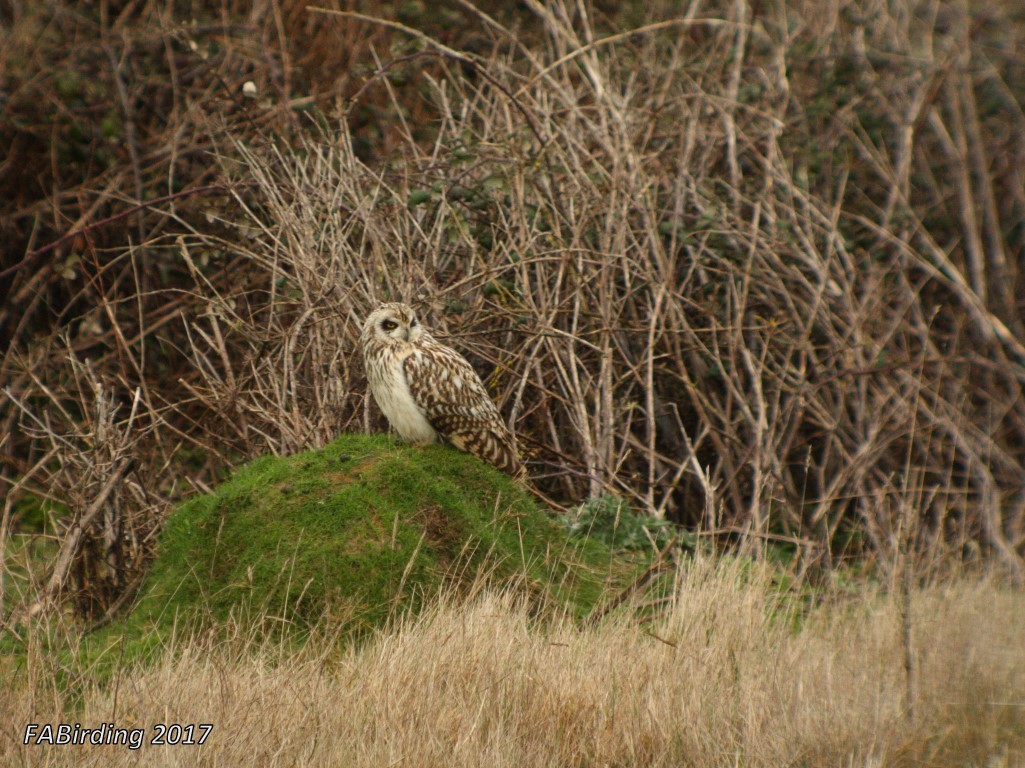
Moving further around the Point and thinking that having seen one ‘Shortie’ was a bonus we were delighted to have even closer views of a second bird who after briefly flying around perched on a grassy mound allowing for another photo opportunity.


Short-eared Owl. 

Returning full circle back to the main pool we enjoyed close views of a feeding Little Egret and Common Snipe and logged 5 Greenshank and a single Spotted Redshank in its typical grey winter garb.

Little Egret.

My thanks to Victoria and Trevor for their company and making this a worthwhile trip to the coast with a final tally of 60 species. FAB.

Linking to:
I'D-Rather-B-Birdin'

Tuesday, 20 December 2016

A winter favourite at Farlington.

Once again birding and blogging have taken a back seat during the past few months partly due to the demands of stubborn, aging parents whose health, mobility and living issues increasingly require more physical support. 

Fortunately a recent outing to Farlington Marshes lifted my spirits as I reconnected with one of my favourite over wintering species, the Dark-bellied Brent Geese (Branta bernicla), that frequent the marshes in their thousands.


As the tide rises in Langstone Harbour the geese leave their watery feeding areas and move onto the marshes, some stopping at the lake together with a varied mix of waders and ducks, including Avocet, Black-tailed Godwit, Dunlin,  Redshank, Greenshank,  Knot, Grey Plover, Ringed Plover, Shelduck, Mallard, Teal, Wigeon, and Pintail. 


Both large and smaller family groups eventually settle on the grassy fields to feed and rest offering an opportunity to get much closer to this delightfully dapper goose.

 Above is a juvenile lacking the white crescent neck band of the adult pictured below.


Linking to Wild Bird Wednesday

Tuesday, 1 March 2016

SBC Fieldtrip to Farlington Marshes.

As a follow up to my previous post 13 hardy souls joined me on Sunday morning, with the temperature hovering just a few degrees above freezing point and a very strong north-easterly wind, for the scheduled Surrey Bird Club walk around Farlington Marshes LNR.

Due to the weather conditions I didn't find many opportunities for additional photos during this walk so some inclusions are of those species seen but captured during my recce visit last week.


A scan over the extensive mudflats produced our first sightings, albeit distant, of six different waders.

Views around Farlington Marshes LNR.
The inland pool was nearly devoid of any water fowl but it did enable us to get much better views of the elegant male Northern Pintail in all it breeding finery.

Male Northern Pintail.

Trying to unsuccessfully get out of the gusty wind we followed the stream which enabled us to get reasonably close to the Brent Geese and plenty of Black-tailed Godwit, many beginning to show signs of their breeding colours.
Black-tailed Godwit with Teal. Brent Geese, Black-headed and Herring Gulls

Moving on to the eastern sea wall with the tide well on the turn provided more views of waders including Dunlin, Turnstone, Grey Plover, Ringed Plover and Oystercatcher. 

Grey Plover, Knot, Dunlin and Turnstone.

Scanning the inland marsh when a flock of Lapwing and other species took flight I spotted a very small falcon, probably a Merlin, but it disappeared before any of the group could see it!

Lapwing.

Brent Geese, Pintail, Oystercatcher and Shelduck.
Along the western sea wall a couple of Pipits tested our ID skills as they flew up briefly and then disappeared back into the waterside vegetation. With perseverance we eventually identified them as Rock and a Water Pipit ... nice additions to the day list.

Finally a couple of images of the most numerous species seen throughout our walk the Dark-bellied Brent Geese.


List of my sightings:
Blackbird, Common Buzzard (2), Coot, Carrion Crow, Curlew, Dunlin, Little Egret, Black-tailed Godwit, Goldfinch, Greenfinch, Dark-bellied Brent Geese, Canada Geese, Great Crested Grebe, Little Grebe, Black-headed Gull, Common Gull, Herring Gull, Grey Heron, Lapwing, Magpie, Mallard, Red-breasted Merganser, Merlin, Moorhen, Oystercatcher, Northern Pintail, Rock Pipit, Water Pipit, Grey Plover, Ringed Plover, Redshank, Robin, Shelduck, Northern Shoveler, Skylark (heard), Common Snipe, Starling, Stonechat, Teal, Turnstone, Wigeon, Woodpigeon, Wren. [44].

Linking to Wild Bird Wednesday.

Friday, 26 February 2016

Farlington Marshes LNR.

On Sunday (28 Feb) I will be leading a field trip for the Surrey Bird Club (SBC) to Farlington Marshes LNR that comprises around 300 acres of coastal grazing marsh, reed beds, scrub, with both freshwater and brackish pools. The land was first reclaimed from Langstone harbour between 1769 and 1773 by building a clay and timber wall to provide grazing land for cattle. The sea wall has been much improved and provides an ideal route around the reserve to view the wildlife both within the marshes and on the sea or extensive mudflats at low tide. 


On Tuesday I made a recce visit to check out the wildlife and to get some images of the species that can be seen here just in case the windy weather that is forecast for Sunday doesn't provide me with many photo opportunities.

During the winter months one of the main attractions are the very large flocks of Dark-bellied Brent Geese that feed on the grazing marsh.

At this time of year the marsh also supports good numbers of Curlew, Northern Pintail, Oystercatchers, Lapwing and Teal plus I was also fortunate to get several sightings of two Short-eared Owls.

During my recent visit I also saw three species of Grebe, Red-breasted Merganser, Shelduck, Shoveler, Wigeon, Gadwall, Dunlin, Redshank, Grey Plover, Knot and Turnstone plus good numbers of Black-tailed Godwits (see below) disturbed from feeding by a low flying Common Buzzard.


At high tide I also watched the spectacle of many hundreds of Dunlin streaming close above the water seeking out a suitable spot to roost and wait for the mud to reappear while inland there is always something else to capture one's attention such as ....

a perching Stonechat, one of many Northern Shoveler in their full breeding plumage and the various gull species including the Black-headed Gull. The site also hosts reasonable numbers of Little Egret (see below).

During my wandering I logged about 50 species but with more eyes on Sunday it is possible to add a few more including Kingfisher, Peregrine, Merlin, Water Rail, Rock Pipit, and the elusive Bearded Tits. FAB.

Linking to: Saturday's Critters, I'D-Rather-B-Birdin' and Through My Lens.

Wednesday, 23 December 2015

A Winter Favourite.

During a very recent foray around Farlington Marshes, on a somewhat dreary day, I took the opportunity to grab a few images of the delightful Brent Geese that visit this coastal location in very large numbers during the winter months.

I adopted my usual slow stealthy approach in order to get within reasonable range of one group quietly feeding on a grassy area inside the sea wall. One or two individuals checked me out but despite being out in the open they were extremely tolerant.

Preening ... just part of their daily activities.

A very elegant species and I'll look forward to making their acquaintance again in the New Year. FAB.

Linking to WILD BIRD WEDNESDAY.

Friday, 13 March 2015

Sunshine Birding.


We have been fortunate weather wise in the south-east with warmer temperatures and the long awaited appearance of some blue skies. This prompted me about a week ago to make another visit to Thursley Common in the hope of catching the over-wintering Great Grey Shrike in the lens.

Just after crossing the short boardwalk another birder indicated with hand signals that he had the bird in view.


Over the following two hours this bird was very mobile and in the company of 'Geordie' I made several circuits of Shrike Hill as we both attempted to get some photos. Typically the bird never got really close enough so a distant record shot (below) had to suffice for now.

A cropped shot of the perched Great Grey Shrike. Later during my wanderings around the common I was entertained by the flight displays and songs of several Woodlark.

A Woodlark showing its distinctive broad supercilia and stubby tail perched briefly for the watcher.

On Tuesday Anita and I made a late morning decision to drive southwards to the coast and took a leisurely stroll around Farlington Marshes under a sunny sky. 
Unfortunately the tide was well in so we missed most of the wildfowl and wader movement from the harbour onto the grazing marsh but we still  enjoyed the spectacle of the thousands of Brent Geese. 


I also added Rock Pipit to my year list while listening to the glorious song of the Skylarks as they soared high up into the blue sky.

Brent Geese feeding and flying in every direction and then we spotted one individual (below) that had been colour-ringed and has probably faithfully returned to the UK every winter for the past 10-15 years.


Several species were seen flying out across the harbour including Shelduck (above) and Wigeon (below). You can view more images of flying Shelduck by visiting FABirding.

And finally, any trip here wouldn't be the same without decent views of a Little Egret (below) feeding in one of the small pools. More images of this species to follow in due course.

Wishing everyone a glorious wildlife watching weekend, wherever you are.  FAB.

Linking to Saturday's Critters and I'D-Rather-B-Birdin' ,

LinkWithin

Related Posts with Thumbnails