Showing posts with label Golden Plover. Show all posts

Sunday, 16 January 2011

Windy Coastal Walk.

On Saturday morning we met up with our friends Tony and Jean on the south coast at Pagham Lagoon Spit for a walk around the harbour to the North Wall. The Lagoon held a few Tufted Ducks, 5 Goldeneye, a pair of Red-breasted Mergansers and the usual Little Grebes. Unfortunately the tide was falling so our intial views across the harbour were the very large numbers of Dark-bellied Brent Geese moving between the water and distant fields to feed.
Dark-bellied Brent Geese.
The view on arriving at the North Wall was one of water, water everywhere ... totally flooded fields and very little to be seen close by. However once we ventured along the embankment we picked out Wigeon, Pochard, Mallard, Teal, Shoveler, Shelduck, Canada Geese and finally large numbers of waders much further away. 
With many of the species somewhat distant I hunkered down to reduce the effect of the strong wind and attempted some digiscoping while watching the thousands of Lapwing lift off, circle around and then resettle on the very wet meadows.

Apart from the Lapwing there were also good numbers of Black-tailed Godwits, Knot, Curlew, Dunlin, Redshank, a few Grey Plover, Oystercatchers plus Ruff and Common Snipe.
I would have preferred to get some closer (and sharper) views but keeping the gear steady while attemting to focus on the continually moving waders in such poor light tested my patience somewhat! Anyway watching large numbers of species, especially waders, is always a delight.
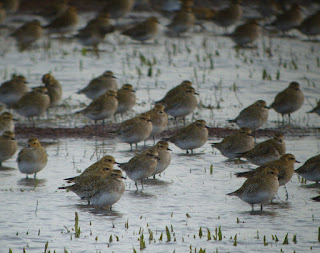
 A line of Golden Plovers resting face on into the wind.
A few Redshank taking shelter.

Other sightings included a Kestrel and a very distant Sparrowhawk, 5 species of gulls including Mediterranean, Cormorant, Grey Heron, Mute Swan, Skylark and Linnet plus I also heard a Bearded Tit calling from the reeds. By the end of the day I had added 14 species to my year list so together with an unexpected sighting of 2 Hawfinch during a local patch walk (Horton C.P.) my January total now stands at 90.  All I need now is some decent weather and light to add some species to the photo album.    FAB.

Thursday, 4 March 2010

Reunion in Kent.

On Tuesday I arranged a day out with David, an ex-RHS work colleague, who has moved to Kent to restart his life again. Our day started at Oare Marshes where I  met David, his wife June and most unexpectedly Rob, one of their sons, who has got the birding bug. 
With a nearly clear blue sky and not a breath of wind we headed out along the sea wall and scanning the bushes around the car park produced Reed Buntings and Meadow Pipits. The mudflats were littered with Redshanks but our attention very quickly turned to a pale ghostly shape quartering over the inland marsh.
The direction of the sun and the flight path of the Barn Owl failed to provide a very close encounter but we watched this individual for over half an hour as it searched for a meal and I managed a few record shots.
Our eyes soon returned to a search of the sky over Sheppey and we soon latched onto several Marsh Harriers and possibly a Buzzard. Bearded Tits were often heard as we wandered slowly but never showed themselves. At the sea wall hide we added Avocets (40+), Shelduck, Cormorant, a female Sparrowhawk mobbing a Harrier plus the usual Gulls. 
The East Flood held the expected Mallard, Tufted Ducks, Teal, Wigeon, Gadwall, Northern Pintail, Shovellers, Coot, Moorhen, Redshank, Lapwing, a single Ruff, a dozen Common Snipe and masses of Golden Plover (pictured above). The waders took flight as a Peregine flew fairly high over the marsh heading westwards without stopping to hunt for a meal. On the western side we added Greylag Geese, Mute Swan, Little Egret, Grey Heron, Kestrel plus Starlings, Dunlin and Pied Wagtails.
David & Rob.
After consuming our packed lunches we headed inland towards 'Stodders' and my hosts stopped on the edge of an area of farmland to enable me to scope out two Whooper Swans (tick for 2010) distantly amoungst a group of Mute Swans but no sign of any Bewick's. Our afternoon was spent at Grove Ferry.
Scanning from The Mound we found the usual Lapwing, Wigeon, Teal and Mallard on the pools but no other waders. The chat soon got around to our chances of finding a Bittern and scanning with the scope along one of the furthermost reed banks I located the camouflaged 'head up' shape standing partly hidden by the reeds.
This digiscoped image has been heavily cropped but you should be able to make out the browner shape of the Bittern just off centre-right. It soon started moving and then disappeared from view. During our leisurely stroll to two of the hides we heard both Water Rail and several Cetti's Warblers. A number of sightings of Marsh Harriers, mainly males and just when neither of us had our cameras ready a fly past by another Bittern!
 
Unfortunately this was all I could manage as it disappeared to our left in the fading light. My day in Kent ended at David's new home with a fish pie supper which was greatfully appreciated after a glorious day out on the Kent marshes in good company before I made my way home in the dark.  FAB.

Friday, 21 August 2009

Oare Marshes - A day alone!

Last weekend I decided that I needed some time to myself and headed to one of my favourite locations, Oare Marshes, on the north Kent coast. When I started out on the two hour drive the weather looked promising but the closer I got to my destination the clouds thickened and there was the hint of rain in the air (not going to be good for taking pics!). This long distance view over the fields showed a lot of activity on The Swale with many sailing vessels on the water and explained why there was no space in the very small car park. A view of the East Flood taken from the car before I located the last available roadside space to park the car. This is the place to view waders resting around the shallow pool and on the low islands at high tide.
Most of the waders, Black-tailed Godwits (too many to count), Redshanks, Golden Plovers and Lapwings had decided on this day to stay well away from the road and the poor light made it difficult to get any decent pics. However there was one Ruff feeding fairly close by.
Then a single Lapwing walked past.
It then flew up into the air uttering it's unmistakable 'peewit...peewit' call as it joined its friends.
The Golden Plovers showing their black bellies were all grouped together and I managed this record shot by digi-scoping.
My previous post shows the effect on the waders when the cows walked through the pool. During the mahem that ensued I saw 10 Avocet take flight but they failed to re-land on the flood. Other sightings included a single Greenshank, Cormorants, Grey Heron, Mute Swans, Greylag Goose, Mallard, Teal, Coot, Moorhen and Shovellers.
From the hide I carefully searched through the 100's of Black-tailed Godwits and eventually located a single Dunlin and then a Curlew Sandpiper (another first for 2009). In the far distance a Marsh Harrier was drifting over Mocketts Hill on the other side of The Swale. Leaving the hide my attention turned to a small flutter, a Skipper, that eventually stayed still long enough for this shot.
A moment later my peripheral vision caught sight of a blue shape perched on a post in a ditch near the path and as I turned around a Kingfisher took flight, obviously aware of my presence, and headed towards the sluice gates. A few moments later it returned and flashed past me in the opposite direction and disappeared. (One day I'll get a photo!) Below is the view up into Faversham Creek with the tide receding.
From the creek I looked back onto the flood pool and whilst battling the strong wind I located these few Black-tailed Godwits sleeping and feeding.
While also watching 2 Little Grebes constantly diving I just caught a hint of the sounds of Bearded Tits calling as they moved through the reeds but never showing themselves. This Black-headed Gull was searching the seaweed for a meal as the tide continued to turn exposing larger expanses of mud.
Using the scope I was able to locate a few Common Plovers, Oystercatchers and a single Whimbrel easily distinguished from a Curlew by its smaller size, striped head markings and its shorter decurved bill. A small group of young Pied Wagtails also moved past searching for flies.
Heading west towards Dan's Dock there were at least a dozen Little Egrets on the West Flood plus lots more Coot and then another distant Marsh Harrier floating over the reed bed. Single House Martin and Swallow flew westwards. Various 'flutters' (Painted Lady, Gatekeeper & Common Blue) appeared and disappeared, blown about by the strengthening wind. My attention then turned to these other residents. First a male Common Darter (Sympetrum striolatum) and then....
this female Common Darter perched on the pathway just long enough for a few quick shots.
A few minutes later I took this pic and the realised that it was a Ruddy Darter (Sympetrum sanguineum), distinguished from a Common Darter by the lack of pale panel markings on the thorax, the noticeable constriction of the abdomen around S4 plus two black marks on S8 & S9.
This is the view towards Uplees Copse from Dans Dock with the sound of a Skylark somewhere in the sky above me.

One day I will walk the full circuit but on this occasion I decided to return to the car and head home after a very enjoyable and productive few hours in the company of wildlife that keeps me sane. FAB

Saturday, 10 January 2009

Memories from 2008

As it has been a very 'grey day' I thought I would look back at some images taken on warmer days during a holiday to the north Norfolk coast last November. This has now become an annual pilgramage (funds permitting) during the early and or late winter particularly to witness the very large flocks of Pink-footed Geese (some 60,000+) that feed on the grazing marshes around Holkham.


This Turnstone was enjoying the remains of a crab for lunch on the beach at Titchwell.

A species I first saw on the south coast (at Pagham) in 1994 was Little Egret.....their numbers have now expanded and so have their range. It is now unusual NOT to find them in good numbers along the Norfolk coast. This individual posed for me at Cley Marshes.


Finally views of Golden Plover at Cley Marshes...
and part of a flock of 4-500 at Titchwell Marsh.
Throughout the coming year I hope to bring you a few more memories including some images from trips outide the UK.

LinkWithin

Related Posts with Thumbnails