Showing posts with label Sparrowhawk. Show all posts

Friday, 19 February 2016

London Wetland Centre.


With a forecast of a few hours of decent weather on Friday morning I paid another visit to the London Wetland Centre at Barnes in the hope of catching up with a Bittern but it was not to be. Nevertheless there was still plenty of birds on view, both wild and captured species.


My southerly route towards the main reed-beds provided an opportunity to snap a few of the captive species including Hooded Merganser, Marbled Teal and White-headed Duck.


A male Tufted Duck

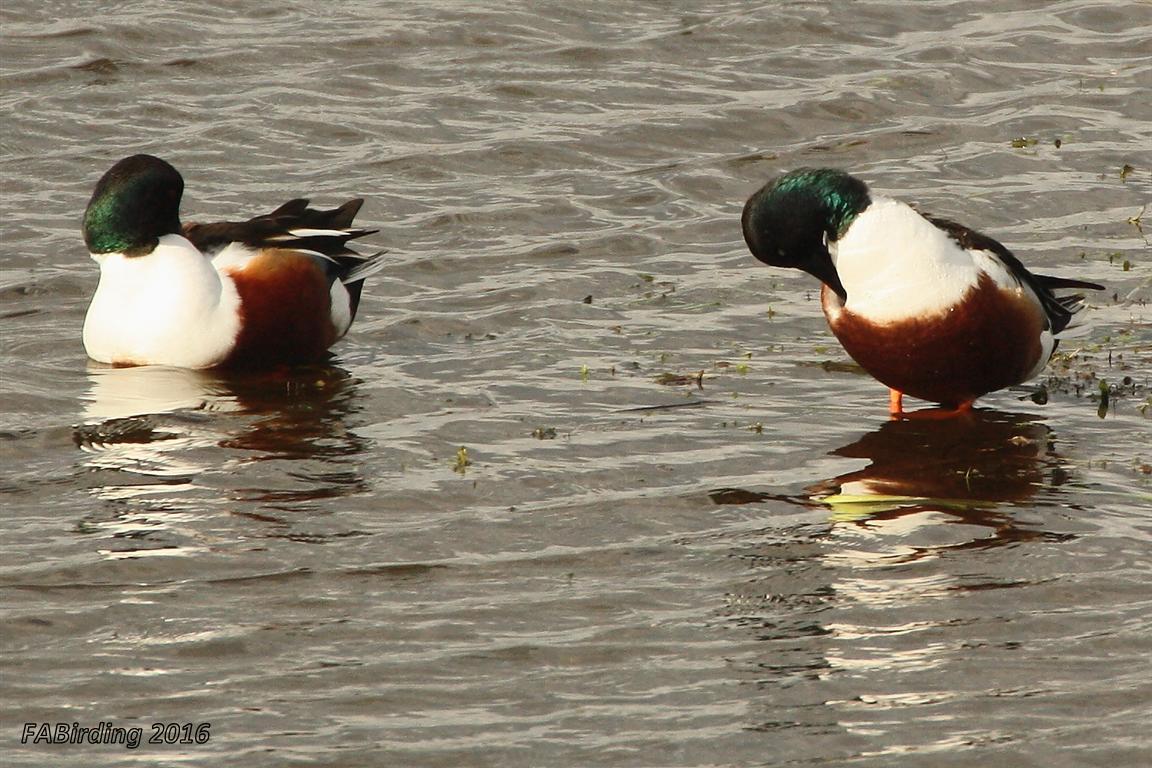
A scan over the flooded grazing marsh produced Grey Heron, Mute Swan, Cormorant, Wigeon, Gadwall, Pochard, Coot, Moorhen, Mallard, Teal, Canada Geese, a single Egyptian Goose plus numerous Northern Shoveler, many enjoying a preening session in the sunshine.


The centre which opened in 2000 occupies the site of the former Barn Elms reservoirs covering a total area of about 100 acres including open water, muddy banks, grazing marsh, some woodland and an extensive reedbed right in the heart of the south London urban landscape. Three quarters of the site was designated an Site of Scientific Interest in 2002.


My route back to the centre only produced one additional sighting, an over flying Little Egret. The northern part of the reserve has several hides overlooking the open water enabling decent views, albeit often distant of the ducks, gulls and and a much reduced number of Northern Lapwing.


My only raptor sighting was a male Sparrowhawk who made a brief appearance on one of the small islands and from the first floor of the Peacock Hide I spotted a male Pintail (below) in its elegant finery fortunately within reach of the lens.

Despite the lack of a Bittern sighting (again!) it was a joy to be out in the winter sunshine enjoying our native wildlife. FAB.

Linking to Saturday's Critters and I'D-Rather-B-Birdin' 

Monday, 27 April 2015

Foggy Birding.

Last Friday I took a break from wielding the paintbrush and paid a very early morning visit to Tices Meadows. During my drive south-westwards across the county the dawn sunshine at home soon changed to patches of fog and on arrival it was obvious that the meadows where almost totally shrouded in a foggy blanket.
Fortunately there was compensation as I walked into this site from the varied bird song including Blackbird, Dunnock, Song Thrush, Wren, Robin, Chiffchaff, Chaffinch, Blackcap, Willow Warbler and Nightingale.

Just above a dense patch of scrub where a hidden Nightingale was singing a male Blackcap (Sylvia atricapilla) perched nearby and repeatedly sang.


With little to see on the water through the fog I strolled slowly along a track between the reed beds and a male Sparrowhawk jinked through the sallows and when I turned around it was perched on a fence post. As you can see the conditions weren't particularly conducive for getting any quality images so just a record shot! 
Nearby I listened to my first Reed Warbler of the year and then spotted the male being joined by a potential partner and the singing abruptly stopped as the pair disappeared deep into the reeds together. A little further on I also heard the scratchy songs of at least two Sedge Warblers. Eventually some of the fog dissipated enabling me to add two Little Ringed Plover and House Martin to my year and county lists.

When I retraced my route back towards the car I watched several Common Whitethroat and a Chiffchaff (Phylloscopus collybita) managed to get within reach of the lens.

Once again I stopped close to the spot where I had earlier heard a Nightingale (Luscinia megarhynchos) and eventually one popped into the open and sang its beautiful verses. Not the sharpest of images but it will do for the time being!


All in all, a very interesting morning despite the foggy conditions. FAB.

Linking to Nature Notes and Wild Bird Wednesday. 

Tuesday, 16 December 2014

Bittern at Barnes.


It was a chilly but clear morning on Sunday when I joined a Surrey Bird Club field-trip to the London Wetland Centre at Barnes. Some of the shallower parts of the extensive pools showed how cold it had been overnight with a thin layer of ice enabling this Coot to 'walk on the water'.

There were a number of species on our wish list and it wasn't long before the star attraction, a [Eurasian]  Bittern, (Botaurus stellaris) was located on the edge of a distant reed bed.

Typical of this well camouflaged species it stood stock still for many minutes before adopting its upright pose to scan the vicinity for a possible meal before disappearing into the reeds.


Other species logged included Lapwing, Mallard, Teal, Pochard, Gadwall, Northern Pintail, Tufted Duck, Moorhen, Cormorant, Little Grebe, Northern Shoveler, Wigeon, Mute Swan, Canada, Greylag and Egyptian  Geese, Gulls (Herring, Black-headed, Common and Lesser Black-backed), Grey Heron, Robin, Stonechat, Tits (Blue, Great and Long-tailed), Chaffinch, Goldfinch, Ring-necked Parakeet, Carrion Crow, Magpie and Blackbird.


Whilst high up in the Peacock Hide I watched a male Sparrowhawk dashing low over the marsh scattering the wildfowl, Pigeons and Starlings before coming to rest in a tree close by but getting a clear shot through the foliage was near impossible.

On returning to the WWT Hide with one of my colleagues we were both fortunate to get another view of the Bittern that had reappeared in almost the same spot.

After walking up through the reeds it eventually decided to fly off to another distant reed bed. 
For many of my fellow birders this was probably the best ever views they had experienced of this elusive species and I'm pleased to have got a few record images to share for this weeks edition of Wild Bird Wednesday.  FAB.

Friday, 19 February 2010

Hunters Eyes.

As promised a few more images of the male (Eurasian) Sparrowhawk (Accipiter nisus) that visited my garden this week hoping to catch a quick meal but fortunately the little ones were on their guard and promptly hid away from the consumate hunters' prying eyes.
Staring intently straight at the 'watcher' through the window.

Listening and looking..... 

Now if you think this guy looks big then just remember that his female partner is often 25%  larger - possibly one of the largest differences between sexes in any bird species and although not quite as colourful (brown above with brown barring on the breast) she is also a fearsome hunter.

Can he detect movement up in the Pittosporum where the Sparrows usually hide?

This predator whilst a specialist in catching woodland birds can be found in many varied habitats not least trying its luck in hunting down garden birds. This hawk's hunting behaviour has often brought it into conflict with humans particularly racing pigeon owners and it has also been blamed for the decreases in passerine populations. My own unscientific view is that if there is a thriving Sparrowhawk population then there must also be a substantial population of its natural prey ... natures balance. 

The eyes search in every conceivable direction so don't even think about hiding behind him!

If its sharp tallons and the piercing eyes aren't enough, just check out that fearsome beak.  FAB.

Tuesday, 16 February 2010

Window Watching in the Rain again!

Another dismal dreary day with constant rain showers has kept me indoors today. While catching up with the action at the Winter Olympics (Vancover 2010) I kept half an eye open for any activity through the window.
Robin enjoying the coconut fat feeder.
Collared Dove waiting for a friend.
House Sparrow takes a brief rest from feeding.

Greenfinch and House Sparrows were the main visitors plus an ocassional drop in by a single Starling, Blackbird, two Blue Tits and one of the female Blackcaps. At one stage a pair of Magpies patrolled around the bottom of the garden pushing the smaller birds high into one of the nearby trees but they soon resumed their feeding activities once the corvids moved on to create havoc elsewhere. 

Later this afternoon while catching up on some reading my peripheral vision indicated that a larger shape had just landed and I turned around to find a male SPARROWHAWK had alighted on the perch above the Hibiscus. (Another garden tick for 2010.)  As you can imagine everything else had very promptly disappeared into cover. The hawk sat perfectly still with his deadly tallons gripping the perch and just turned his head in every possible direction with those fearsome eyes searching for any possible movement.
It was difficult to contain my excitement but as I clicked away with the camera I called out to loudly for Anita to come and see him. He must have heard me call her name as he stared directly at me for a brief moment before resuming his search for a possible meal.
He hung around for what seemed ages but in reality was only a few minutes before moving up on top of the ivy that covers the clothes post to make a further search of the garden before flying off to perch again for a minute or two in a nearby tree.
Once I have sorted through the rest of the shots I hope to find a few better pictures of this accipior to share with you.  FAB.

LinkWithin

Related Posts with Thumbnails