Showing posts with label Common Buzzard. Show all posts

Saturday, 2 June 2018

In, Around and Above the Stew Ponds.

It has been many months since I posted any information about the bird life on my local patch so here are some images of a few of the 50 or so species I have seen so far this year frequenting the Stew Pond and surrounding area.

 Grey Herons are daily visitors, patiently waiting for a tasty meal to swim within their reach.


Cormorants turn up fairly regularly to fish the Great Pond often spending a lot of time sitting around doing nothing!

I have recorded Tufted Ducks annually over the last ten years. Evidence of breeding over that period has been spasmodic and the youngsters rarely survive due to predation ... there are some extremely large fish in the pond!


Again the Mandarin Duck has been an annual breeding species with sighting from January through to August. Until two years ago it was not uncommon to record up to 15 males courting just one or two females through January into March but I believe increased  disturbance from dog walkers has affected this and other species greatly in the last two years. This year I only saw one male on 5 April.


Egyptian Goose is a very infrequent visitor but a pair turned up on the island on 5 April. Unfortunately the pond plays host to quite a few pairs of breeding Canada Geese who are extremely territorial so other geese species don't tend to hang around for long like pairs of Greylag Geese who dropped in briefly between the 8th and 15th May.

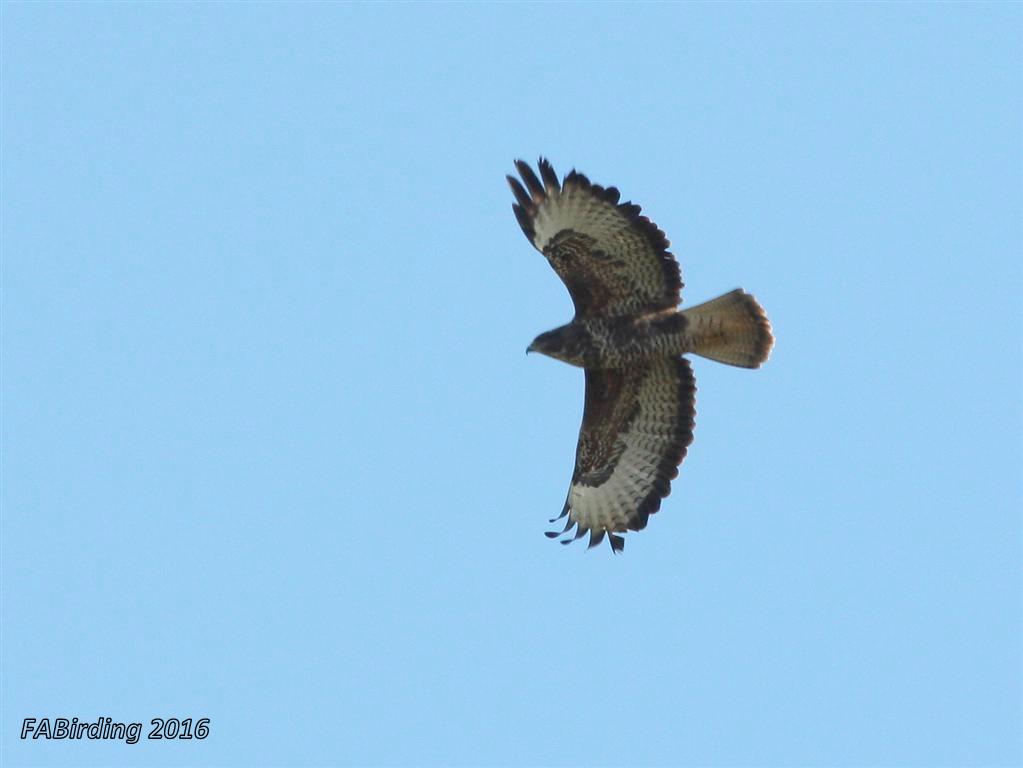
 Common Buzzard nests locally so it is not unusual to see at least one or two flying around.


A selection of migrant warblers can be found in the surrounding area including good numbers of Chiffchaff. Others include Blackcap, Common Whitethroat, Garden Warbler and I have recorded Willow Warbler on the common for the last 6 years during April into early May but they don't seem to stay. Just one male seen and heard singing close to the Stew Pond on 1 May this year.

The Jay is not the most common corvid locally but certainly the most colourful. Typically very wary of humans this individual was very confiding ... for a few minutes.

Linking to:

Saturday, 19 March 2016

More Coastal Birding.


Whenever we visit my father-in-law on Hayling Island I usually manage to wangle an hour or two to wander part of the shoreline overlooking Langstone Harbour and yesterday I was able to extend my time by walking part of the 'Billy Trail'. With the tide well on the ebb most of the waders; Curlew, Godwit, Redshank, Dunlin, Grey Plover and Knot; were specks out on the expanding mudflats with large numbers of Brent Geese also seen flying to other parts of the harbour.


Looking inland this Little Egret was sitting quietly by the edge of a stream that crosses one of fields which is also often frequented by a Kingfisher but no sighting during this walk. A Common Buzzard (below) made a brief appearance overhead before disappearing beyond the nearby woodland.


With little else catching my attention I retraced my steps and made my way towards the old Oyster Beds with the strident calls of hundreds of gulls increasing in volume the closer I got to their nesting site. A month ago there were just a handful of Black-headed and one or two Mediterranean Gulls but now the colony was alive with activity as they jostled one another for their allotted spaces.

I will feature some additional images taken of the Mediterranean Gull in a separate post very soon. 

Close to the path I disturbed a Rock Pipit while out in the harbour I also spotted a pair of Shelduck and a single Red-breasted Merganser.


One of a pair of Brent Geese wandering around the edge of the tidal pool and close by a couple of Oystercatchers (below) were seeking out morsels from the muddy margins.


Now if my visit yesterday had coincided with a high tide I might well have experienced the joy of watching mixed gatherings of thousands of waders; usually Dunlin, Grey Plover, Redshank and Knot; taking refuge on the much depleted shingle shoreline. The images below were taken just about a month ago.

Linking to:
Saturday's Critters
I'D-Rather-B-Birdin'

Saturday, 12 March 2016

Coastal Birding.


Today I am raiding the recent archives for some more images of the birds seen during my visits to the coastal marshes around Langstone Harbour last month.


I enjoy watching large numbers of any species and the overwintering Dark-bellied Brent Geese always put on a good display as they fly in from their tidal roost to feed on the grazing marsh. Their gargling, guttural calls are very distinctive as they chatter amongst themselves while feeding. 

A very dapper looking goose.


The evocative call of a Curlew is another common sound as it passes overhead to seek out another feeding location.

A pair of Common Buzzard make a brief appearance, lazily floating above the marsh.


A lonesome male Teal makes its way across the harbour at high tide.


Little Egrets fly in and out of the reed fringed pools where they can be seen waggling their bright yellow feet to disturb their likely prey.

Linking to:
Saturday's Critters

Monday, 4 May 2015

Some Spring Migrants on Thursley Common.


Just over a week ago, taking a well earned break from the decorating,  I paid another early morning visit to Thursley Common to see what other Spring migrants might have turned up on this special lowland heath habitat with its acidic bog and woodland.

Stonechat (Saxicola torquatus)
Looking across the open landscape the first bird of the day was a resident male Stonechat perched high on the remnants of an old tree. I also listened and scanned for any sign of any of the four Curlew that had recently been reported (at least one pair turn up most years in early spring) but didn't find one. Maybe I'd be lucky on my return route.
As I walked through Pine Island I heard and the caught sight of several twittering Goldfinch with a Chiffchaff singing nearby.

Tree Pipit (Anthus trivialis)

As I headed up over Shrike Hill a Woodlark flew overhead and a singing Skylark ascended high into the blue sky. 

Descending the southern slope I heard the distinctive song of a Tree Pipit but initially couldn't find it until I spotted a likely candidate fly up from the heather and land in one of the lonesome conifers. A cropped record shot was the best I could achieve before this migrant moved onto another song perch much further away.


Most of the Gorse is now in full flower and some of the larger stands are good spots to find a Dartford Warbler .. I saw one fly but it promptly disappeared into the dense greenery. 

Close to one of the large sandy tracks I thought my ears had deceived me when I heard the croaking call of a Nightingale and on being joined by another birder, who has carried out the BTO bird surveys here for at least the last 20 years, we joyfully listened to not one but two Nightingales singing. I was told that this is the second Spring that a this species has been recorded at this particular spot on the common. 

On the other side of the track a returning Willow Warbler (Phylloscopus trochilus) whistled softly.

In the nearby wooded area, at a similar spot to my previous visit, a male [Common] Redstart (Phoenicurus phoenicurus) made a welcome brief appearance. After their initial arrival from Africa in April they tend to disperse across the common to separate territories within the various wooded areas.

As I walked through the field I heard the repeated call of a Cuckoo and immediately quickened my steps in the hope of locating another migrant visitor that has successfully returned from overwintering in Africa.

Since 2011 we’ve been satellite-tracking Cuckoos to find out why - See more at: http://www.bto.org/science/migration/tracking-studies/cuckoo-tracking#sthash.gPHwnzWS.dpuf
Since 2011 the BTO has been satellite-tracking this 'Red Status' species to try and find out why half the numbers in the UK have been lost over the past 20 years.


So following the calls I finally caught up with this iconic species but kept a substantial distance away so as not to disturb him as he changed position from time to time.

Cuckoo (Cuculus canorus)
 
On my return route with a pair of Common Buzzard wheeling overhead I also added Linnet and Common Whitethroat to my photo list as well as seeing Blackcap, Blackbird, Wren, Crow, Chaffinch, Long-tailed Tit, Song Thrush and Reed Bunting.

While snapping a reflective shot of one of a dozen or so Canada Geese present on the pools, as I returned to the boardwalk, I heard the distinctive call of a Curlew but was a little slow to react as a single bird flew high overhead only to drop down and disappear amongst the damp grasses. Well at least I was finally able to add it to my 2015 County year list!

And the grand finale. as I trod the boardwalk, was a brief visit by a Hobby (Falco subbuteo), another returning migrant, but only allowing just another distant record image. FAB.

Friday, 22 August 2014

A New Transect for 2015.

Adjacent to my regular patch circuit around Epsom Common Ponds is Ashtead Common National Nature Reserve, extending over 500 acres of ancient woodland owned and managed by the City of London Corporation. In the 1870's the City was concerned that access to the open countryside was being threatened, and as a result promoted two Acts of Parliament to enable it to acquire and protect various open spaces from development.

Last month during a walk with one of the Wardens I offered my services to carry out Butterfly recording over a new fixed route (transect) starting in April 2015. I have walked the proposed route on several occasions recently and this post provides an insight to the varied wildlife I have already encountered.
 
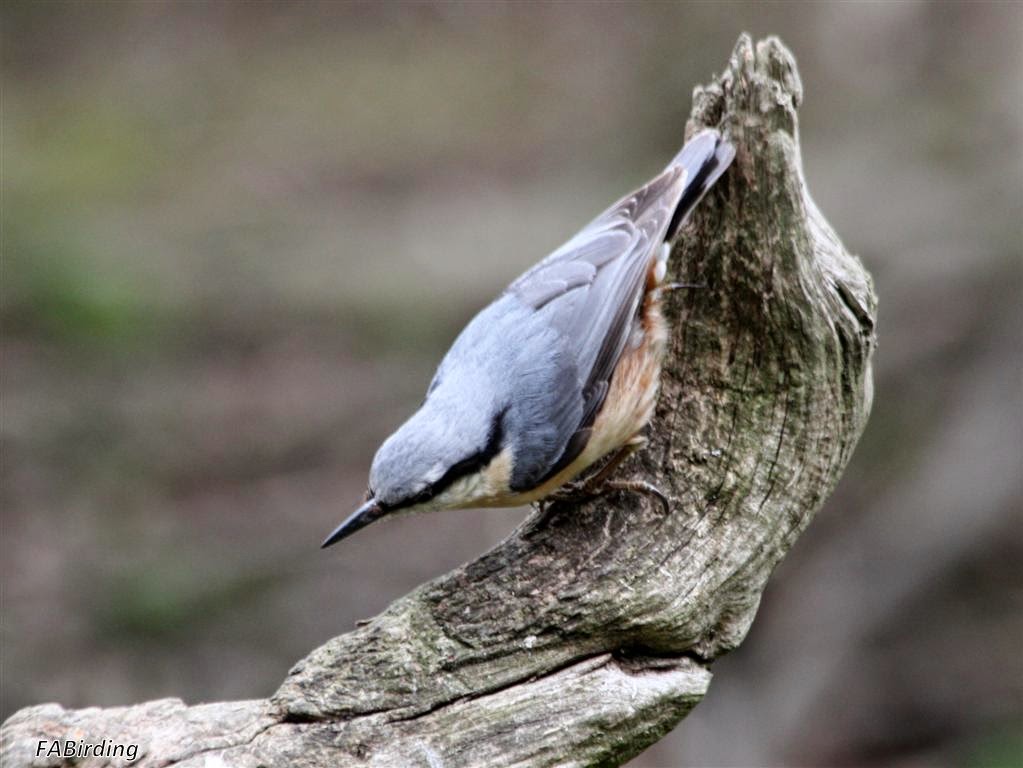
The start of the transect begins at 'Chessington View' overlooking the fields above Rushett Farm, a good spot to listen to Skylarks in the Spring and to locate Nuthatch at almost any time of the year. During the winter large flocks of Redwing and Fieldfare congregate in the trees in between their feeding forays onto the nearby fields. Carrion Crows, Jackdaws and Magpies are fairly numerous throughout most of the year.
 
[Eurasian] Nuthatch. (Sitta europaea)

The route climbs gently upwards following one of the main rides through the woodland passing an area that was cleared some time ago and the coppiced Hazel was protected by woven rustic barriers to prevent it being browsed by Deer and it appears to have been sucessful.

This 1st section has already produced recent sightings of Brimstone, Green-veined White, Speckled Wood, Meadow Brown, Comma and Silver-washed Fritillary. Bird species seen or heard here include Great-spotted Woodpecker, Robin, Blackbird, Song Thrush, Blackcap, Chiffchaff, Chaffinch, Treecreeper, Blue, Great and Long Tailed Tits, Goldcrest and the very noisy Ring-necked Parakeets.

Speckled Wood.


Section 2 is over similar terrain and passes a very muddy coloured pool called Flag Pond where all three species of Newt; Common, Palmate and Great crested have been recorded.

This is a good place to search for Dragonflies and Damselflies.
Ruddy Darter. (Sympetrum sanguineum)

There are over 2,300 ancient pollarded Oaks across the common which play host to an amazing variety of wildlife; bugs, insects and nesting opportunities for many species of birds. A year ago I noticed that some of the Birch trees had been 'ring-barked' which prevents the sap flowing upwards and now a few have felled themselves ... just one of the many simple and natural methods employed in managing the woodlands.

The woodlands can often be surprisingly quiet until the peace is shattered by the very distinctive loud burst of song from one of the many resident Wrens.

A juvenile Wren. (Troglodytes troglodytes)

My route then passes around an area of archeological significance, the site of a 1st and 2nd Century AD Roman Villa, Bath House with adjacent tile works.

Excavations were first carried out between 1924 to 1929 and again in 1966, 2006 and more recently during August to September 2013 by the Surrey Archaeological Society. As expected nature has very quickly recolonized the diggings with grasses, nettles, ferns and brambles providing dense ground cover.


The open area below the 'King Oak' should be a very good spot for butterfly species. I have already logged Meadow Brown, Ringlet, Gatekeeper, Small and Large Skippers, Comma and Peacock. This part of the common with its mix of Oaks and Sallows is also an excellent place to see Purple Hairstreak and the handsome Purple Emperor.


As my boots brushed past the grasses lining the narrow path numerous Grasshoppers of different sizes and colours hopped from stem to stem.

I don't know if this is typical but every time the lens got close they all tried to move around the grass stem to hide!
 

A young Roe Deer patiently watched my progress before heading off into the undergrowth.


There are a number of seats along my route providing convenient spots to rest awhile and watch the wildlife. 

Sometime I find someone has also used it for other purposes ... the remains of a recent Hazelnut snack by a Grey Squirrel.


At the end of section 6 close to my rest stop I spotted a Hornet and a resting Migrant Hawker.

Various gates and fences are encountered all over the common and many of the latter form the boundaries to specific areas that are grazed by cattle on a rotation basis to maintain this special landscape.

Some of the main open rides are designated bridleways but access to many other pathways is restricted by the use of natural Birch filled barriers that need to be regularly topped up during the year. 

Silver-washed Fritillary.

The final two sections of the transect follow part of the north-western  boundary overlooking Rushett Farm where it is not uncommon for me to find a Common Buzzard, which nest in the adjacent wood, perched on one of the old Oaks or soaring above the fields.

If all goes well with the arrangements for next year I'll look forward to providing weekly wildlife updates between April and September from this interesting location.  FAB.

I'm linking this post to:
Saturday's Critters hosted by Eileen
Camera Critters hosted by Misty
I'D-Rather-B-Birdin' hosted by Anni

LinkWithin

Related Posts with Thumbnails