Showing posts with label Migrant Hawker. Show all posts

Friday, 23 September 2016

Waterside Wildlife.


A recent leisurely stroll along the towpath beside the River Wey Navigation on a warm sunny day provided the following wildlife encounters.


 Common Darter.

Brown Hawker.

At one spot I watched at least half a dozen Migrant Hawkers in flight over the water and then managed to locate one individual resting overhead.


Just a few butterfly species were seen including a single Small Copper, several Green-veined Whites plus a Comma and Red Admirals.

Comma.

 Red Admiral.


Linking to:
Saturday's Critters

Monday, 15 September 2014

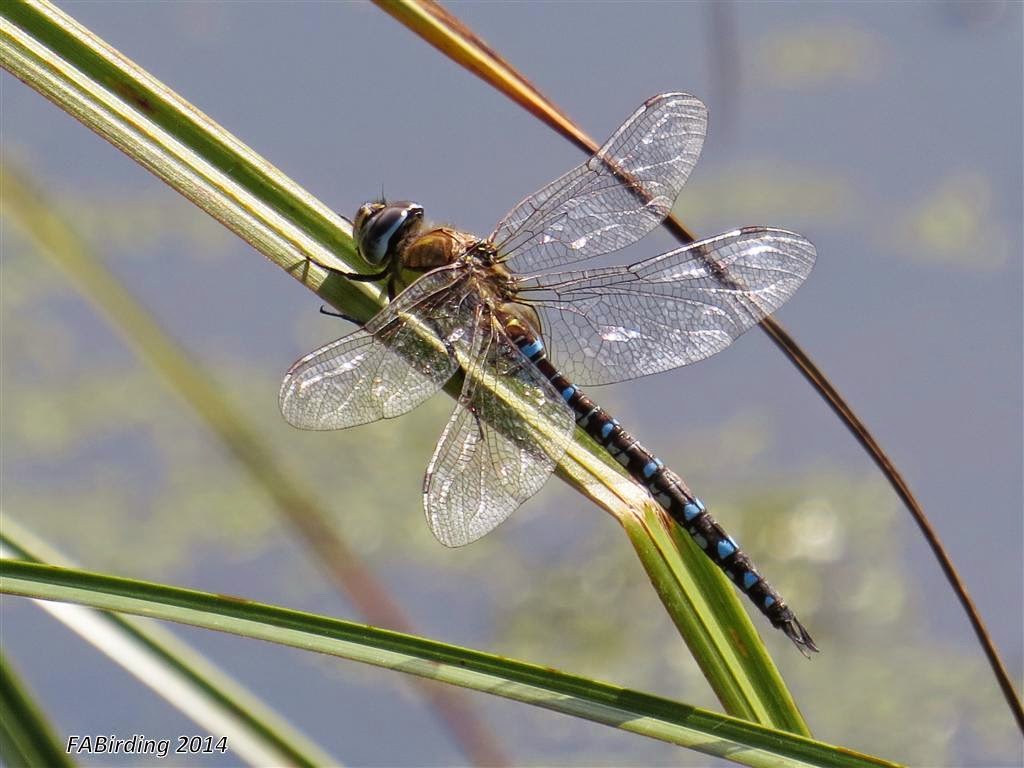
Migrant Hawker.


I don't know whether I have been unobservant in past summers but I seem to have seen far more Migrant Hawkers (Aeshna mixta) this year than ever before or maybe I've just been in the right location at the right time.
Whilst I published a couple of images a month ago taken last September a very recent visit to The London Wetland Centre at Barnes provided an opportunity to grab a few up to date shots of this delightful dragonfly as there were plenty of males hawking low around the waterside fringes.
 The only females I spotted were attached in tandem to their partners.


I tried desperately to get a head-on in flight shot but for some reason they only wanted to hover just above the reeds pointing towards the water! Obviously far more interested in finding a mate than pleasing the whims and wishes of a wildlife watcher.

At least the image shows how each wing works independently of the others thus enabling these Hawkers to both hover and undertake those intricate movements in any direction they desire.  FAB.

Friday, 22 August 2014

A New Transect for 2015.

Adjacent to my regular patch circuit around Epsom Common Ponds is Ashtead Common National Nature Reserve, extending over 500 acres of ancient woodland owned and managed by the City of London Corporation. In the 1870's the City was concerned that access to the open countryside was being threatened, and as a result promoted two Acts of Parliament to enable it to acquire and protect various open spaces from development.

Last month during a walk with one of the Wardens I offered my services to carry out Butterfly recording over a new fixed route (transect) starting in April 2015. I have walked the proposed route on several occasions recently and this post provides an insight to the varied wildlife I have already encountered.
 
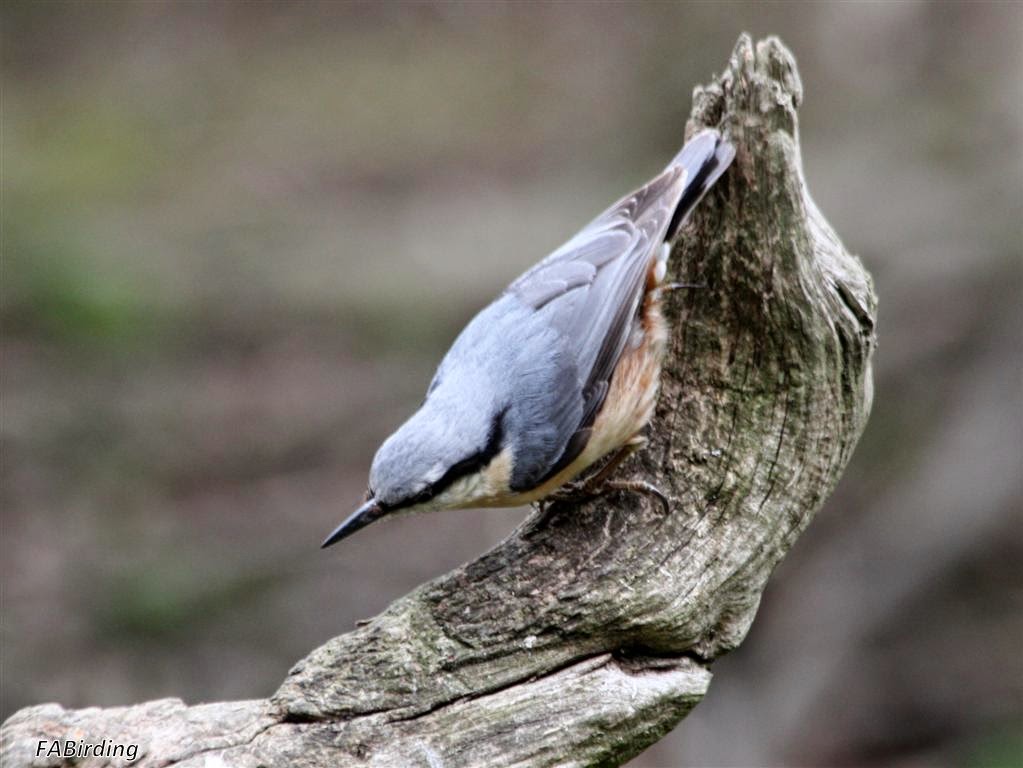
The start of the transect begins at 'Chessington View' overlooking the fields above Rushett Farm, a good spot to listen to Skylarks in the Spring and to locate Nuthatch at almost any time of the year. During the winter large flocks of Redwing and Fieldfare congregate in the trees in between their feeding forays onto the nearby fields. Carrion Crows, Jackdaws and Magpies are fairly numerous throughout most of the year.
 
[Eurasian] Nuthatch. (Sitta europaea)

The route climbs gently upwards following one of the main rides through the woodland passing an area that was cleared some time ago and the coppiced Hazel was protected by woven rustic barriers to prevent it being browsed by Deer and it appears to have been sucessful.

This 1st section has already produced recent sightings of Brimstone, Green-veined White, Speckled Wood, Meadow Brown, Comma and Silver-washed Fritillary. Bird species seen or heard here include Great-spotted Woodpecker, Robin, Blackbird, Song Thrush, Blackcap, Chiffchaff, Chaffinch, Treecreeper, Blue, Great and Long Tailed Tits, Goldcrest and the very noisy Ring-necked Parakeets.

Speckled Wood.


Section 2 is over similar terrain and passes a very muddy coloured pool called Flag Pond where all three species of Newt; Common, Palmate and Great crested have been recorded.

This is a good place to search for Dragonflies and Damselflies.
Ruddy Darter. (Sympetrum sanguineum)

There are over 2,300 ancient pollarded Oaks across the common which play host to an amazing variety of wildlife; bugs, insects and nesting opportunities for many species of birds. A year ago I noticed that some of the Birch trees had been 'ring-barked' which prevents the sap flowing upwards and now a few have felled themselves ... just one of the many simple and natural methods employed in managing the woodlands.

The woodlands can often be surprisingly quiet until the peace is shattered by the very distinctive loud burst of song from one of the many resident Wrens.

A juvenile Wren. (Troglodytes troglodytes)

My route then passes around an area of archeological significance, the site of a 1st and 2nd Century AD Roman Villa, Bath House with adjacent tile works.

Excavations were first carried out between 1924 to 1929 and again in 1966, 2006 and more recently during August to September 2013 by the Surrey Archaeological Society. As expected nature has very quickly recolonized the diggings with grasses, nettles, ferns and brambles providing dense ground cover.


The open area below the 'King Oak' should be a very good spot for butterfly species. I have already logged Meadow Brown, Ringlet, Gatekeeper, Small and Large Skippers, Comma and Peacock. This part of the common with its mix of Oaks and Sallows is also an excellent place to see Purple Hairstreak and the handsome Purple Emperor.


As my boots brushed past the grasses lining the narrow path numerous Grasshoppers of different sizes and colours hopped from stem to stem.

I don't know if this is typical but every time the lens got close they all tried to move around the grass stem to hide!
 

A young Roe Deer patiently watched my progress before heading off into the undergrowth.


There are a number of seats along my route providing convenient spots to rest awhile and watch the wildlife. 

Sometime I find someone has also used it for other purposes ... the remains of a recent Hazelnut snack by a Grey Squirrel.


At the end of section 6 close to my rest stop I spotted a Hornet and a resting Migrant Hawker.

Various gates and fences are encountered all over the common and many of the latter form the boundaries to specific areas that are grazed by cattle on a rotation basis to maintain this special landscape.

Some of the main open rides are designated bridleways but access to many other pathways is restricted by the use of natural Birch filled barriers that need to be regularly topped up during the year. 

Silver-washed Fritillary.

The final two sections of the transect follow part of the north-western  boundary overlooking Rushett Farm where it is not uncommon for me to find a Common Buzzard, which nest in the adjacent wood, perched on one of the old Oaks or soaring above the fields.

If all goes well with the arrangements for next year I'll look forward to providing weekly wildlife updates between April and September from this interesting location.  FAB.

I'm linking this post to:
Saturday's Critters hosted by Eileen
Camera Critters hosted by Misty
I'D-Rather-B-Birdin' hosted by Anni

Sunday, 10 August 2014

Migrant Hawker.


During a patch walk last Thursday I watched five Migrant Hawker (Aeshna mixta) but they weren't very co-operative so here are a couple of shots taken last September from around the pond at Bookham Common.


Hopefully when the current stormy weather ceases I'll get a chance to photograph some of our other varied Odonata  ..... FAB.

Sunday, 26 September 2010

Late Summer Fliers.

Just a few of the images taken in the last 7 days or so.
Tatty and washed out Common Blue.

Comma.

Distinctive underwing of the Comma while feasting on ripe Blackberries.

Male Common Darter lying in wait.

Common Darter - eyes in every direction.

Migrant Hawker

The weather forecast is not particularly good so who knows what we may find this week.  FAB.

Friday, 10 September 2010

Coastal Visit.

Yesterday morning I headed southwards to Pagham Harbour and arrived just under two hour before high tide so most of the wildlife was very distant but would slowly get closer as the day wore on.
Little Egret fishing on the Lagoon Pool.
Other species included Little and Great Crested Grebe, Tufted Ducks, Mute Swan and Coots.
As I headed inland there were the usual Black-headed Gulls, Black-tailed Godwits and Curlew feeding plus a few Magpies. Lots of  Swallows were skimming the water and feeding up before their long journey south for the winter. Linnets, Goldfinches and Chiffchaffs were also seen.
As I approached the North Wall two Common Sandpipers called as they flew off but fortunately one returned but it was well camouflaged amongst all the tidal sludge! During the next 45 minutes I added Grey Wagtail, Teal, Wigeon, Canada Geese, Lapwing, Oystercatcher, Dunlin, Redshank, Spotted Redshank, Grey Plover, Ringed Plover, Grey Heron, Reed Warbler, Great Black-backed Gull, Herring Gull, Robin, Woodpigeons and Carrion Crow.  
I then joined up with a group of birders who were watching a WRYNECK and just managed a distant record shot (heavily cropped) before it flew out of sight.

While scoffing my packed lunch several Little Egrets flew overhead, a Cetti's Warbler called out several times and I also added Reed Buning, Greenftinch, Common Whitethroat, Chaffinch, Starlings, Common Buzzard and Kestrel to my day list.
The only real 'full frame' shot of the day...a Migrant Hawker sunning itself.
On the return journey back to the car a Northern Wheatear provided one of the last photo opportunities.
I slowly crept closer and closer before it decided to find another resting post. Won't be long before it takes off and heads southwards towards Africa.
Finally it was time to stop 'swanning around' and head home.   FAB

Tuesday, 31 August 2010

Migrant Hawker.

Migrant Hawker (Aeshna mixta) is a late-summer and autumn dragonfly often seen flying at tree top level but fortunately for me today this male had dropped down lower for a rest.  
Something I hadn't realised until I checked my ID guide was that on cooler days the predominantly blue mature male colouring may change to lilac-grey similar to the immature coloration.      FAB.  

LinkWithin

Related Posts with Thumbnails