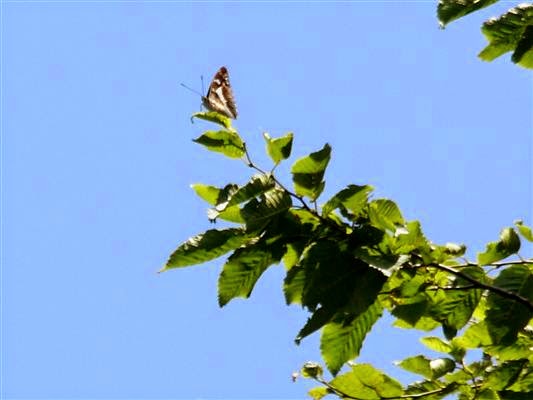
Showing posts with label Red Admiral. Show all posts

Friday, 23 September 2016

Waterside Wildlife.


A recent leisurely stroll along the towpath beside the River Wey Navigation on a warm sunny day provided the following wildlife encounters.


 Common Darter.

Brown Hawker.

At one spot I watched at least half a dozen Migrant Hawkers in flight over the water and then managed to locate one individual resting overhead.


Just a few butterfly species were seen including a single Small Copper, several Green-veined Whites plus a Comma and Red Admirals.

Comma.

 Red Admiral.


Linking to:
Saturday's Critters

Friday, 15 July 2016

Recent Forays on Ashtead Common.

During the past week I have made three separate forays onto different parts of Ashtead Common and on each occasion whilst the temperature was more or less favourable the strong breezes and cloudy skies have conspired against me seeing and getting photos of some of the expected species. Nevertheless here are images of some of the species seen.

Large Skipper (Ochlodes venata). Of the three Skipper species this one is the easiest to find and identify and has been the most common on my transect walks from late June to date.

However the Small Skipper (Thymelicus sylvestris) has so far been less obvious than the same period last year and I have yet to find and clearly identify its close relative the Essex Skipper on my transect visits.

This mating pair of Small Skipper were spotted during a walk that I led for the local branch of Butterfly Conservation on Thursday when a total of 17 species was recorded including many Purple Hairstreak and Purple Emperor (c20) flying high above the Oak canopies. One Purple Emperor tantalisingly fluttered around a few of us at head height for a few minutes but failed to land!

Small White (Pieris rapae).

Comma (Polygonia c-album).

Red Admiral(Vanessa atalanta).

The most numerous species both on my woodland transect and other walks on the common at the moment is the Ringlet (Aphantopus hyperantus) which is happy to fly providing there is a little warmth even on the dullest of days.

The BC walk on Thursday also provided my first local sighting of a fresh male Gatekeeper (Pyronia tithonus).

Finally this Beautiful Demoiselle (Calopteryx virgo) below was seen as I wandered alongside the stream on my return to the car and was certainly aware of my presence.


Thursday, 13 August 2015

Friday Flutters - Weekly Update.


Despite the lack of sunshine over recent days the collage above proves there are still a few colourful butterflies to be found around my local birding patch, providing some photo opportunities, in lieu of the avian species that are all still hiding from my lens.

First up was a single Small Copper (Lycaena phlaeas) that alighted briefly beneath my feet before moving onto another leaf and then promptly closing its wings!

A few male Common Blue (Polyommatus icarus) were obvious as they flitted hither and thither before disappearing deep into the grasses to rest briefly before their next territorial foray.


I saw a few Meadow Browns but as expected the Gatekeepers (Pyronia tithonus) were far more numerous but not very active under a cloudy sky. The undersides of both sexes are very similar but this one opened its wings (below) to reveal a female.

A very fresh Red Admiral (Vanessa atalanta) landed on a old tree stump and provided a different splash of colour.


As I walked over the upper grassy meadow a couple of male Small Heath (Coenonympha pamphilus) were chasing one another and this was one of the few occasions I have managed to get a shot as this tiny flutter that is so well camouflaged when it settles deep amoungst the grasses.

The star find of the week was a resting Painted Lady (Vanessa cardui), a migrant species that visits our shores from North Africa. Interestingly I photographed this individual within 50 yards of a single sighting I recorded here during August last year.

With the present unsettled weather pattern it might be a while before I get some more photo opportunities.

Wednesday, 14 May 2014

Rocca di Garda.

On our second day at Garda after an early morning guided tour around the town which included sampling some ice-cream and alcoholic beverages we purchased our lunch from a local mini market and commenced the climb to the summit of Rocca di Garda that dominates the skyline above the town.

An important castle was founded on this site in the 5th century and became the centre of a large important jurisdiction which developed during the Longoband and Carolingian period. Protected by natural cliffs on three sides and the eastern slope was defended by an imposing town wall, parts of which are still visible amongst the heavy undergrowth. It was ceded by the empire to the town of Verona at the end of the 12th century.

Our steep climb started directly behind the Church of St. Maria Assunta and as we gained altitude, initially up a never ending flight of steps, the vista opened up over the town and the lake.

The very steep ascent was quite arduous but from the summit you can appreciate its commanding location with views in most directions although somewhat hampered by the extensive mixed woodland which now envelopes all but the north-western cliff. We were rewarded with views of Garda Harbour and Punta San Vigilio.

The view northwards towards the Dolomites.

On the summit there were open areas of grassland and an unexpected pleasure was watching a few species of butterflies including Wall, Swallowtail, Red Admiral and several Whites.

 Wall (Lasiommata megera).

Swallowtail (Papilio machaon).

Red Admiral (Vanessa atalanta).

Our decent southwards off the hill was a little easier on the leg muscles as we enjoyed views of Cuckoo, Hooded Crows and Kestrels flying overhead while wending our way along narrow roads adjoining unspoilt countryside. 

Our route, somewhat extended due to my navigation error, eventually took us to the outskirts of Bardolino and then we returned at a very leisurely pace north along the lakeside promenade back to Garda.

Monday, 22 July 2013

Admirals, Fritillary and a rare Emperor.

During a recent visit to Bookham Common I finally managed to grab some images of several butterfly species that can be found in sunlit woodland glades although the numbers on the wing are definitely much lower than this time last year.

 Red Admiral (Vanessa atalanta)

 White Admiral (Limenitis camilla)
Although traditionally found in broadleaved woodlands this elegant species is very tolerant of the shade which has helped its expansion into mixed conifer and deciduous plantations.
It has a powerful gliding flight and I had to wait a long time for one to come to rest in the sunshine.

Like many species the under wing pattern and colours are totally different but they never wanted to pose in quite the right place for a clear shot!

 Silver-washed Fritillary [male] (Argynnis paphia)

The males, distinguished by the four bold sex brands along the veins of their forewings, were very active chasing one another hither and thither, while trying to hunt down a receptive female.

Silver-washed Fritillary [female] (Argynnis paphia)


However the highlight of my visit came around midday when I joined two other wildlife watchers and witnessed a number of 'dog fights' between two male Purple Emperors high above the master oak. Whilst I found it too difficult with my limited lens to capture this fascinating activity I did manage to snap a record shot (heavily cropped) of one male perched on the very tip of one of the highest branches.
Purple Emperor (Apatura iris)

Monday, 10 September 2012

Results of the Big Butterfly Count 2012.

I have just received an e-mail from the Butterfly Conservation with the results of the Big Butterfly Count which took place in the UK between the 14 July and 5 August. Bearing in mind what most wildlife watchers have observed this year I was not at all surprised to learn that 15 out of the 21 target species showed a year on year decline plus 11 species declined by more than a third compared to the 2011 counts all no doubt due to the impact of our wettest summer for over 100 years.

The Meadow Brown (Maniola jurtina) took the top spot with the numbers recorded rising by 186%. Other single-brooded grassland species whose caterpillars probably benefited from the lush growth of their food plants and slightly better weather conditions during their later flight periods were the Ringlet and Marbled White.
 Ringlet (Aphantopus hyperantus).

Two other brown butterflies, the Gatekeeper and Speckled Wood, whose caterpillars also feed on grasses but frequent hedgerows and woodland habitats unfortunately did not fare so well.
Gatekeeper (Pyronia tithonus).

Speckled Wood (Pararge aegeria). Numbers decreased by 65%.

Another loser was the Brimstone (Gonepteryx rhamni) with counts down by 53%.

Counts for the Red Admiral (Vanessa atlanta) were down 72% but in the past few days I have seen plenty of this colourful species on the wing.

One of the few successes was the Six-spot Burnet (Zygaena filipendulae). This day flying grassland moth came in in 6th place and did well for the second year in succession.

 So who knows what the situation will be next year ... I guess it will all depend on the weather.   FAB.

LinkWithin

Related Posts with Thumbnails