Showing posts with label Four Spotted Chaser. Show all posts

Tuesday, 31 July 2018

There be Dragons here.


Many of my readers will know of my regular visits, throughout the seasons, to the acidic heathland, bog, ponds and woodlands at Thursley Common National Nature Reserve  for its wealth of wildlife, notably its special birds and a habitat that also supports over 20 species of Odonata.

A carved sign alongside the boardwalk depicts some of the delights that can be found here and this post serves to illustrate the dragon species I have seen here during the past month.

Four-spotted Chaser (Libellula quadrimaculata).

Four-spotted Chaser (Above and below)


Black-tailed Skimmer (Orthetrum cancellatum) [Male above - Female below]


Keeled Skimmer (Orthetrum coerulescens) [Male above - Female below]


Keeled Skimmer - Mating pair.

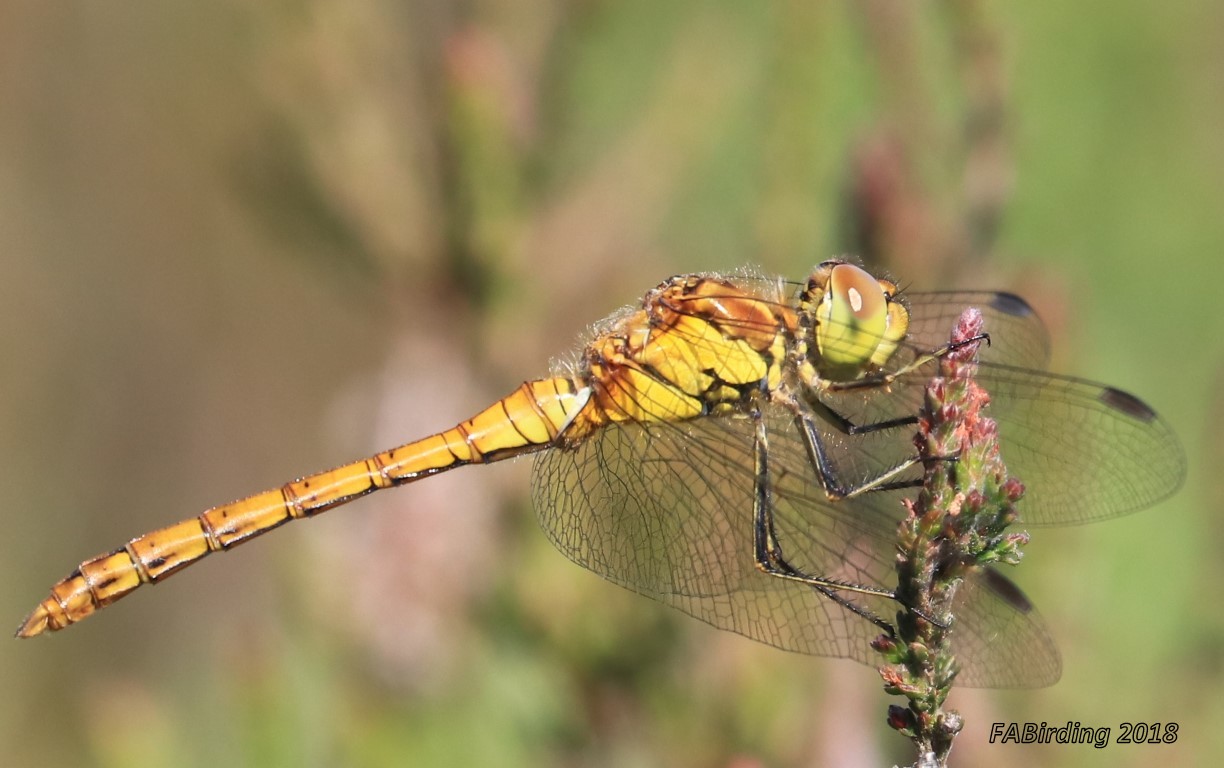
Common Darter (Sympetrum striolatum) [Male above - Female below]


Black Darter (Sympetrum danae) [Male above - Female below]


The Damsels will feature in a future post.

Monday, 28 May 2018

Four Spotted Chaser.


During a visit to Thursley Common N.N.R. last week I came across this fairly confiding immature male  Four Spotted Chaser (Libellula quadrimaculata) well away from any water on the edge of a wood next to the heath.


Later on around the acidic pools, their typical habitat, I watched several males aggressively chasing one another in territorial flight and managed to capture one taking a very brief rest.

I saw several other species of Damselfly so I will definitely be revisiting in the near future. FAB.

Tuesday, 23 June 2015

Thursley Common N.N.R.

During a recent visit to Thursley Common on another windy day I was surprised to locate a pair of (Eurasian) Teal, feeding and paddling just yards from the boardwalk, and totally oblivious to my presence.
 
Usually I would expect them to immediately take flight at the slightest hint of any human presence so close by so I took this opportunity to gather a few shots, mainly of the male with his very distinctive head pattern, as his partner managed to keep out of view beneath the overhanging vegetation.


Unfortunately this quiet encounter didn't last very long as the pair sensed the intrusion of some noisy walkers approaching from upwind and they promptly took flight. My attention then turned to seeking out a Four Spotted Chaser (Libellula quadrimaculata) taking a rest below my feet in the watery shadows.


I had seen very few dragonflies or damselflies, probably due to the slightly cooler but windy conditions, so I was delighted to spot a Hobby dashing low across the pools and then land in a distant tree.

I waited for quite some time before this individual took flight to seek out more food and it was eventually joined by three more Hobby but attempting to get any quality images of this very fast flying species with my zoom lens (fully extended) was certainly a challenge. I've no doubt the other two photographers on the boardwalk with their very expensive gear had much more success.


After about ten minutes the Hobbies disappeared and on my reverse route I stopped to take a few more shots of the basking Common Lizards (images saved for a future post) and then spotted a resting Large Red Damselfly (Phrrhosoma nymphula) amoungst the heather.


Linking to Nature Notes, Wordless (on Tuesday), and Wild Bird Wednesday.

Saturday, 6 June 2015

Heathland Wildlife.


During a recent break from wielding the paint brush I visited Thursley Common and wandered the various tracks and pathways around this lowland heath habitat under a blue, cloud strewn sky and a very gusty south-westerly wind. 

Not surprisingly in such windy conditions there was very little activity on the acidic bog pools but after a patient search I managed to grab a shot (above) of a Four-spotted Chaser (Libellula quadrimaculata) who stopped patrolling for a brief rest.

During periods when the sun became unshackled from the drifting clouds I was joined on the boardwalk by one of a few Common Lizards soaking up the rays.


During a lengthy detour across the heath the only other Odonata that came within range of the lens was this male Common Blue Damselfly (Enallagma cyathigerum).


Throughout my visit the birds weren't very co-operative despite seeing or hearing Chiffchaff, Chaffinch, Common Whitethroat, Curlew, Cuckoo, Willow Warbler, Linnet, several Woodlark, Skylark, Great Spotted Woodpecker, Carrion Crow and Kestrel.

In a small wooded area this Coal Tit constantly called as it collected food for its nestlings.


One heathland species that you can almost guarantee that will pose for the lens is the Stonechat.


Linking to Saturday's Critters.

Wednesday, 18 June 2014

Encounter with Arthur

As I began another stroll on the boardwalk at Thursley Common yesterday I bumped into (not literally!) a very interesting gentleman called Arthur, a Yorkshire man who is 75 years young and an experienced and passionate photographer of Odonata.
While watching the dragonflies zipping over the water in a very strong breeze we chatted for over 30 minutes and my brain had to work a little harder than normal as Arthur only referred to any of the various Odonata by their Latin names! I soaked up his enthusiastic knowledge and if I learned anything about photography from him it was just get out and practice, practice and learn from your mistakes ... excellent advice.

  
As we both agreed the conditions (he called it a bit 'thin') were not really conducive to getting decent low down images of the dragonflies I headed onwards through Pine Island and out onto the heathland. While watching a singing Skylark soaring up high into the sky I was aware of the calls of a warbler close by. After a little searching I found the individual and took a quick shot before it moved deeper into cover.


The soft contact call sounded like a Chiffchaff or a Willow Warbler but I think the paler cheek pattern, the thicker albeit pale supercilium, paler legs and longer primary projection indicate that this is a juvenile Willow Warbler (Phylloscopus trochilus). [I'm sure someone will correct me if I'm totally wrong].


A few of the other species seen and snapped, often at a distance, included Woodlark (6), Cuckoo (3), Stonechat (5) and Green Woodpecker. In addition I also saw Great Spotted Woodpecker, Tree Pipit, Skylark, Common Redstart, Chaffinch, Common Whitethroat, Magpie, Crow, Jackdaw, Common Buzzard, Tufted Duck, Canada Geese, Blackbird, Chiffchaff, Willow Warbler, Linnet, Long-tailed Tit, Great and Blue Tit and heard the resident Curlews calling. 
 

While following a path through an area of flowering Bell Heather I spotted a blue butterfly. Initially I didn't pay much attention to which species this might be but after it flew away I reviewed the images to reveal it was a male Silver-studded Blue (Plebeius argus) and my first sighting for this year.


One image of its under wing pattern revealed the distinctive silvery-blue centre within the black marginal spots.

After passing the 'lazy' gate I spent a little time capturing a few images of a Small Tortoiseshell (Aglais urticae) enjoying a nectar feed in the sunshine.

On my way back across the common while making a detour through one of the pine plantations I met up with Arthur again. He had decided to take a stroll away from the boardwalk as the stiff breeze was still hindering him getting any more shots of the Odonata. This time our discussions turned to past occupations and he was intrigued to learn that I had worked for the Royal Horticultural Society (RHS) and we both knew a number of people who had also worked there ... it's a small world.

Back along the boardwalk it was still fairly breezy but I managed a few captures of resting Libellula quadrimaculata (Four-spotted Chasers).
  
Another interesting encounter. Stay well Arthur and maybe our paths will cross again.  FAB.

Thursday, 12 June 2014

Watching Chasers and Hobby.


On Monday I paid another visit to Thursley Common with the faint hope that I might add something to the year list. A male common Redstart was singing from atop a tall pine as I followed the entrance track.

The pools were very quiet with a few Tufted Ducks lazing around so I decided to head onto the heath in search of an elusive Dartford Warbler and failed even to hear one! I did however enjoy the company of  singing Wren, Linnets, Stonechat and Meadow Pipit plus two high soaring Common Buzzards followed by a tantalizing brief glimpse of a Hobby as it disappeared behind a large stand of pines but surprisingly no hirundines in the sky. A few other things caught my eye including lots of day flying Moths and the Orchids popping up everywhere.

On returning to the pools I was amazed at the numbers, probably triple figures, of Four-spotted Chasers dashing hither and thither across the surface and this boded well for another, hopefully closer, sighting of any hawking Hobby.

Fortunately one Four-spotted Chaser decided to take a brief rest close to the boardwalk making my life easier than trying to focus on a fast flying body over the water.

Then a Hobby appeared flying fast over the marsh and before I could adjust the camera settings it gained height rapidly and soon became a speck in the sky.

I hung around for about an hour and whilst it reappeared on several occasions again briefly at low level most of its dragon hunting was done high up in the blue so just a few cropped shots available in the following collage.

I enjoyed the spectacle of watching this consummate avian hunter grabbing and then consuming its prey on the wing whilst looking for its next quarry.  FAB.

Wednesday, 21 May 2014

Wildlife on Thursley Common.

I made another outing to Thursley Common last Thursday to check out the wildlife. 

As usual I entered the common via the boardwalk and stopped by one of the acid pools to see if there was any Odonata activity. It soon became obvious that there were a number of Chasers skimming over the water so just a matter of waiting for one to settle somewhere.


While I waited a Large Red Damselfly perched close by for a photo call with several others in tandem seeking a place to settle whilst being harried by other uncoupled individuals.
Eventually a Four Spotted Chaser (Libellula quadrimaculata) landed nearby to take a rest.

Nice to see them with their pristine wings before all the battles take a toll. The sexes are very much alike and their brown abdomen becomes much darker as they mature. They often fall prey to the Emperor Dragonfly which patrols the water at a similar height of 70cm.

As on a previous visit (please click the link to view earlier images) I saw at least four male Redstart but they were typically always singing from fairly high perches so I had to crop the images taken so that you can appreciate their stunning colours.


This male was singing with from the same location for some ten minutes in direct competition with another male not too far away.
You can listen to it's song here.


Further over on the heath I noticed at least two spotty looking young birds flitting about the track side foliage and eventually managed a quick photo as I wasn't sure of the species ID at the time.

Having now cropped the image and looked more closely at its markings; including the rufous rump; I'm now fairly sure that it is a juvenile Stonechat.

I was also hearing the calls of several Common Whitethroat and just my luck one male perched briefly enabling a shot through a gap in the young birch growth.

Other species seen included Willow Warbler, Chiffchaff, Chaffinch, Mistle Thrush, Robin, Wren, Blackbird, Crow, Jackdaw, Magpie, Mallard, Tufted Duck, Canada Geese, Curlew, Great-spotted Woodpecker, Common Buzzard (6), Cuckoo and Skylark.

One of the many Common Lizards sunning itself on the boardwalk. I'll be going back when there are more species of Odonata on the wing and hopefully spend some time watching their predator, the Hobby.  FAB.

LinkWithin

Related Posts with Thumbnails