Showing posts with label Black-headed Gull. Show all posts

Saturday, 19 March 2016

More Coastal Birding.


Whenever we visit my father-in-law on Hayling Island I usually manage to wangle an hour or two to wander part of the shoreline overlooking Langstone Harbour and yesterday I was able to extend my time by walking part of the 'Billy Trail'. With the tide well on the ebb most of the waders; Curlew, Godwit, Redshank, Dunlin, Grey Plover and Knot; were specks out on the expanding mudflats with large numbers of Brent Geese also seen flying to other parts of the harbour.


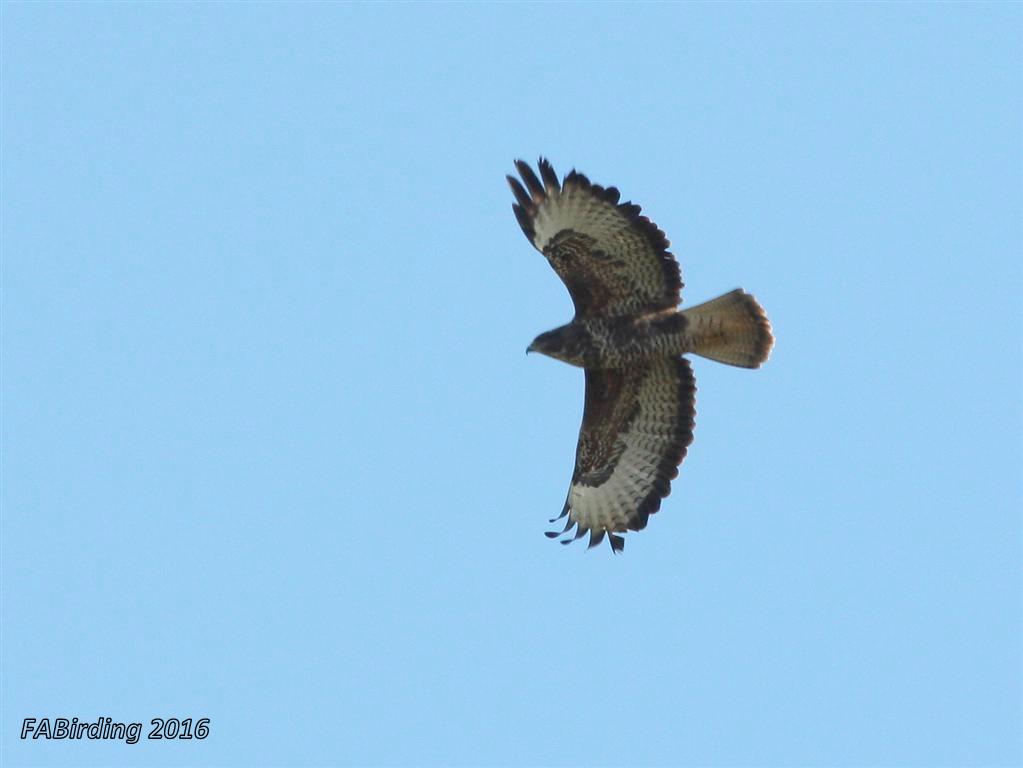
Looking inland this Little Egret was sitting quietly by the edge of a stream that crosses one of fields which is also often frequented by a Kingfisher but no sighting during this walk. A Common Buzzard (below) made a brief appearance overhead before disappearing beyond the nearby woodland.


With little else catching my attention I retraced my steps and made my way towards the old Oyster Beds with the strident calls of hundreds of gulls increasing in volume the closer I got to their nesting site. A month ago there were just a handful of Black-headed and one or two Mediterranean Gulls but now the colony was alive with activity as they jostled one another for their allotted spaces.

I will feature some additional images taken of the Mediterranean Gull in a separate post very soon. 

Close to the path I disturbed a Rock Pipit while out in the harbour I also spotted a pair of Shelduck and a single Red-breasted Merganser.


One of a pair of Brent Geese wandering around the edge of the tidal pool and close by a couple of Oystercatchers (below) were seeking out morsels from the muddy margins.


Now if my visit yesterday had coincided with a high tide I might well have experienced the joy of watching mixed gatherings of thousands of waders; usually Dunlin, Grey Plover, Redshank and Knot; taking refuge on the much depleted shingle shoreline. The images below were taken just about a month ago.

Linking to:
Saturday's Critters
I'D-Rather-B-Birdin'

Friday, 26 February 2016

Farlington Marshes LNR.

On Sunday (28 Feb) I will be leading a field trip for the Surrey Bird Club (SBC) to Farlington Marshes LNR that comprises around 300 acres of coastal grazing marsh, reed beds, scrub, with both freshwater and brackish pools. The land was first reclaimed from Langstone harbour between 1769 and 1773 by building a clay and timber wall to provide grazing land for cattle. The sea wall has been much improved and provides an ideal route around the reserve to view the wildlife both within the marshes and on the sea or extensive mudflats at low tide. 


On Tuesday I made a recce visit to check out the wildlife and to get some images of the species that can be seen here just in case the windy weather that is forecast for Sunday doesn't provide me with many photo opportunities.

During the winter months one of the main attractions are the very large flocks of Dark-bellied Brent Geese that feed on the grazing marsh.

At this time of year the marsh also supports good numbers of Curlew, Northern Pintail, Oystercatchers, Lapwing and Teal plus I was also fortunate to get several sightings of two Short-eared Owls.

During my recent visit I also saw three species of Grebe, Red-breasted Merganser, Shelduck, Shoveler, Wigeon, Gadwall, Dunlin, Redshank, Grey Plover, Knot and Turnstone plus good numbers of Black-tailed Godwits (see below) disturbed from feeding by a low flying Common Buzzard.


At high tide I also watched the spectacle of many hundreds of Dunlin streaming close above the water seeking out a suitable spot to roost and wait for the mud to reappear while inland there is always something else to capture one's attention such as ....

a perching Stonechat, one of many Northern Shoveler in their full breeding plumage and the various gull species including the Black-headed Gull. The site also hosts reasonable numbers of Little Egret (see below).

During my wandering I logged about 50 species but with more eyes on Sunday it is possible to add a few more including Kingfisher, Peregrine, Merlin, Water Rail, Rock Pipit, and the elusive Bearded Tits. FAB.

Linking to: Saturday's Critters, I'D-Rather-B-Birdin' and Through My Lens.

Thursday, 11 February 2016

Patch Birds.


Visits to my local patch have been somewhat infrequent this year mainly due to the inclement weather. 

Earlier this week on a very blustery morning following severe overnight gales  initially there seemed to be very little avian activity apart from a single Black-headed Gull on sentry duty ...


 ... and a solitary Coot resting at the waters edge.


When I reached the Great Pond the effect of the recent high rainfall was clear to see with water stretching far beyond its normal boundaries. Again it appeared bird-less but as the sun peeked through several species emerged from the saturated wooded margins. I logged around 30 Mallard, a pair of Northern Shoveler, a single male Tufted Duck and a pair of Teal.


As I circled the pond I noticed the emergence of a very colourful species that regularly appears at this time of year ... Mandarin Ducks. Initially two pairs drifted into view and then a further six males joined the party.


After a short time at least four of the males departed. In previous years I have often seen ten or more males chasing after just one or two females before trying their luck elsewhere!

 It will be interesting to see whether any of the pairs hang around.  FAB.

Linking to WILD BIRD WEDNESDAY.

Wednesday, 25 February 2015

Fences and Flyers.


A few more images from my recent visit to Farlington Marshes incorporating the fences and some of the flying species that occupy this landscape. Linking to Good Fences hosted by TexWisGirl.

Miles of barbed wire fencing erected to segregate the different habitats around this reserve also helps to contain cattle used to manage the grazing areas and to deter us two legged beings from trespassing. 

Meadow Pipit hanging on tightly.


Dark-bellied Brent Geese. 


Black-headed Gull looking for somewhere to land.


Barnacle Geese (part of a 28 strong flock)


My view over the reed bed where most of the in-flight shots were taken. FAB.

To view the previous post images also taken during this visit please click HERE and Here.

Wednesday, 10 December 2014

Wings over the water.


With falling temperatures and chilling winds the birds haven't been very active but as soon as the park visitors arrive with any sort of handout the resident Black-headed Gulls seem to appear from everywhere and provide an opportunity to capture some in-flight shots. So here are a few from a recent session.


Flaps down for a safe landing.


Diving in at speed.


Losing some weight! .... Better watch out below!

Flying off with the prize.  Linking to Wild Bird Wednesday.

P.S. I have just learned that a close friend and birding companion for many years passed away on Sunday and my thoughts go out to his wife and family at this most difficult time. I hope to catch up with everyone in the next few days. FAB.

Tuesday, 18 November 2014

Black-headed Gull.

Our most commonest colonial breeding gull occupying coastal and inland waters, often in large numbers, is the Black-headed Gull (Chrioicocephalus ridibundus). 
It is fairly easy to identify at any time of year as it is our only gull species that reaches maturity in just two years. 

However its given name doesn't correctly match its looks as adults (above) in their summer plumage actually sport a dark chocolate-brown hood but of course from a distance it does look black.

At this time of year most of the adults are now in their winter plumage (above) and their dark cap is replaced by just a bold dark ear spot and the bill gains its black tip. The distinctive all white tail is also an obvious ID feature (see below) when in flight.


Well into autumn this years juveniles (above and below) are now sporting their 1st winter plumage, retaining some faded brown on the wings and the distinctive black tail band which is again very obvious in flight.


 A 1st winter individual flying in ahead of an adult just for comparison.  FAB.

Linking to WILD BIRD WEDNESDAY hosted by Stewart.

Saturday, 8 November 2014

Flying Around.

A very windy walk around Heron Pond in Bushy Park today. Certainly not ideal conditions for capturing birds in flight but the camera rose to the challenge.

Mallard preparing for splashdown.

The pond is home to a large number of Black-headed Gulls of various ages now sporting their winter plumage. Above is a 1st-winter still carrying some of its juvenile wing colours and black tail band.

By way of comparison above is an adult BHG in full winter garb.

Occasionally something much larger drops in. I often have difficulty identifying the juvenile larger gulls so this could be a Great Black-backed based on the features shown in the next image BUT I'll wait to hear what the experts say. 

 And finally a fly past by a Mute Swan.

Wishing everyone a wonderful wildlife watching weekend, wherever you are.  FAB.

Linking to Saturday's Critters and I'D-Rather-B-Birdin'.

Saturday, 18 October 2014

Wildlife around Heron Pond.

A very mixed week weather wise so here is a small selection of the wildlife seen during my visits to Heron Pond in Bushy Park.

As usual one of the very approachable Grey Heron was waiting near the car park.

Black-headed Gulls, in various stages of their winter plumage, waiting for a handout.


Ducks on the water included the bright eyed Tufted, Gadwall with its finely vermiculated grey body and a single (Northern) Shoveler all slowly changing into their full breeding plumage.

A surprising find this week was a juvenile Herring Gull in its mottled plumage resting on the remains of a floating nest.

 The pond also supports a small but healthy population of Red-crested Pochard.

Large numbers of Jackdaw frequent the park. They are fairly friendly and always willing to pose.

The local residents also include these two introduced species, Canada and Egyptian Geese. 

At this time of year one is never far away from a Red Stag wandering through the bracken on the lookout for hinds or protecting his existing harem often resting and hidden deep in the vegetation.

During the rut the general advice is to keep at least 50 metres from any of the deer, especially the stags but sometimes they just appear and let everyone know their intentions!

And then he sauntered away to be camouflaged once again by the autumnal hues of the ferny landscape.

All these three images are cropped so I wasn't that close and always respect the boundaries when photographing any wildlife. FAB.

Linking to Camera Critters, Saturday's Critters and I'D-Rather-B-Birdin'.

LinkWithin

Related Posts with Thumbnails