Showing posts with label Spoonbill. Show all posts

Friday, 25 May 2018

Farlington Marshes - Winter Birding.


Earlier this year I made three visits to Farlington Marshes, one of my favourite sites on the south coast, to enjoy the spectacle of winter birding.

 
One of the main attractions being the thousands of Dark-bellied Brent Geese that migrate southwards from their arctic breeding grounds in late September to spend the winter months in and around Langstone Harbour.


The reserve and surrounding harbour attracts large numbers of waders, including Dunlin, Knot, Grey Plover and Oystercatchers (above) plus Ringed Plover, Turnstone and Black-tailed Godwit (below) in their drab grey winter plumage.


Wildfowl increase through the winter months with particularly high numbers of Teal and Northern Pintail (above) plus Shelduck (below).

During these winter visits I have logged 64 species including Avocet, Marsh Harrier, Peregrine, Water Rail, Water Pipit, Short-eared Owl, Bearded Reedling and one of several Spoonbill (below) that irregularly visit this site.

I will be revisiting this area throughout the year and hope to share the diversity of species that can be seen here.  FAB.

Linking to:
Saturday's Critters
I'D-Rather-B-Birdin'

Sunday, 28 May 2017

Birding on Lake Kerkini, Greece (Part 1).


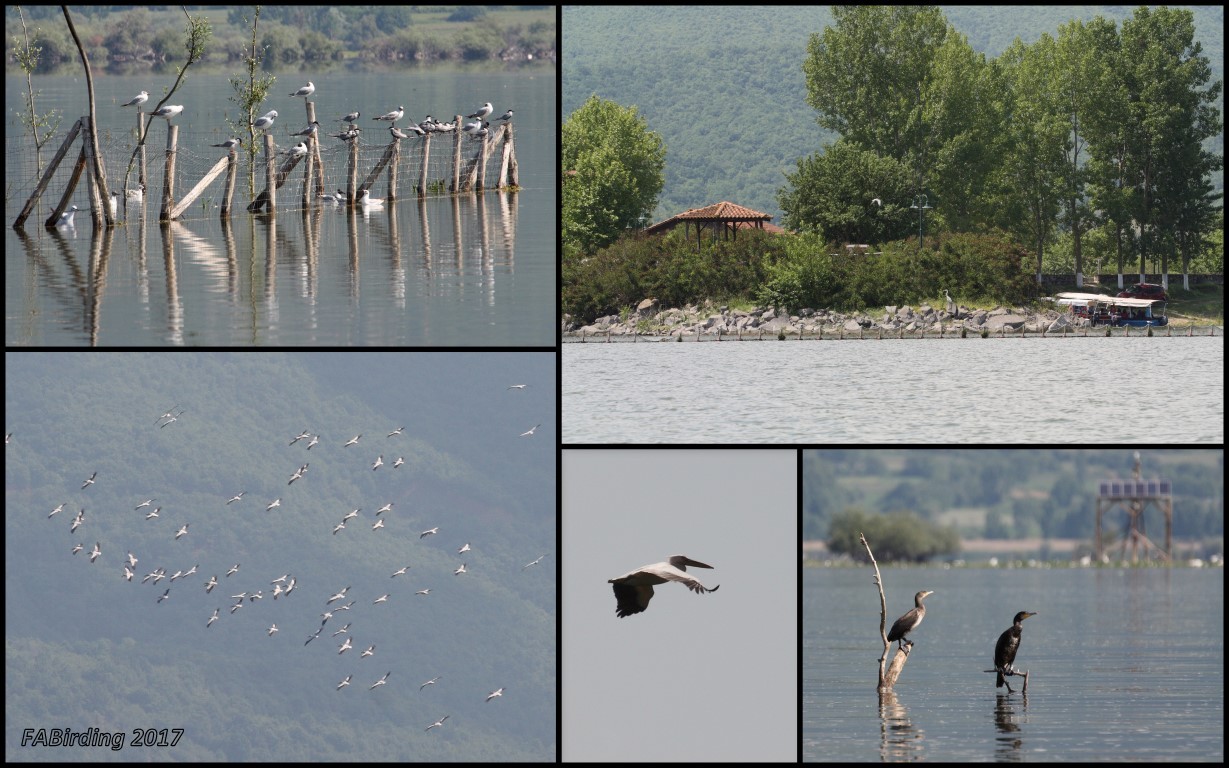
One of the highlights of our week in Northern Greece was a morning excursion across Lake Kerkini to the drowned forest to view the various birds that regularly visit and nest on this important wetland habitat.


Brief history of Lake Kerkini.
Historically the lake fed at it’s north-eastern corner by the River Strimonas flowing out of Bulgaria was not permanent. In 1932 the first dam was built at Lithotopus at the south-eastern end but following a build up of sediments over the ensuing fifty years a higher dam and improvements to existing embankments was completed in 1982 to improve flood protection and provide agricultural irrigation. The lake is approximately 15km long, with a maximum width of 8.5km and its depth varies from 1 to 10 m. Its surface rises and falls depending on the season from 55 to 85 km2.

We set out from Kerkini Harbour on perfectly calm water heading towards the north-eastern corner with large flocks of Dalmatian Pelicans soaring against the backdrop of the mountains or lazily flying over the lake; resting Great Cormorants, plus Black-headed Gulls and Terns. Both Common, Whiskered, Black and White-winged Black Terns were easily identified flying around us.

Great Crested Grebe dashes across the water along side the boat. During our days around the lake we saw hundreds of pairs in various stages of courtship. Apparently the actual number of nesting pairs is unknown and difficult to estimate due to the size of the lake and their distribution!

So where to look next? A Squacco Heron eying up a meal below its wire perch or flying past us; Grey Heron overhead and a distant Great White Egret and Pygmy Cormorant.

The wire fences accommodated a nice collection of Whiskered Terns with Black-headed Gulls.

As we drifted slowly into the drowned forest we were surrounded by the shear volume of sounds of nesting Great Cormorants together with the much smaller and rarer Pygmy Cormorants which breed here.
The reason for the lakes' success as a both a feeding and breeding location is the sheer number of fish available providing the spawning areas remain intact.

Dotted in amoungst the Cormorants were nesting Spoonbills (above) with the breeding adults sporting their ochre  breast band and neck patch.

Dotted in amoungst the Cormorants were nesting Spoonbills (above) with the breeding adults sporting their ochre  breast band and neck patch. More images of this species will appear on FABirding in due course.


The other species that entranced me (below) was the Black-crowned Night Heron. Perched out in the open this individual provided great views.  
You can click here to view some other close ups on FABirding.


Before long it was time for our expert local guide and boatman to move on and take us to view the other important species on the lake; both Dalmatian and White Pelicans at their breeding platforms.


This encounter will form the subject of a follow up post .. Part 2.


Linking to:
Nature Notes
Wild Bird Wednesday

Sunday, 18 August 2013

Cley Marshes NWT Reserve.


During our recent long weekend on the North Norfolk Coast we made regular visits to Cley Marshes NWT Reserve but often only stopping off at Bishops Hide to scan over Pats Pools before heading elsewhere along the coast. 

More often than not any waders present were always too far away but there was always a few other species that ventured a little closer to the hide.


Avocet constantly feeding, Shelduck parents aggressively chasing off anything that got close to any of their 15 goslings and Coot just showing off.

Throughout our numerous visits over the years it has been unusual for us not to see Marsh Harriers quartering over the extensive reed beds but this activity is often interspersed with long periods when individuals perch atop one of the few trees as they monitor their options for their next foray.

Fortunately our visits coincided with the flight of this majestic species so the opportunity was grabbed to capture a few images as one individual effortlessly glided close to the hide.


(Western) Marsh Harrier (Circus aeruginosus)


These brief forays by the Harriers often result in pushing the various waders into the air and on more than one occasion it was a decent sized flock of Black-tailed Godwits (Limosa limosa) that felt threatened but it didn't take them too long to resettle on the far side of the pool. 
During this frenetic activity I did notice that there was one Godwit feeding alone much closer to the hide and it decided not to take to the sky so my attention turned to it as it's particular colouring suggested that it might just be a different sub species.


What struck me about this particular individual was that its rufous summer plumage extended much further down the breast suggesting that this could be an Icelandic Black-tailed Godwit (Limosa limosa ssp. islandica). Unfortunately it's legs, which should be shorter, were never fully exposed but everything else including the slightly shorter bill length indicated 'islandica'. [I would be interested to here what any of my readers think about its ID].

On one particular day we decided to spend longer at Cley and undertook a leisurely anticlockwise circuit of the whole reserve. 

After leaving Bishops Hide we headed up onto the East Bank towards Arnold's Marsh where a Black-winged Stilt had reportedly been seen but we couldn't find it. However we did get views of  four Spoonbills and a hastily taken shot as three of them they decided to move location. Scanning the marsh did produced Spotted Redshank, Greenshank and Ringed Plover.


Dropping off the bank to get some relief from the stiffening breeze I was totally surprised when I found a Painted Lady and managed a couple of shots before it flew away. (My first sighting this year.)

Climbing up onto the shingle sea defence bank provides a good spot to scan all over the reserve and across the sea but there was little activity apart from a few gulls, Cormorant and the occasional flypast of Sandwich and Common Terns returning from fishing trips with food for their growing youngsters.
Anita, always ready to help carry the gear, has often commented that she would never have thought 40 yeas ago that, as a 'townie', she would ever be interested in birding and wildlife but that's why I admire her so much as we continue to enjoy our life together.

 
A brief visit to the North Scrape hide didn't produce any more photo opportunities so we strolled on past the beach car park and then along the West Bank, watching flying Little Egrets, before returning to the boardwalk  and back to the Visitor Centre for some much needed refreshments.


Once again a very enjoyable visit to Cley Marshes and I'm sure it won't be our last.  FAB.


Linking to Camera Critters and I'D-Rather-B-Birdin' 

Saturday, 15 May 2010

Birding with Friends (Part 2).

Continuing on from (Part 1) we decided to head over to Dungeness for the afternoon. First stop was the ARC Pit and the search for Tree Sparrows was unsuccessful. (They were probably hiding away from the cold and windy weather!) A Marsh Harrier was sighted while we searched the mixed hirrundine flocks of Swifts, Swallows, Sand and House Martins for any Red-Rumped Swallows but again no joy.
 Mute Swan.
We then moved onto the main reserve and having checked the sightings board headed straight towards Denge Marsh where a distant large white blob feeding along a water filled gully increased my heart rate.
Moving closer I was eventually able to get some reasonable cropped shots of a Spoonbill with its spatula shaped bill. (Another 2010 tick).
It eventually flew off to another feeding location but way out of sight.
 Greylag Goose.
Searching through the tussock grass on the wet meadow I located a single Wood Sandpiper and a little while later we also caught up with a half a dozen Yellow Wagtails but regretfully too far away for my lens.
Most of the small birds were hiding away but one Sedge Warbler presented a challenge as it sang heartily from a bramble bush showing off its deep red gape.

While discussing the merits or otherwise of this Oystercatcher nesting on a tern raft a Whimbrel called as it flew overhead and over to our right we heard the distinctive deep 'booming' of a Bittern. (First time I've heard this sound for some years).   
Somewhere out here is a Bittern!
A Reed Bunting balancing precariously!
Nearly the end of a perfect day in good company and around 60 species seen plus the sky eventually changing from grey to blue with the power station on the horizon. Our day together ended with us enjoying a very tasty meal at a fish resturant in Rye before we departed on the two hour drive home.  FAB.

LinkWithin

Related Posts with Thumbnails