Showing posts with label Marsh Harrier. Show all posts

Friday, 13 June 2014

A Fritillary First.

On Wednesday I accepted an invitation from a friend and ex work colleague who I haven't seen for two years to go to Kent and hopefully see and photograph a rare butterfly. So after a 100+ mile road journey I picked David up from his home and we headed off to East Blean Woods. It was a glorious sunny day with the temperature slowly rising and so was my anticipation of seeing this sedentary flutter that only flies in such conditions.
A slightly muddy walk into the wood to a semi sunlit glade and my first sighting was a perched individual ..

 .. a Heath Fritillary (Melitaea athalia). What a fabulous under-wing pattern.

Over the next hour or so the numbers of these delightful butterflies flitting around our feet, rarely flying higher than our knees, increased to 30+ but unless they were are occupied by procreation they only perched very briefly and not often with their wings open so patience was definitely the order of the day.


This rare species is traditionally only found in in the south-east in acid woodlands where it prefers newly coppiced areas (giving it its nick-name, the Woodsman's Follower) containing an abundance of its primary food plant, Common Cow-wheat (Melampyrum pratense). Due to its very limited distribution in Kent, Essex, Devon, Cornwall and Exmoor it is a high priority species and were it not for conservation efforts over the past two decades it would certainly now be extinct in England.

As you can imagine I was absolutely delighted to have witnessed this flutter for the first time.

Other wildlife seen included a Broad-bodied Chaser, Small Tortoiseshell and several green-blue Lacewing.

We then left the shaded woodland habitat and drove over to Grove Ferry in the Stour Valley and undertook a walk around the reed beds in the very hot sunshine.The avian activity was pretty sparse probably due to the rise in temperature and we both commented on the distinct lack of any hirundines in the sky.

From two of the hides we had decent views of Marsh Harrier, Common Tern and a juvenile Heron.
All in all an excellent excursion into Kent ... many thank David and I hope it won't be so long before we see each other again.  FAB.

P.S. During a walk around the glades on Bookham Common today I saw my first White Admiral and Silver-washed Fritillary of the season. [Click here for an image of the Silver-washed Fritillary on my other blog]

Linking to Saturday's Critters hosted by Eileen.

Sunday, 18 August 2013

Cley Marshes NWT Reserve.


During our recent long weekend on the North Norfolk Coast we made regular visits to Cley Marshes NWT Reserve but often only stopping off at Bishops Hide to scan over Pats Pools before heading elsewhere along the coast. 

More often than not any waders present were always too far away but there was always a few other species that ventured a little closer to the hide.


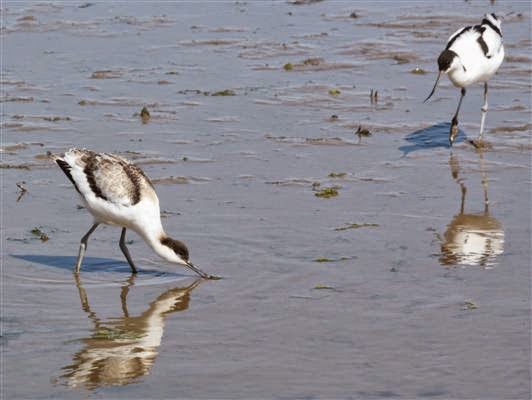
Avocet constantly feeding, Shelduck parents aggressively chasing off anything that got close to any of their 15 goslings and Coot just showing off.

Throughout our numerous visits over the years it has been unusual for us not to see Marsh Harriers quartering over the extensive reed beds but this activity is often interspersed with long periods when individuals perch atop one of the few trees as they monitor their options for their next foray.

Fortunately our visits coincided with the flight of this majestic species so the opportunity was grabbed to capture a few images as one individual effortlessly glided close to the hide.


(Western) Marsh Harrier (Circus aeruginosus)


These brief forays by the Harriers often result in pushing the various waders into the air and on more than one occasion it was a decent sized flock of Black-tailed Godwits (Limosa limosa) that felt threatened but it didn't take them too long to resettle on the far side of the pool. 
During this frenetic activity I did notice that there was one Godwit feeding alone much closer to the hide and it decided not to take to the sky so my attention turned to it as it's particular colouring suggested that it might just be a different sub species.


What struck me about this particular individual was that its rufous summer plumage extended much further down the breast suggesting that this could be an Icelandic Black-tailed Godwit (Limosa limosa ssp. islandica). Unfortunately it's legs, which should be shorter, were never fully exposed but everything else including the slightly shorter bill length indicated 'islandica'. [I would be interested to here what any of my readers think about its ID].

On one particular day we decided to spend longer at Cley and undertook a leisurely anticlockwise circuit of the whole reserve. 

After leaving Bishops Hide we headed up onto the East Bank towards Arnold's Marsh where a Black-winged Stilt had reportedly been seen but we couldn't find it. However we did get views of  four Spoonbills and a hastily taken shot as three of them they decided to move location. Scanning the marsh did produced Spotted Redshank, Greenshank and Ringed Plover.


Dropping off the bank to get some relief from the stiffening breeze I was totally surprised when I found a Painted Lady and managed a couple of shots before it flew away. (My first sighting this year.)

Climbing up onto the shingle sea defence bank provides a good spot to scan all over the reserve and across the sea but there was little activity apart from a few gulls, Cormorant and the occasional flypast of Sandwich and Common Terns returning from fishing trips with food for their growing youngsters.
Anita, always ready to help carry the gear, has often commented that she would never have thought 40 yeas ago that, as a 'townie', she would ever be interested in birding and wildlife but that's why I admire her so much as we continue to enjoy our life together.

 
A brief visit to the North Scrape hide didn't produce any more photo opportunities so we strolled on past the beach car park and then along the West Bank, watching flying Little Egrets, before returning to the boardwalk  and back to the Visitor Centre for some much needed refreshments.


Once again a very enjoyable visit to Cley Marshes and I'm sure it won't be our last.  FAB.


Linking to Camera Critters and I'D-Rather-B-Birdin' 

Tuesday, 13 August 2013

Norfolk Weekend Preview.

On 2nd August we headed off to the North Norfolk Coast for an extended long weekend to celebrate our 40th Wedding Anniversary. Our hotel at Kelling had recently been refurbished and provided excellent accommodation, superb meals and was, of course, ideally situated to enable us to do some very relaxed birding nearby at Cley Marshes and a few other locations a bit further along the coast.

I won't bore you with a list of species seen during our four days away but here is is just a taster of some of the birds we enjoyed watching.

 Black-tailed Godwit in its glorious rusty-orange breeding plumage.

 Shelduck family with 15 ducklings.

One of the many highlights at Cley Marshes was watching the Marsh Harriers quartering the reed beds, occasionally putting any waders into the air and often being mobbed by one of the Black-headed Gulls.
 Marsh Harrier.

At Titchwell Marsh one of the older hides enabled us to get closer views of some species, including Northern Lapwing and many of the juvenile Avocets plus distant views of Dunlin, Ruff, Knot, Common Snipe and 3 Spoonbills.
 Northern Lapwing.

 Avocets (Adult keeping a watchful eye on a juvenile feeding).

Juvenile Avocet.

On the day of our Anniversary I booked a place on one of the boat trips from Morston Quay so we could view the Grey and Common Seals out on Blakeney Point with the added bonus of watching Common, Sandwich and Little Terns fishing fairly close to the boat.

Lazy Seals on Blakeney Point.

I will be sharing a few more images from this very enjoyable and relaxing trip in some future posts.  FAB.


Saturday, 29 June 2013

Fenland with friends. (Part 2)

Continuing from my previous post (Early Start in Suffolk) I didn't have to wait long before my companions for the day to arrive. It had been just over four years since Keith (holdingmoments) had spent a day birding with me in Surrey so while more caffeine was consumed we chatted as if it was only yesterday. I have only known Trevor (aka The Herald) via his blog postings but the immediate healthy banter between us suggested that this was going to be a good day regardless of what we may or may not see at RSPB Lakenheath.

As we headed off along the trail behind the Reserve Centre we were greeted by Goldfiches on the feeder plus Reed Bunting and Reed Warblers flitting in and out of the reeds. Further along the path the strident calls of Cetti's Warbler got us scanning every possible spot for any glimpse of this generally secretive songster but without success while the diminutive Wrens popped up everywhere.

As we arrived at the first watch-point overlooking the main reed-bed a Bittern rose up and flew away from us and was probably startled by a member of the reserve staff undertaking the morning survey. While being entertained by a family of Greylag Geese we quickly added Marsh Harriers, both perched and quartering the reed tops, Common Tern, Cormorant, Cuckoo's calling and in flight, Kestrel, Blackcap and a Kingfisher but no sign of any Bearded Reedlings.

There were a few Swifts but certainly not the numbers I had witnessed on my earlier visit some 10 days previously.

 
Our route then took us up onto the bank overlooking the river and over the distant farmland a low flying Barn Owl appeared to be attacked by a brown coloured raptor and they both disappeared. After what seemed ages the Barn Owl re-appeared looking no worse for the encounter ... our belief is that the Barn Owl was carrying prey and was probably successfully molested by a female Sparrowhawk.  


Moving onwards we eventually reached the furthest watch-point overlooking a more extensive reed-bed with more sightings of Marsh Harriers but we didn't locate the Common Cranes that were apparently in this general area. We did finally get views of a number of Hobbies hawking insects as we commenced our return route. 
 Grey Heron flying over.

With a lessening of bird activity our attentions turned to other wildlife. A Stoat dashed across our path while we were all trying to get shots of Reed Warblers deep within the reeds ... I wasn't successful!

The vegetation was carefully scanned for anything that our lenses might capture and for me this included Scarce Chaser, Azure Damselfly and Brown-lipped Snail but I bet Keith and Trevor have many, many more beasties on their memory cards. I was fascinated by a very tiny Moth (see image below) with exceptionally long antennae and somehow managed to catch one in my fingers but I couldn't get my pocket PowerShot to focus so Trev did the honours while it perched on my finger. We had no idea of its name so Trev dubbed it 'Frank's Finger Moth'!!

I eventually got a close up of another individual and thanks to Trevor's subsequent diligent research I now know it is a Yellow-bared Longhorn micro moth (Nemophora degeerella).

Another interesting creature was this Golden-bloomed Grey Longhorn Beetle (Agapanthia villosoviridescens) with its velvety coat and two tone antennae.

Returning to our first stop of the day our patience eventually paid off as we heard the calls of Bearded Reedlings ....

.... and then a pair flitted across the water and finally settled on the feeder tray but unfortunately partially obscured by the waving reeds. Not an ideal image but for me it will suffice for now.

The voice of another visitor sitting close by rang bells in my memory and I was delighted to have a brief chat with a old acquaintance, Trevor Gunton a very respected ornithologist, who way back in the 1980's introduced me to many of the special birds along the North Norfolk Coast. I chuckled when he commented that we were both much younger then but he still had a glint in his eyes when talking about the birds we both love to watch

We returned to our vehicles and enjoyed a late picnic lunch while reminiscing over our day so far. For me this had been my style of relaxed wildlife watching in the company of two like minded friends but it wasn't to end here so you will have to stay tuned for the final installment.  FAB.

Linking to I'D-Rather-B-Birdin' hosted by Anni and Wild Bird Wednesday hosted by Stewart.

Tuesday, 26 April 2011

Sunny Stour Valley Walk.

On Monday we drove south-eastwards into Kent to meet up with two more friends who were desperate for a relaxing day out birding as a break from their heavy work schedules.

The location was the Stour Valley and our day trek around Stodmarsh NNR which started from Grove Ferry where Anita and I listened to our first Nightingale of the day plus a distant calling Cuckoo that was to remain elusive despite Derek's optimism that it would perch close enough for a portrait photo! On our walk to The Ramp we also heard a single Turtle Dove, Cetti's Warbler, Chiffchaff plus Sedge and Reed Warblers. Mallard, Gadwall, Tufted Duck and Coot on the water with Common Terns noisily fishing and a male Marsh Harrier quartering the vast reed beds. Konik ponies are used to manage the damp pastures.

 Male Reed Bunting (Emberiza schoenichus).

A distant male Marsh Harrier quartering the reed beds.

During one of our many rest stops as we circumnavigated this reserve we also watched another pair of Marsh Harriers and a minimum of 12 Hobby hawking for insects but regrettably too far away for the lens. Swallow and House Martis were also logged plus a swimming Grass Snake.

 Common Whitethroat (Sylvia communis) singing its heart out.

 Cormorant.
Throughout our circuit we were constantly bombarded by the close explosive and repeated calls from a warbler that shouts out its own name 'cetti-cetti-cetti' from a nearby hidden perch within a dense thicket before immediately flying onto its next hidden hideaway. Fortunately on one occasion my camera was pointed at the right spot when this compact warbler, red-brown above with its distinctive pale supercilium and eye ring, perched for just a few moments to provide a record shot.

 Cetti's Warbler (Cettia cetti) pauses briefly before flying to its next hidden song perch.

Another species that likes to sing its repeated, jittery song interspersed with various whistling notes as it slowly climbs up its perch within the reed bed is the [European] Reed Warbler (Acrocephalus scripaceus). 

[Northern] Lapwing patrolling his territory on recently created pool where we also logged two Common Redshank but didn't find the Green Sandpipers or Little Ringed Plover that has apparently been seen about 40 minutes earlier. 

In the damp woodland a Robin was collecting a varied mixture of flies and caterpillars.

After a welcome cup of tea at the end of our walk we drove across country towards our friends home with a brief stop at the 1500 acre woodland at Kings Wood, Challock to view the impressive display of Bluebells. 


Unfortunately when I loaded the 17-85 lens the zoom had become locked at 70mm so this was the best I could produce under the circumstances. A visit to the specialist repair centre is going to be needed very soon to hopefully sort the problem out! Our day ended with a relaxing meal at a very quiet riverside pub plus a large glass of well earned amber liquid.    
I'll be heading to Stodmarsh again in 9 days time to go birding with another long-time friend so hopefully I'll manage to get some different species in front of the lens next time.   FAB.

For more images from around the world, hosted by Springman, please go to  

Monday, 30 November 2009

Norfolk (Day 3)

The plan for Day 3 was hatched by Keith, one of our four friends, who desperately wanted to visit the 'Raptor Watchpoint' at Hickling Broad as he had read about seeing Harriers, Merlin, Owls and Common Cranes coming into roost at the end of the day. So after another hearty breakfast we set out in convoy to follow the coast road south-east via Cromer towards Hickling.

The first brief stop was at a very windy West Runton and a short walk down to the deserted beach.

This tractor has seen better days due to the effects of sea water!

Lesser Black-backed Gulls playing in the surf.

Our next stop planned stop was Sea Palling but the sighting of a day flying Barn Owl hunting in a roadside field provided a pleasant interlude. (Sorry no pics). In the 1840's one of Keith's ancestors was a stationed at Sea Palling. He spoke to a local who provided valuable information as to the former location of the 'Watch Keepers Cottages' and the inland wooden Watch Tower but most of the original properties in this hamlet  were destroyed during severe storms and flooding in the 1950's.

At my suggestion we then drove towards Horsey Gap stopping briefly to log Red-legged Partridge and a pair of Egyptian Geese in the roadside fields. As we headed out onto the dune system the sky darkened ...

... and small skeins of Pink-footed Geese constantly flew overhead moving up the coast. This area of coastline is also well known for its large colony of breeding Grey Seals.

Access to much of the beach is prohibited from October through to January so we battled against the strong winds and walked along the high sandy dune embankment to get these closer views.

Two Grey Seals were talking to one another as they played in the water.

On our return walk to the cars, while watching a single Common Ringed Plover on the shoreline, Keith spotted two Snow Buntings flitting along the beach but very close to the embankment. They quickly disappered out of view so he suggested that I walk ahead and try to get some shots. So fighting the wind I strode forwards and found a dip where I waited and a few moments later they reappeared again briefly before continuing their foray along the sand


Our next stop was Horsey Mere. A quick scan with the bins over the nearby fields produced a Marsh Harrier at long distance while everyone else was thinking of refreshments and other creature comforts.

The National Trust were selling off goods at reasonable discounts as they have to vacate the tea rooms etc in case of winter flooding. The plastic friend got a minor battering for some cards, a sovenier mug and a picture.

While Anita and Jean took a tour inside the Watermill (for free!) the rest of us followed a pathway around the edge of Horsey Mere in the hope of seeing some avian activity but very little was seen over the thick reedbed fringes. We finally made it to the Hickling Broad Reserve car park where we took the track that eventually led us to the ...

Raptor Watchpoint at Stubbs Mill.
Stubb Drainage Windmill was constructed between 1795 and 1825. It is estimated that there were once 200 wind powered drainage windmills in the Broadlands.


This was the scene from the viewing mound and during the hour that we spent here we eventually counted a maximum of 30 Marsh Harriers coming into roost well over a quarter of a mile away. Other sightings were 155 Lapwing, Jay, Wren, Woodpigeons, Stock Dove, Grey Heron, Kestrel, Starling and a Great Tit BUT no Cranes. Ah well there's always another year.

Borrowed distant view of Marsh Harrier from a previous Norfolk trip.  FAB

LinkWithin

Related Posts with Thumbnails