Showing posts with label Essex Skipper. Show all posts

Friday, 27 July 2018

Transect Update - Weeks 16 and 17.


The temperatures during my Week 16 and 17 transect walks varied between 24 and 28 deg.C definitely the hottest and most humid so far this season with the total number of sightings dropping slightly in the higher temperature last week.

Gatekeepers continued to be the highest recorded species over the last two weeks.

Gatekeeper


Sightings of all the three Skipper species recorded on the transect has shown a downward trend for the last three years. The reasons could be weather related at the larval stage; the timing when the grass rides are mown plus the ever increasing spread of bracken outcompeting the grasses.

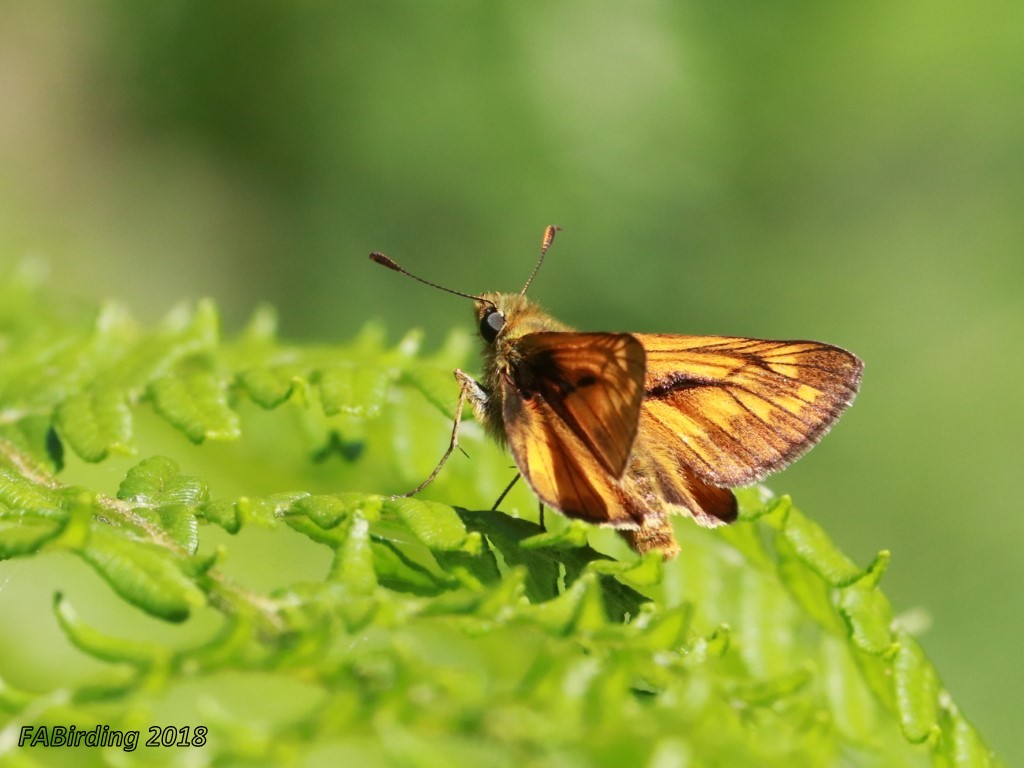
Essex Skipper
Although the number of Meadow Brown and Ringlet logged during weeks 16 and 17 have fallen they continue to be the top two annual recorded species for this transect.

Ringlet
Perhaps not unexpectedly for this oak woodland site the one species that has done exceptionally well this year is the Purple Hairstreak. On the 21 July I recorded 26 and last week I logged 43 with many other sightings away from the transect.

Purple Hairstreak


Just one Marbled White seen again in Section 4 last week.

Marbled White

Two other species that has definitely caught my eye this season are the diminutive Brown Argus with nine individuals recorded last week plus six Common Blue.

Common Blue - Female (left) Male (right)

Brown Argus

Over the last 17 weeks I have now recorded 1024 separate sightings of 21 species. This total to date far exceeds any of the previous three years annual counts BUT this does not infer that some of these flutters are doing well just that the recent lengthy period of warmer conditions has brought them out of hiding and made it easier to find and count them.

Linking to:

Saturday, 14 July 2018

Transect Update for Weeks 14 and 15.

My butterfly transect walk for week 14 was undertaken with temperatures around 25 deg.C and just before a short camping holiday in Kent when it soared well above 30 deg.C. On my walk last Monday (Week 15) the temperature was a more comfortable 23 deg.C.

Week 14 produced the highest count of 11 Large Skipper (above) so far this year.


Whilst I logged sightings of 9 Small/Essex Skippers I was only able to clearly identify 4 individuals as Essex Skippers (above).

As expected the most prominent species seen were Ringlets (above) with a total of 171 recorded over the two visits and Week 15 saw the emergence of the Gatekeepers (below). 


I recorded Large, Small and Green-veined Whites on both walks with the former producing 14 sightings and was also the only species that stopped long enough to be captured by the lens.

Large White.

I also recorded my highest count of 26 Purple Hairstreaks in Week 14 and the highest overall annual total so far of 39 easily exceeding any of the previous three years records. The White Admiral tally for this season stands at 40 to date and is double the sightings recorded over the last four years, 


Conversely sightings of Silver-washed Fritillary has so far been much lower than last year.

Three new species for this season were seen in the last two weeks:

Holly Blue.

Peacock.

A female Brown Argus. This is only the second time in four years that I have recorded this species on the transect.

Linking to:

Monday, 3 August 2015

Small and Essex Skippers.

Small Skipper (Male)

All transect walkers have been requested to make more effort in distinguishing between two very similar species, the Small and Essex Skippers, based on the following slightly different field marks.

Small Skipper: Undersides of the tips of the antennae are orange-brown. The male has a slightly curved, conspicuous sex brand on each of its upper fore-wings. both sexes are very similar.
Essex Skipper: Undersides of the tip of the antennae are black. The male has short, straight, inconspicuous sex brands.
Plus the females of both species are plain orange and the under-wings of both sexes are very similar.

So for me this is certainly not an easy task unless any individual is perched with its wings open and even then you may need a magnifying glass or a good view of the underside of the antennae through close focusing binoculars, which I don't yet posses. So wherever possible I often resort to grabbing a shot or two to review on the laptop later but even this approach doesn't always provide conclusive evidence.

The first three images are all of a male Small Skipper (Thymelicus sylvestris).


My identification of the next image, based on the underside colour of the antennae, is a female Small Skipper.


And finally just by way of comparison the last, somewhat grainy image is a male Essex Skipper (Thymelicus lineola) with a small, straight sex brand on the wing.

Both species should still be on the wing during August and I'm sure I'll have a few more tricky encounters to unravel their true identities! [All images shot handheld using 70-300mm lens with 1.4x converter]

Linking to:
Nature Notes hosted by Michelle; 
Through My Lens, a new meme hosted by Mersad.

Tuesday, 27 August 2013

Bookham Butterflies.


Just beyond this old gate on Bookham Common proved to be an ideal spot to watch and snap a few of our colourful butterflies during the past week.

 Common Blue [male] (Polyommatus icarus)

 Common Blue [female - blue form] (Polyommatus icarus)

 Small White (Pieris rapae)

Large White (Pieris brassicae)

 Essex Skipper (Thymelicus lineola)

Silver Y Moth (Autographa gamma)

 Brimstone (Gonepteryx rhamni)

 A very tatty Silver-washed Fritillary (Argynnis paphia)

Peacock (Inachis io)

Gatekeeper (Pyronia tithonus)

Other species seen were Small Copper, Meadow Brown, Ringlet, Small Tortoiseshell, Comma, Speckled Wood, a very out of place Chalkhill Blue with lots of Grasshoppers around my feet. I also enjoyed some of natures bounties, a few sweet and juicy Blackberries. I filled a bag to take home but they didn't last long with a dollop of ice cream ... scrumptious.  FAB.  

Wednesday, 4 July 2012

Grassland Flutters.

A very recent wander around the grassland and wildflower meadows within Horton Country Park on another windy day produced my first sightings this year of species that enjoy this particular habitat.
 Essex Skipper (Thymelicus lineola)
This little butterfly, first recognised as a new species in 1889, is easily confused with the Small Skipper (Thymelicus sylvestris) but the black tips to the underside of the antennae (orange-brown on the Small Skipper) is usually my only way of separating these two species .... but only after I've got a reasonably good image for comparison! The flight period is usually from the end of June until the end of August.

 Large Skipper (Ochlodes venata)
This species is our most widespread 'orange' Skipper; single-brooded with a normal flight season that starts in late May or early June, reaching a peak in mid-July and usually disappears by the end of August.
Large Skipper (Ochlodes venata)
 This male was resting and swaying in the breeze on Cock's-foot which is the caterpillar's main food plant.
 Meadow Brown (Maniola jurtina)
Probably the commonest and most widespread of our butterflies that is capable of flying on overcast days with a lengthy flight period from late may until October (depending on the weather conditions).

Two for the price of one! (Meadow Brown and a Skipper).

As all these species lay their eggs in a variety of grasses with their caterpillars (except the Essex Skipper) overwintering it is vitally important that not all tall grasses are cut at this vulnerable stage of the life cycle to ensure good numbers survive from year to year. Now all we and the flutters need is a good spell of dry, warm weather so that we can all enjoy the myriad of colours usually seen flitting around the meadows at this time of year.  FAB.

LinkWithin

Related Posts with Thumbnails