Showing posts with label Peacock. Show all posts

Saturday, 14 July 2018

Transect Update for Weeks 14 and 15.

My butterfly transect walk for week 14 was undertaken with temperatures around 25 deg.C and just before a short camping holiday in Kent when it soared well above 30 deg.C. On my walk last Monday (Week 15) the temperature was a more comfortable 23 deg.C.

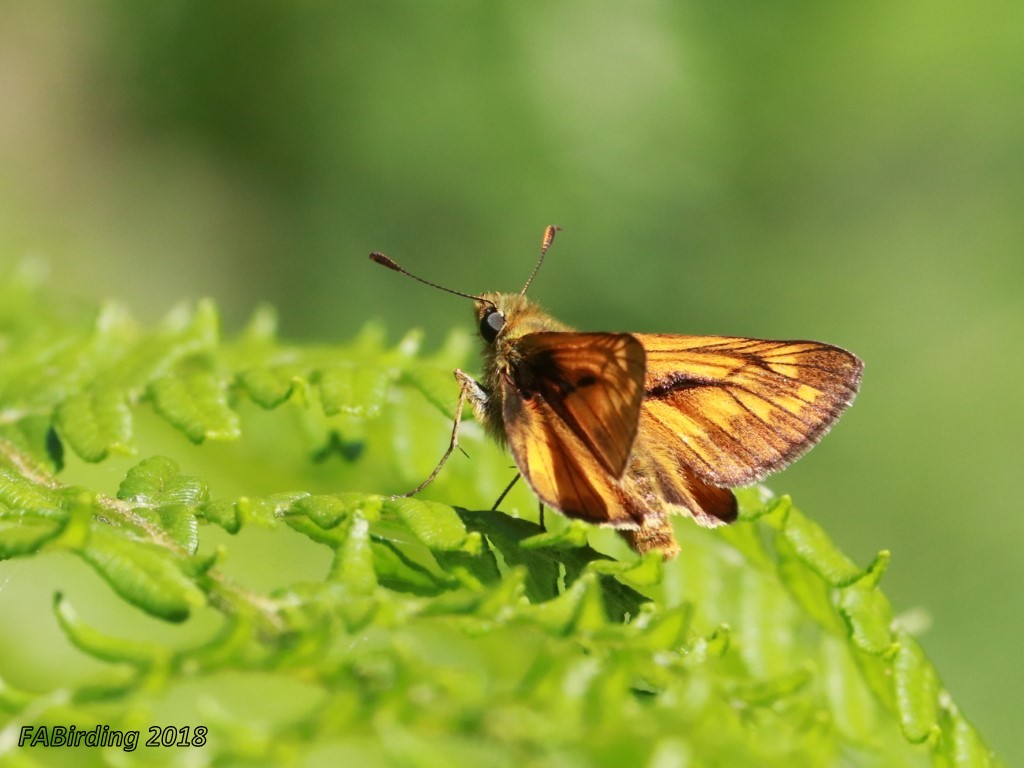
Week 14 produced the highest count of 11 Large Skipper (above) so far this year.


Whilst I logged sightings of 9 Small/Essex Skippers I was only able to clearly identify 4 individuals as Essex Skippers (above).

As expected the most prominent species seen were Ringlets (above) with a total of 171 recorded over the two visits and Week 15 saw the emergence of the Gatekeepers (below). 


I recorded Large, Small and Green-veined Whites on both walks with the former producing 14 sightings and was also the only species that stopped long enough to be captured by the lens.

Large White.

I also recorded my highest count of 26 Purple Hairstreaks in Week 14 and the highest overall annual total so far of 39 easily exceeding any of the previous three years records. The White Admiral tally for this season stands at 40 to date and is double the sightings recorded over the last four years, 


Conversely sightings of Silver-washed Fritillary has so far been much lower than last year.

Three new species for this season were seen in the last two weeks:

Holly Blue.

Peacock.

A female Brown Argus. This is only the second time in four years that I have recorded this species on the transect.

Linking to:

Saturday, 23 April 2016

Friday Flutters and Patch Birds.

During my patch walks this week the most obvious LBJ was the Chiffchaff with several pairs chasing one another while other singletons were either singing or busily searching for insects.


I have also completed my third weekly butterfly transect walk through the oak woodland on the north of Ashtead Common, hence the return of 'Friday Flutters'.
Due to the lower temperatures the variety and number of each species recorded was very low. Just three Brimstone, including this image of a resting female attempting to soak up as much warmth as possible from the limited sunshine.


The only nectar sources available have been the early flowering Bluebells and Lesser Celandine but this week the woodland floor was starting to come alive with large patches of Wood Anemone. The only other flutter recorded this week on the transect was the Peacock (below).


A Kestrel patiently surveys its surroundings in one of the large open woodland glades.

I always encounter a few of the very acrobatic Long-tailed Tits during my walks and have watched several still collecting nesting material.

Once again this week the three pairs of Lapwing on the fields at Rushett Farm were very vocal as they endeavoured to chase off any of the Carrion Crows that entered their territorial airspace.

Linking to:
Saturday's Critters
Nature Notes

Friday, 8 May 2015

Butterfly Transect Update.

Following up on a post last August entitled 'A New Transect for 2015' I am pleased to say that my offer to carry out a new butterfly recording transect on Ashtead Common National Nature Reserve, managed by the City of London Corporation, has now been confirmed. This involves a weekly stroll over a fixed route from April to September, a total of 26 weeks, in suitable weather between 10.45 and 15.45 to record the variety and numbers of species seen throughout each of the 8 dedicated sections.

Whilst I have carried out three surveys so far the weather hasn't been particularly brilliant with gusty winds on most days between 8-20 mph combined with temperatures barely acceptable for the flutters so it is perhaps not surprising that I have only recorded 7 species; Brimstone (6), Large White (3), Small White (3), Green-veined White (1), Orange Tip (6), Peacock (2) and Speckled Wood (6).

Speckled Wood


Peacock

Throughout the 500 acres (200 hectares) of Ashtead Common there are over 2,300 ancient oak pollards, many over 400 years old, which play host to a surprising variety of wildlife. Continual management is required to maintain the health of these veteran Oaks by reducing their crowns, clearing away the understory growth and where appropriate allowing younger trees to thrive so they can eventually take over from their forefathers.


In the open wooded pasture glades many old trees remain standing, weathered by the passage of time with shattered and torn limbs but continuing to play their part in the landscape as hideaways for numerous tiny creatures and nesting cavities for the birds and mammals.


During my most recent survey I noticed this sign stating that three weeks ago there had been six fires within the wooded pasture areas on the common all thought to have been deliberately lit. Fortunately through prompt action of the public and the Fire Brigade the overall damage was minimised.

I had previously seen evidence of a similar situation on my nearby birding patch at Epsom Common and have to wonder at the mentality of the idiots that  think this behaviour is acceptable.


Hyacinthoides non-scripta
Throughout the transect there are numerous patches of our native Bluebells and as soon as more wild flowers come into flower I'm sure other species of butterfly will be seen. One very majestic veteran that I walk pass is the King Oak which at the moment is still to come into leaf.

The King Oak

One species I was hoping to record along the transect is the Holly Blue but although I eventually found one resting it was seen elsewhere and therefore hasn't yet figured in the statistics.

Holly Blue

Linking to Saturday's Critters hosted by Eileen.

Friday, 17 April 2015

Friday Flutters.

Brimstone (Gonepteryx rhamni)
With the warmer temperatures the butterflies are beginning to show themselves during my regular wildlife wanderings so I thought it was time to resurrect 'Friday Flutters' to highlight what species I have been seeing.

During a patch walk at Epsom Common on 27th March I encountered at least 5 Brimstone on the wing throughout the open woodland. Unfortunately they weren't very cooperative when it came to getting any clear shots.


Just over a week ago at Tices Meadows I saw my first Small Tortoiseshell of the year but was unable to get any shots.

Typically the easily recognised Peacock has been on the wing locally since at least late February having awoken from hibernation. As you can see this individual is already well frayed around the edges!
Peacock (Inachis io)

Two weeks ago a Holly Blue dashed past me at Epsom Common Stew Pond and yesterday one was flying around the garden. Today, possibly the same female with its heavy black wing tips, was spotted by Anita in the garden resting on a rose leaf so I couldn't pass up the opportunity of a few shots and more images will be posted on FABirding.

Holly Blue [female] (Celastrina argiolus)


During an early morning patch walk today I came across at least 15 Bee Flies with their very distinctive hairy body and long proboscis resting at the edge of a dry path.
Bee Fly (Bombylius major)

And my other first sighting was a Specked Wood resting on the leaf litter in the woodland.

Speckled Wood (Pararge aegeria)
Linking to Saturday's Critters hosted by Eileen.

Friday, 25 July 2014

Boots still walking.

Exactly four years ago I published a post entitled 'Boots are made for ....' and reported on the wildlife I encountered on a particular walk so I thought it would be interesting to repeat the walk, which I did today, and review any changes. Well, of course, the boots have changed ... the others wore out some time ago but my shadow is still the same! However the introduction to the original post (see below) is still relevant today.

"These boots are made for walking, and that's just what they'll do".

The repeated lyrics of the well known song by Nancy Sinatra released in 1966, when I was somewhat younger, and subsequently covered by many other artists including Jessica Simpson's own rewritten version. The rest of the original lyrics bear no relationship to my daily life but without boots I wouldn't have got anywhere. As a youngster I explored the local common and woodlands; as a teenager I hill-walked (often with my father in places such as the Brecon Beacons), hiked, rock scrambled and even climbed a bit with a close friend (Snowdonia, North Wales in the depths of a snow and ice filled winter was fun); I cycled a lot (even owned a tandem for a few years which won the heart of one young lady ... for a short time!) and also canoed along various rivers and canals; then car ownership enabled me to explore other parts of the UK testing the boots over mountains,  moorlands, valley floors, clifftops and beaches. In more recent times the boots now usually carry me over less treacherous terrain as I stroll here and there often stopping to watch our native wildlife or to just soak up my surroundings at a much more leisurely pace.

So are you ready boots? Start walkin'! An anti-clockwise circuit of Banks Common (connected to Bookham Common which has featured in numerous posts). The first thing I notice is that the vegetation is a lot thicker and higher than July 2010 as a Great-spotted Woodpecker repeatedly utters its distinctive 'kick .. kick' call and a male Blackcap flies across my path while a Goldfinch converses with its companions beyond my immediate view. The PowerShot SX50 HS focuses on the first of numerous Gatekeepers nectaring on Lesser Burdock. 

As I head towards the bridge a passing dog walker advises me that the path ahead is very overgrown and muddy underfoot .. I'm not deterred, I'm wearing boots! I am however conscious of the ever present danger of being stung by the overhanging large nettles as a tiny insect takes a nip somewhere above my bare ankle. As in the past the hedgerows were full of Bindweed, their white trumpets glowing like light bulbs amongst the dark green foliage where a 2nd brooded Small White Butterfly was resting. Natures colour palette of  greens, blues, purples, yellows and reddish-browns was provided by Teasels, Bittersweet, Tufted Vetch, Agrimony, Tansy, Grasses, Thistles, Ragwort, Honeysuckle and Common Sorrel just to name but a few.

Silver-washed Fritillary where thin on the ground with only two individuals seen during my whole walk. With the relatively high temperature I was glad of the shaded areas throughout my walk but they afforded little in the way of wildlife activity. However as soon as the view opened up that changed dramatically

On the opposite side of the meadow a single Common Buzzard drifted above the tree line constantly issuing its mewing 'piiyay..piiyay' call while Large Skippers, Meadow Browns and Common Damselflies rested nearby. The fence post is still standing but the moss has invaded its crown.

The view over the style hasn't changed but in the opposite direction the hay field has long since been converted into horse paddocks for expensive bloodstock. At this point I heard the calls of both a Chiffchaff and a distant Nuthatch as a number of Blue Tits flitted through the hedgerow. I also noticed that a Dragonfly had landed 15 feet high up on a bare branch but totally inaccessible for a photo. Using my bins I ascertained it was a Common Hawker and then a Ladybird landed and without a 'by your leave' hitched a ride on my arm for a while.

There were one or two fresh Brimstone getting a nectar fix.

Surprisingly I didn't come across any horse riders during this leisurely stroll but I did watch a Kestrel hunting on the far side of the meadow for over 15 minutes, constantly dropping into the long grass and then rising up again to hover while looking for a tasty meal. I think it was eventually sucessful as it flew to its regular tree and didn't reappear. 

During the walk I saw several male Darters frantically chasing one another during their territorial battles and towards the end of my circuit I found one male Ruddy Dater taking a well earned rest.

As I returned to my vehicle the final wildlife colours were provided by a beautiful Peacock showing off its brilliant upper wing patterns and its cryptic under wing camouflage.

In conclusion, a few changes to the landscape, a lack of sightings of any White Admiral butterflies (a typical scenario on most of my recent forays) and certainly fewer birds seen or heard with the notable absence of any colourful Yellowhammers. 

However one thing doesn't change ... on my exit route the traffic on the 'magic roundabout' (M25) was at a standstill but the trains were still running!  


I make no apologies for the length of this post but do hope you will join me again sometime when the boots go walkin'. FAB.

Linking to Saturday's Critters hosted by Eileen.

Sunday, 29 June 2014

Follow the Leader.

Last week I joined two walks organised by the Surrey and South West London Branch of Butterfly Conservation.

The first was to Mitcham Common, a previously unvisited location for me. The original oak woodland was cleared with the arrival of early Neolithic people, and subsequently kept open and infertile through agricultural practices such as grazing. Due to the nature of the underlying gravels, the inherent soil is largely acidic and infertile. In the early 19th Century the gravels were extracted for road building leading to the creation of Seven Islands Pond amongst others. During the 20th century some of the ponds created by gravel extraction were filled in between the wars and ploughed for agriculture to aid the war effort. Also during the mid to late 1900s areas were used as landfill for inert waste. This destroyed parcels of valuable wet habitat, and irrecoverably altered the hydrology and topography of the Common, now a mosaic of grassland, acidic heath and pockets of mixed woodland. 

Mitcham Common - Images courtesy of www.geograph.org.uk

The leader was Malcolm Bridge and during a two hour stroll the group saw 14 species. Part of our time was spent searching for a rare species, the White-letter Hairstreak, in a small area containing a few young Elms. I managed a brief glimpse of a perched individual through my bins before it disappeared into the high canopy. 


For the next 20 minutes or so the group scanned the canopy often suggesting that they had a number of brief sightings but when I took a few shots of a wing above a leaf some 40 feet overhead it turned out to be a Holly Blue!


After the walk finished I took a stroll around the grasslands behind the Mill House Ecology Centre and added Small Copper and several Marbled Whites to my list.

Cinnabar Moth Caterpillars on Ragwort, Comma and Small Copper.

The second walk was led by Francis Kelly at Whitmoor Common which comprises a series of sandy heathland pockets surrounded by woodland. The commons were once grazed by the commoners' stock which helped maintain the open aspect but since the cessation of these rights and traditions, the commons have increasingly become prone to afforestation by the natural invasion of Scots pine and silver birch. 

A large pond in the centre of the common is a major focus for dragonfly activity in the area, with 19 species being recorded in or around the vicinity of the pond itself.

Male Broad-bodied Chaser.
I recorded Emperor, Four-spotted and Broad-bodied Chaser, Black-tailed Skimmer plus Common and Azure Damselflies. Downy Emerald is another specialist species found here .. typically found in the shaded areas under overhanging vegetation, but not seen on this occasion.
My bird sightings included Common Buzzard, Kestrel, Blackcap, Willow Warbler, Jay, Wren, Blackbird, Linnet, Stonechat and on the pond, Mallard plus Little Grebe feeding its chick.

In the woodland caterpillars of the Peacock butterfly were busily feeding on Common Nettle, their main larval food-plant .


The main attraction out on the open heath was the tiny Silver-studded Blue. I had previously seen this species on Thursley Common but was hoping for some better images

My first sighting was a dark brown female who wouldn't stop for a photo call and then a handful of males were spotted during our lunch stop and one individual basked long enough for a few shots.


 Male Silver-studded Blue (Plebeius argus) [Shot using PowerShot SX50 HS and cropped]

I logged 16 species throughout this walk but I believe the groups total was probably higher. I might join a few more of these field trips over the coming weeks if only to improve my knowledge of the different butterfly habitats and the chance to add to my image portfolio.   FAB

LinkWithin

Related Posts with Thumbnails