Showing posts with label Little Egret. Show all posts

Saturday, 20 October 2018

Coastal Surprise.

During a very recent camping holiday in the New Forest we made a visit to Keyhaven Marshes and spent a few hours wandering along the coastal path.

Pied Wagtail

Numerous individuals were seen feeding and flying around the muddy margins at Keyhaven harbour.

One of two Northern Wheatear seen along the shoreline feeding up before continuing their southerly migration.


Little Egrets - Fishing and flying.


Black-tailed Godwit

The inland pools produced sightings of various waders including Redshank, Greenshank, Dunlin, Black-tailed Godwit and a very brief visit by a Temminck's Stint but the most exciting sighting was of two juvenile Grey Phalarope.

[Juvenile - 1st Winter] Grey Phalarope (Phalaropus fulicaius)

This small wader, similar in size to a Dunlin, is listed in most guides as a Red Phalarope but commonly referred to as the Grey. Distinguished from its close relative, the Red-necked, by its slightly thicker bill and pale grey scapulars.


Linking to:
Saturday's Critters


Tuesday, 14 March 2017

Farlington Marshes Fieldtrip.

On Sunday I drove southwards to lead a Surrey Bird Club field trip at Farlington Marshes.

The weather forecast was not promising with heavy rain predicted for most of the morning but fortunately this failed to materialize with any significance. Under an overcast sky and light drizzle just two members, Trevor and Victoria, joined me at 9am for the planned walk around the reserve.

High tide was due at around 11.30 so we started by scanning the extensive mudflats locating numerous Dark-bellied Brent Geese plus good numbers of Shelduck that traditionally overwinter around Langstone Harbour. Small groups of Northern Pintail with the elegant males in their full finery were spotted together with a few waders; Dunlin, Grey Plover, Redshank, Black-tailed Godwit, Oystercatcher and Curlew.

As the tide rises the Brent Geese leave the harbour to fly into the grazing marsh.

Heading inland towards the stream the first of several Cetti’s Warblers boldly called from the nearby vegetation, typically moving ahead of us out of sight! Amongst a small group of gulls we found two Mediterranean Gulls enabling a clear comparison with their Black-headed companions. A few Lapwing briefly appeared in the sky above the reed bed. Due to the damp conditions, not surprisingly, we failed to see any Bearded Reedlings near the information building where we sheltered briefly from the constant drizzle. At this point Victoria unfortunately decided it was time to return home.

The sun eventually tried to make an appearance and the drizzle finally abated so under a lightening sky and hopeful for an interesting afternoon Trevor and I walked out to rejoin the sea wall path.

Oystercatchers flying across the harbour. This image was taken just a week earlier under better lighting conditions.

With flat calm waters on the falling tide we finally spotted a small flotilla of Red-breasted Merganser, a single female Goldeneye and Great Crested Grebe. An LBJ flitting through the field edge shrubbery was eventually identified as a Chiffchaff. Walking towards The Deeps we added Wigeon, Shoveler plus a distant perched Kestrel eating its prey.

Another image shot a week earlier shows a collection of waders; Dunlin, Grey Plover, Turnstone and Knot: taking refuge on a tiny reducing island at high tide.

At the Deeps, a winnowing Little Grebe failed to make an appearance but a pair of Reed Buntings and Tufted Duck were added to our day list. Several more Skylarks were seen and heard. Having earlier heard a Meadow Pipit calling in flight we located 2 Rock Pipits feeding in and out of the grass margins on the sea wall path.

At around 1.30pm while watching various flocks of waders moving out across the harbour I turned around only to find a Short-eared Owl hunting over the Point and then disappearing out of view. We retraced our steps and relocated this individual sitting on a fence post before it eventually flew of east towards North Binness Island.

Chatting to another birder helped us to get scoped views of a preening Spoonbill at the back of the distant reed bed. A definite rarity for this site and an excellent addition to the trip list. Shamefully I had previously spotted and discounted an unmoving white blob well-hidden way out in the grass as probably a plastic bag!!

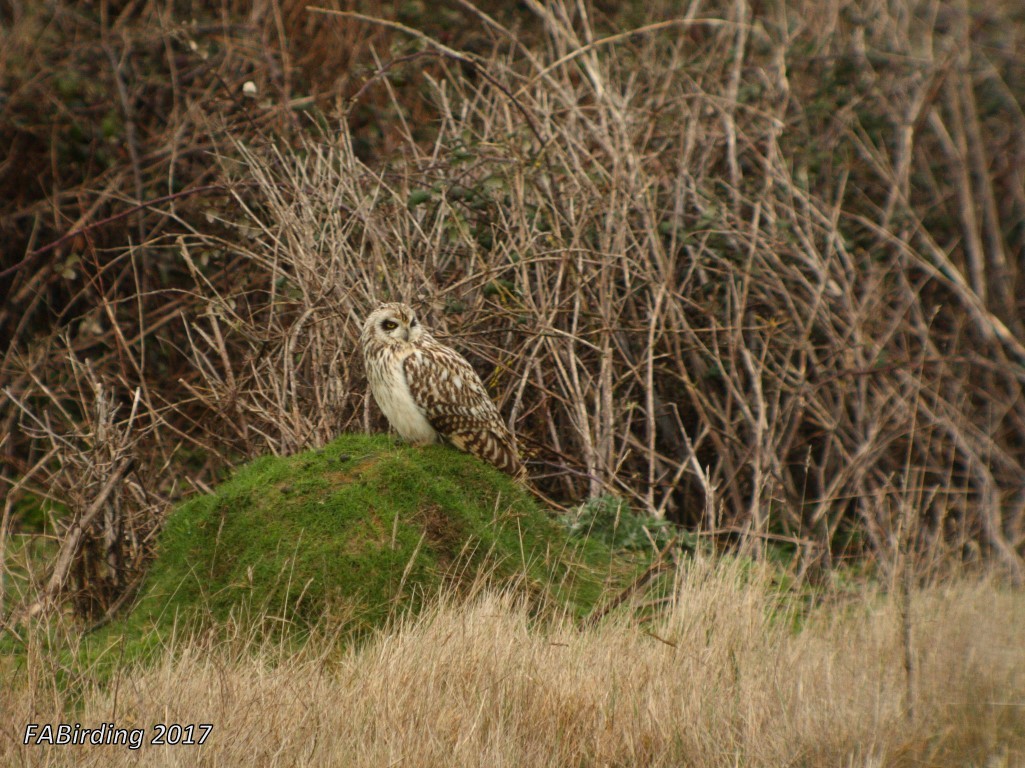
Moving further around the Point and thinking that having seen one ‘Shortie’ was a bonus we were delighted to have even closer views of a second bird who after briefly flying around perched on a grassy mound allowing for another photo opportunity.


Short-eared Owl. 

Returning full circle back to the main pool we enjoyed close views of a feeding Little Egret and Common Snipe and logged 5 Greenshank and a single Spotted Redshank in its typical grey winter garb.

Little Egret.

My thanks to Victoria and Trevor for their company and making this a worthwhile trip to the coast with a final tally of 60 species. FAB.

Linking to:
I'D-Rather-B-Birdin'

Sunday, 10 July 2016

Pagham North Wall.

A week ago we decided to drive to the south coast and took a very leisurely stroll along the North Wall overlooking the expansive waters of Pagham Harbour.

One of a number of Swallows taking a rest from chasing insects above the horse paddock behind the harbour wall. Other insect feeders on the wing were Sand and House Martins plus a few Swifts high in the sky.

Unfortunately our arrival coincided with the high tide so most of the bird life was somewhat distant but we managed to spot various waders including Oystercatcher, Curlew, Dunlin, Turnstone and Grey Plover.

A few areas of vegetation remain visible at high tide and one held 26 Little Egrets waiting for the waters to recede.
It is interesting to remember that back in the 1980's I would have been fortunate to catch sight of just one of these delightful birds anywhere around the harbour; such has been their breeding success during the last 25 years.

One Little Egret was still working the reed edge for food on one of the inland pools. We heard the distinctive call of Cetti's Warbler and followed its flight from one hidden perch to another deep within the field edge vegetation where a Common Whitethroat (below) was also located.

 Common Whitethroat.

While listening to the calls of Reed Bunting and Sedge Warblers, that typically failed to show themselves, we watched a number of Grey Herons (above) erupt from their heronry site before resettling a few minutes later followed shortly thereafter with the fly past of a Little Egret (below).

The final photo capture on our return walk was of a Roe Buck in the field beyond the harbour wall. Despite the distance between us he was very aware of our presence.

Linking to:

I'D-Rather-B-Birdin'
Wild Bird Wednesday.

Saturday, 19 March 2016

More Coastal Birding.


Whenever we visit my father-in-law on Hayling Island I usually manage to wangle an hour or two to wander part of the shoreline overlooking Langstone Harbour and yesterday I was able to extend my time by walking part of the 'Billy Trail'. With the tide well on the ebb most of the waders; Curlew, Godwit, Redshank, Dunlin, Grey Plover and Knot; were specks out on the expanding mudflats with large numbers of Brent Geese also seen flying to other parts of the harbour.


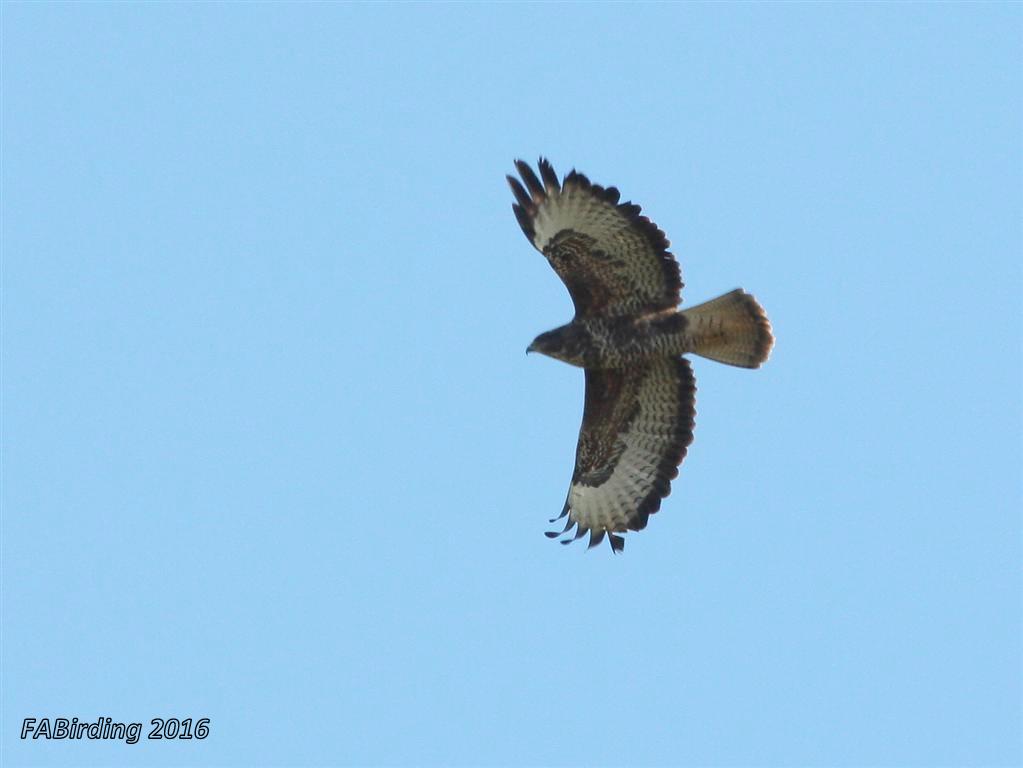
Looking inland this Little Egret was sitting quietly by the edge of a stream that crosses one of fields which is also often frequented by a Kingfisher but no sighting during this walk. A Common Buzzard (below) made a brief appearance overhead before disappearing beyond the nearby woodland.


With little else catching my attention I retraced my steps and made my way towards the old Oyster Beds with the strident calls of hundreds of gulls increasing in volume the closer I got to their nesting site. A month ago there were just a handful of Black-headed and one or two Mediterranean Gulls but now the colony was alive with activity as they jostled one another for their allotted spaces.

I will feature some additional images taken of the Mediterranean Gull in a separate post very soon. 

Close to the path I disturbed a Rock Pipit while out in the harbour I also spotted a pair of Shelduck and a single Red-breasted Merganser.


One of a pair of Brent Geese wandering around the edge of the tidal pool and close by a couple of Oystercatchers (below) were seeking out morsels from the muddy margins.


Now if my visit yesterday had coincided with a high tide I might well have experienced the joy of watching mixed gatherings of thousands of waders; usually Dunlin, Grey Plover, Redshank and Knot; taking refuge on the much depleted shingle shoreline. The images below were taken just about a month ago.

Linking to:
Saturday's Critters
I'D-Rather-B-Birdin'

Saturday, 12 March 2016

Coastal Birding.


Today I am raiding the recent archives for some more images of the birds seen during my visits to the coastal marshes around Langstone Harbour last month.


I enjoy watching large numbers of any species and the overwintering Dark-bellied Brent Geese always put on a good display as they fly in from their tidal roost to feed on the grazing marsh. Their gargling, guttural calls are very distinctive as they chatter amongst themselves while feeding. 

A very dapper looking goose.


The evocative call of a Curlew is another common sound as it passes overhead to seek out another feeding location.

A pair of Common Buzzard make a brief appearance, lazily floating above the marsh.


A lonesome male Teal makes its way across the harbour at high tide.


Little Egrets fly in and out of the reed fringed pools where they can be seen waggling their bright yellow feet to disturb their likely prey.

Linking to:
Saturday's Critters

Tuesday, 8 March 2016

Little Egret.


I distinctly remember my first UK coastal sighting of a Little Egret (Egretta garzetta) in the early 1980's when it was considered a rarity but now it would be a poor days birding if you failed to see any number both at the coast and many inland sites. All these images were taken during late February at Farlington Marshes LNR.

I'm always amazed at the patience these birds display while waiting for the right time to strike.

The moment of impact.

Time to move on and find a better feeding location!

Linking to: Wild Bird Wednesday.

Friday, 26 February 2016

Farlington Marshes LNR.

On Sunday (28 Feb) I will be leading a field trip for the Surrey Bird Club (SBC) to Farlington Marshes LNR that comprises around 300 acres of coastal grazing marsh, reed beds, scrub, with both freshwater and brackish pools. The land was first reclaimed from Langstone harbour between 1769 and 1773 by building a clay and timber wall to provide grazing land for cattle. The sea wall has been much improved and provides an ideal route around the reserve to view the wildlife both within the marshes and on the sea or extensive mudflats at low tide. 


On Tuesday I made a recce visit to check out the wildlife and to get some images of the species that can be seen here just in case the windy weather that is forecast for Sunday doesn't provide me with many photo opportunities.

During the winter months one of the main attractions are the very large flocks of Dark-bellied Brent Geese that feed on the grazing marsh.

At this time of year the marsh also supports good numbers of Curlew, Northern Pintail, Oystercatchers, Lapwing and Teal plus I was also fortunate to get several sightings of two Short-eared Owls.

During my recent visit I also saw three species of Grebe, Red-breasted Merganser, Shelduck, Shoveler, Wigeon, Gadwall, Dunlin, Redshank, Grey Plover, Knot and Turnstone plus good numbers of Black-tailed Godwits (see below) disturbed from feeding by a low flying Common Buzzard.


At high tide I also watched the spectacle of many hundreds of Dunlin streaming close above the water seeking out a suitable spot to roost and wait for the mud to reappear while inland there is always something else to capture one's attention such as ....

a perching Stonechat, one of many Northern Shoveler in their full breeding plumage and the various gull species including the Black-headed Gull. The site also hosts reasonable numbers of Little Egret (see below).

During my wandering I logged about 50 species but with more eyes on Sunday it is possible to add a few more including Kingfisher, Peregrine, Merlin, Water Rail, Rock Pipit, and the elusive Bearded Tits. FAB.

Linking to: Saturday's Critters, I'D-Rather-B-Birdin' and Through My Lens.

Friday, 20 March 2015

Little Egret.


A few images of Little Egret (Egretta garzetta) taken during a couple of recent coastal visits around Langstone Harbour.

They are fascinating to watch as they stealthily walk their fishing patch often shaking their totally immersed yellow feet to disturb likely prey.


Total concentration as its eyes search for a possible snack above the very still water.


I included these last two shots as I liked the way the ripples it created broke up its reflection. FAB.

Linking to Weekend Reflections and Saturday's Critters.

LinkWithin

Related Posts with Thumbnails