Showing posts with label Mediterranean Gull. Show all posts

Monday, 21 March 2016

Mediterranean Gull.


During my visit to the old oyster beds on Hayling Island last week I finally managed to get some distant (cropped) shots of the Mediterranean Gull.

This east European seabird, once a rare visitor to the UK, has now become a widely established and nesting species after a somewhat long slow start. Its initial westward range expansion mainly occurred throughout the 1960's and 1970's with the first British breeding record on the south coast in 1968. However 20 years later there were only 16 nesting pairs which doubled by 1993 and in 2013 our summer population estimates were 600 pairs but with much larger winter visitor numbers. My first recorded sighting was in the Spring of 1996.

They are often found in the company of slightly smaller and less robust Black-headed Gulls, (two in the forefront above) which ironically have chocolate-brown summer hoods whereas the whiter-winged Med Gull actually has a jet black head during the nesting season, hence its scientific name Larus melanocephalus. 


Linking to:

Saturday, 19 March 2016

More Coastal Birding.


Whenever we visit my father-in-law on Hayling Island I usually manage to wangle an hour or two to wander part of the shoreline overlooking Langstone Harbour and yesterday I was able to extend my time by walking part of the 'Billy Trail'. With the tide well on the ebb most of the waders; Curlew, Godwit, Redshank, Dunlin, Grey Plover and Knot; were specks out on the expanding mudflats with large numbers of Brent Geese also seen flying to other parts of the harbour.


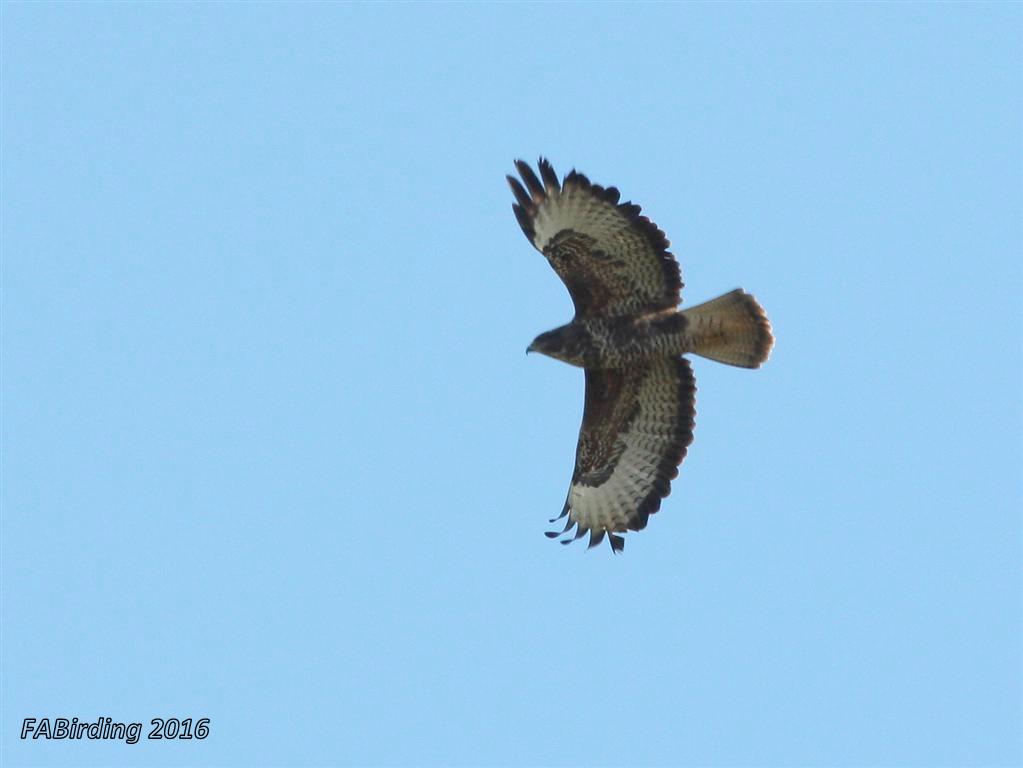
Looking inland this Little Egret was sitting quietly by the edge of a stream that crosses one of fields which is also often frequented by a Kingfisher but no sighting during this walk. A Common Buzzard (below) made a brief appearance overhead before disappearing beyond the nearby woodland.


With little else catching my attention I retraced my steps and made my way towards the old Oyster Beds with the strident calls of hundreds of gulls increasing in volume the closer I got to their nesting site. A month ago there were just a handful of Black-headed and one or two Mediterranean Gulls but now the colony was alive with activity as they jostled one another for their allotted spaces.

I will feature some additional images taken of the Mediterranean Gull in a separate post very soon. 

Close to the path I disturbed a Rock Pipit while out in the harbour I also spotted a pair of Shelduck and a single Red-breasted Merganser.


One of a pair of Brent Geese wandering around the edge of the tidal pool and close by a couple of Oystercatchers (below) were seeking out morsels from the muddy margins.


Now if my visit yesterday had coincided with a high tide I might well have experienced the joy of watching mixed gatherings of thousands of waders; usually Dunlin, Grey Plover, Redshank and Knot; taking refuge on the much depleted shingle shoreline. The images below were taken just about a month ago.

Linking to:
Saturday's Critters
I'D-Rather-B-Birdin'

Sunday, 13 March 2011

Gulls Galore.

A drive southwards to Hayling Island on Friday to visit Anita's parents provided an opportunity for me to take a stroll at the disused Oyster Beds.

The early 19th century was probably the hey day of the Hayling Island oyster beds but in 1902 when new drainage / sewerage pipes were laid to meet increasing housing development the outfall into the harbour nearby caused major pollution and the oyster business failed. In the 1980's a large volume of rubble was 'dumped' into the beds. Many of the 'bunds' have been breached so nearly all of this previously protected area is now tidal. 

Despite high tide being some hours away there was very little on the water apart from two species of gulls: the more common Black-headed (Larus ridibundus) [bottom RH image] which is poorly named as in breeding plumage it has a dark chocolate brown head and the gull that does sport a black head, the MEDITERRANEAN (Larus melanocephalus) plus a thicker and blood red bill with its distinctive white eye. When this species stretches its head the black cap can appear to extend much further down the neck.

With a very strong westerly wind I attempted a couple of digiscoped shots [above and below] of  the Meds out on the closest bund and  estimated that at least 30 individuals were encamped on this rubble island and constantly moving the Black-headed Gulls away from their space. 


Eventually an opportunity arose to capture this special species in flight with the DSLR and 70-300 lens.


Other species sighted included Grey Heron, Little Egret, Cormorant, Mallard, Red-breasted Mergansers, Little Grebe, Oystercatcher, Redshank, Greenshank, Common Ringed Plover, Turnstone, Grey Plover, Curlew and the usual Dark-bellied Brent Geese plus Kestrel, Crow, Magpie, Greenfinch, Mistle Thrush and Great Spotted Woodpecker.   FAB.

Monday, 9 February 2009

Pagham - 'Friends United'.

On Sunday Anita and I travelled to Pagham to meet up with Tony & Jean, Trevor plus Keith & Sue (they emigrated south-west to Somerset some years ago but make an annual visit back to Surrey to see relatives at this time of year). When the others arrived I was already scoping Gulls & Waders on the shingle spit at the harbour entrance enjoying good, if long distance views, of Mediterranean (min x 14), Black-headed & Herring Gulls plus a large high tide roost of Knot, Turnstone, Redshank plus a few Oystercatchers and a Little Grebe in the channel.

Mediterranean Gull
After a quick catch up and introduction to Hugh (Keith's nephew-in-law) we commenced our walk around The Lagoon towards the North Wall after seeing Greenfinch, Dunnock & Kestrel. The lagoon produced Common & Great Black-backed Gulls, Goldeneye (2 females), Wigeon, Teal, Mallard, Moorhen, Tufted Duck and numerous Coot (not Tony's favourite!) using their extraordinary feet to walk, sometimes not too elegantly, across the frozen water. Tony & I had a brief view of a Sparrowhawk dashing over the reeds and then disappeared into the Caravan Park [not seen by the others who were probably chatting!]
Coot on thin ice!
Brent Geese were moving around and 30+ were in the field beyond the Caravan Park plus a large flock of Linnets (40+), highly mobile and only perching briefly. We scanned for any interlopers in the flock but only found another group of Reed Buntings (12+) in the same area [I've not seen that many together before] plus a few Chaffinches (mainly females). Grey Plover scoped through a gap in the hedgerow.
Grey Plover
Blue Tit, Long-tailed Tits (2), Dunnock, Magpie, Woodpigeons and a watchful Robin seen just before we walked onto the North Wall.
From the embankment we had excellent views of Brent Geese feeding in the fields with Curlew, Lapwing, Starlings, Carrion Crows & Golden Plovers plus two Pheasants and a single Meadow Pipit. Hugh located Common Buzzards (3) soaring at long distance and in the harbour as the tide turned there were Black-tailed Godwit, Grey Plover, Dunlin, Redshank, Knot & Shelduck together with the usual ducks including Northern Pintails. Just after everyone decided it was time to return to the cars for lunch I found a Spotted Redshank feeding in a channel exposed by the falling tide. Unfortunately with the sun in my face it was impossible to get anything but a record photo. [Was this the same individual that we saw on 1st Jan?]
Spotted Redshank
Trevor 'concentrating' on keeping an accurate record!
Have the others seen the Spotted Red?
As we started to leave the North Wall something upset all the birds & we had excellent views of the oo's of Brent Geese & various waders flying around and then settling back on the exposed mudflats.
Brent Geese - synchronised flying
The return journey was fairly uneventful apart from me slipping in the deepening mud as the tide receded and ending up on my knees in order to keep bins, scope & camera from being damaged - just my pride & wet, muddy trousers!
After eating our packed lunch we walked out to view the spit so that the others could catch up with the Med Gulls and also added Common Ringed Plover & Grey Heron to my list which totalled 51 for the day. With a dramatic change in the weather - rain coming in from the west we all made our own ways back home to Surrey.

LinkWithin

Related Posts with Thumbnails