Showing posts with label Birds. Show all posts

Thursday, 7 March 2019

Black-throated Diver.

A couple of weeks ago I drove southwards to Mercers Lake, part of the Holmthorpe Sand Pits complex to see if I could catch up with a juvenile Black-throated Diver that had been reported there for some time.
My initial sighting was very distant and this individual never came closer than 100 yards so all the shots posted have been cropped.

Black-throated Diver [juv] (Gavia arctica)

After two partial circuits of the lake, frequently diving for long periods, it reappeared on the south side and spent some time preening before heading away for another diving session.


A nice addition to my 2019 list. FAB.

Tuesday, 13 November 2018

Great White Egret.

I had noted reports of a Great White Egret frequenting Penn Pond in Richmond Park over the past couple of weeks so took the opportunity today to pay a visit. Whilst I had good views through the bins the subject was at extreme range for my lens but here are a few record (cropped) shots.


A nice addition to my Surrey life list.  FAB.

Saturday, 20 October 2018

Coastal Surprise.

During a very recent camping holiday in the New Forest we made a visit to Keyhaven Marshes and spent a few hours wandering along the coastal path.

Pied Wagtail

Numerous individuals were seen feeding and flying around the muddy margins at Keyhaven harbour.

One of two Northern Wheatear seen along the shoreline feeding up before continuing their southerly migration.


Little Egrets - Fishing and flying.


Black-tailed Godwit

The inland pools produced sightings of various waders including Redshank, Greenshank, Dunlin, Black-tailed Godwit and a very brief visit by a Temminck's Stint but the most exciting sighting was of two juvenile Grey Phalarope.

[Juvenile - 1st Winter] Grey Phalarope (Phalaropus fulicaius)

This small wader, similar in size to a Dunlin, is listed in most guides as a Red Phalarope but commonly referred to as the Grey. Distinguished from its close relative, the Red-necked, by its slightly thicker bill and pale grey scapulars.


Linking to:
Saturday's Critters


Saturday, 16 June 2018

Fast Fliers.

In a recent post "Thursley Common-Residents and Migrants" I promised some more images of  a migrant falcon that is known for its exceptional aerial acrobatics.

The Hobby (Falco subbuteo) that regularly catches and eats its insect prey on the wing.

At a distance it appears sickle-like in flight, often resembling a Swift when gliding with folded wings and can easily reach speeds up to 100 mph.

Its aerial agility also enables it to catch birds in flight, particularly hirundines, and I have, over the years, witnessed individuals chasing and catching both House Martins and Swifts.

Whilst not as agile as the Hobby, the Common Swift (Apus apus) is thought to be the fastest species in level flight; recorded at 111.6 km/h or 69.3 mph. I captured these images above my parents house earlier this week where for many years three pairs have nested and reared their youngsters.

Amazing to know that they feed and sleep on the wing and almost never land except at their nest sites. Swifts can't fly in wet weather in the UK so they fly around storms to find dry areas and is thought to be the only UK bird to adopt this method.

Linking to:
Saturday's Critters
I'D-Rather-B-Birdin'

Saturday, 2 June 2018

In, Around and Above the Stew Ponds.

It has been many months since I posted any information about the bird life on my local patch so here are some images of a few of the 50 or so species I have seen so far this year frequenting the Stew Pond and surrounding area.

 Grey Herons are daily visitors, patiently waiting for a tasty meal to swim within their reach.


Cormorants turn up fairly regularly to fish the Great Pond often spending a lot of time sitting around doing nothing!

I have recorded Tufted Ducks annually over the last ten years. Evidence of breeding over that period has been spasmodic and the youngsters rarely survive due to predation ... there are some extremely large fish in the pond!


Again the Mandarin Duck has been an annual breeding species with sighting from January through to August. Until two years ago it was not uncommon to record up to 15 males courting just one or two females through January into March but I believe increased  disturbance from dog walkers has affected this and other species greatly in the last two years. This year I only saw one male on 5 April.


Egyptian Goose is a very infrequent visitor but a pair turned up on the island on 5 April. Unfortunately the pond plays host to quite a few pairs of breeding Canada Geese who are extremely territorial so other geese species don't tend to hang around for long like pairs of Greylag Geese who dropped in briefly between the 8th and 15th May.

 Common Buzzard nests locally so it is not unusual to see at least one or two flying around.


A selection of migrant warblers can be found in the surrounding area including good numbers of Chiffchaff. Others include Blackcap, Common Whitethroat, Garden Warbler and I have recorded Willow Warbler on the common for the last 6 years during April into early May but they don't seem to stay. Just one male seen and heard singing close to the Stew Pond on 1 May this year.

The Jay is not the most common corvid locally but certainly the most colourful. Typically very wary of humans this individual was very confiding ... for a few minutes.

Linking to:

Sunday, 28 May 2017

Birding on Lake Kerkini, Greece (Part 1).


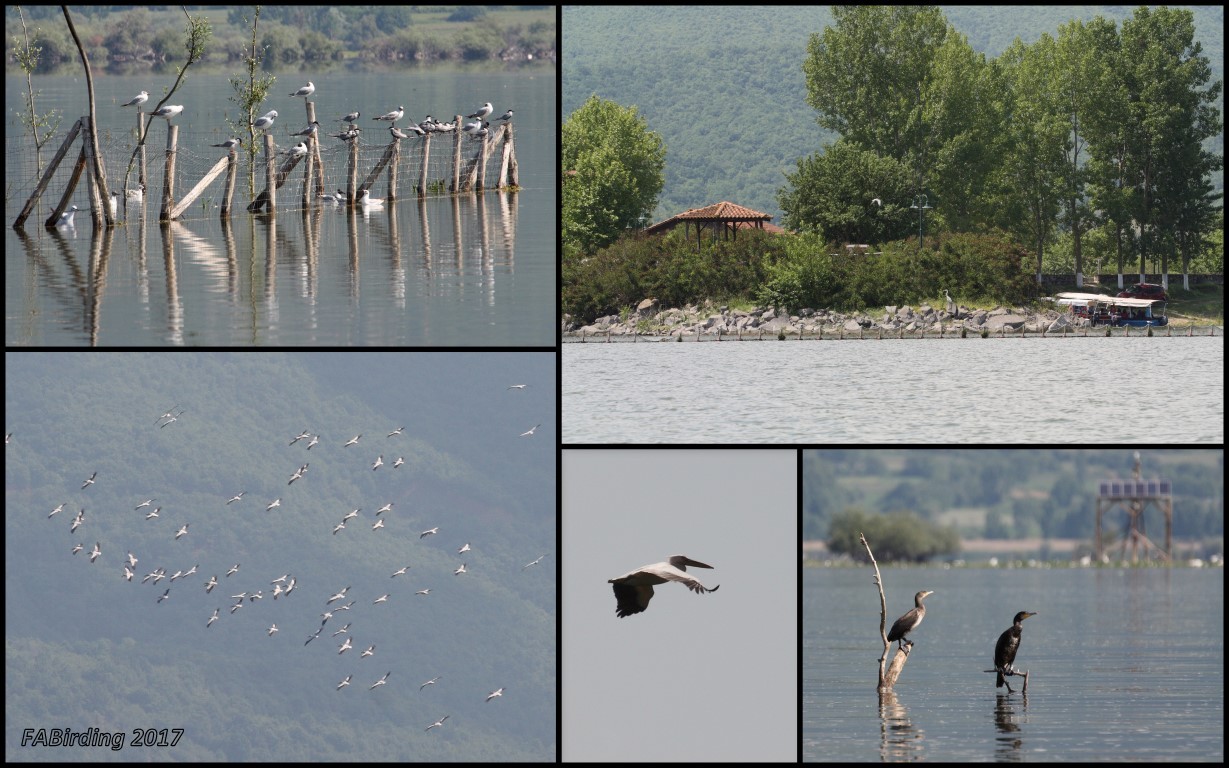
One of the highlights of our week in Northern Greece was a morning excursion across Lake Kerkini to the drowned forest to view the various birds that regularly visit and nest on this important wetland habitat.


Brief history of Lake Kerkini.
Historically the lake fed at it’s north-eastern corner by the River Strimonas flowing out of Bulgaria was not permanent. In 1932 the first dam was built at Lithotopus at the south-eastern end but following a build up of sediments over the ensuing fifty years a higher dam and improvements to existing embankments was completed in 1982 to improve flood protection and provide agricultural irrigation. The lake is approximately 15km long, with a maximum width of 8.5km and its depth varies from 1 to 10 m. Its surface rises and falls depending on the season from 55 to 85 km2.

We set out from Kerkini Harbour on perfectly calm water heading towards the north-eastern corner with large flocks of Dalmatian Pelicans soaring against the backdrop of the mountains or lazily flying over the lake; resting Great Cormorants, plus Black-headed Gulls and Terns. Both Common, Whiskered, Black and White-winged Black Terns were easily identified flying around us.

Great Crested Grebe dashes across the water along side the boat. During our days around the lake we saw hundreds of pairs in various stages of courtship. Apparently the actual number of nesting pairs is unknown and difficult to estimate due to the size of the lake and their distribution!

So where to look next? A Squacco Heron eying up a meal below its wire perch or flying past us; Grey Heron overhead and a distant Great White Egret and Pygmy Cormorant.

The wire fences accommodated a nice collection of Whiskered Terns with Black-headed Gulls.

As we drifted slowly into the drowned forest we were surrounded by the shear volume of sounds of nesting Great Cormorants together with the much smaller and rarer Pygmy Cormorants which breed here.
The reason for the lakes' success as a both a feeding and breeding location is the sheer number of fish available providing the spawning areas remain intact.

Dotted in amoungst the Cormorants were nesting Spoonbills (above) with the breeding adults sporting their ochre  breast band and neck patch.

Dotted in amoungst the Cormorants were nesting Spoonbills (above) with the breeding adults sporting their ochre  breast band and neck patch. More images of this species will appear on FABirding in due course.


The other species that entranced me (below) was the Black-crowned Night Heron. Perched out in the open this individual provided great views.  
You can click here to view some other close ups on FABirding.


Before long it was time for our expert local guide and boatman to move on and take us to view the other important species on the lake; both Dalmatian and White Pelicans at their breeding platforms.


This encounter will form the subject of a follow up post .. Part 2.


Linking to:
Nature Notes
Wild Bird Wednesday

Tuesday, 16 May 2017

Wildlife around Lake Kerkini, Greece.

A few days ago we returned from a wildlife watching holiday in northern Greece.


About 100km from Thessaloniki our base for the week was the family run Limneo Guest House situated in the rural village of Hrisohorafa (Chryssohorafa) on the south east side of Lake Kerkini where the inhabitants are mainly employed in fishing, farming and breeding buffalo.

Very close to the Bulgarian border Lake Kerniki, an irrigation reservoir, is contained by the natural barriers of the Kerkini (Belles) Mountains to the north and the Mavrovouni Mountains in the south and is an important Ramsar wetland site for its breeding Dalmatian Pelicans and Pygmy Cormorants plus host to many other diverse species. I will explain more about the lakes' history in a future post

Our week here was mainly centered around the wildlife on and around Lake Kerkini plus an excursion into the mountains and further afield.


So here are some images as a introduction for follow up posts.

Water Buffalo feeding on the spring grasses. During our stay we enjoyed various culinary delights including their meat cooked in the traditional way.

Our first foray during the afternoon on day one with a visit to two areas around the dam produced a taster for the week ahead. Large flocks of Pelicans, White Stock (also a very local nester in the village), Blue Chaser, the first of many Odonata and the delicately woven nest of a Penduline Tit.

One of the numerous sub-adult Dalmatian Pelican (above) encountered during the week.

A Squacco Heron (above) and a [Black-crowned] Night Heron (below).


Linking to:
Nature Notes
Wild Bird Wednesday

Friday, 5 May 2017

Patch Wildlife.

Just a few images of the varied wildlife seen on my patch walks during the past six weeks.


Strangely Mute Swan is a rare sighting on Epsom Great Pond. It didn't stay very long!


Two pairs of Tufted Ducks have appeared on the ponds. Once again it will be interesting to see if they stick around to breed.

I didn't carry out my weekly transect walk from mid to end of April due to the colder, windy conditions so only six Speckled Wood recorded in the past six weeks.


A female Orange Tip with its very distinctive under-wing pattern.

I didn't record any of this species on the Ashtead Common transect last year but this female was spotted on the 10 April this year and a male was recorded on 2 May. Brimstone's have been the most common species recorded this season but no photo opportunities so date.


Chiffchaff. Just one of many heard and seen around the common. There will be some more images on my FABirding blog shortly.


Willow Warbler singing from a typically high perch.

I nearly stepped on this Adder a week ago. It was basking on an open path but decided to slip into the nearby undergrowth.

Hopefully in a week or so I will have something totally different to post when I return from a trip to Northern Greece. FAB.

LinkWithin

Related Posts with Thumbnails