Showing posts with label Holly Blue. Show all posts

Saturday, 14 July 2018

Transect Update for Weeks 14 and 15.

My butterfly transect walk for week 14 was undertaken with temperatures around 25 deg.C and just before a short camping holiday in Kent when it soared well above 30 deg.C. On my walk last Monday (Week 15) the temperature was a more comfortable 23 deg.C.
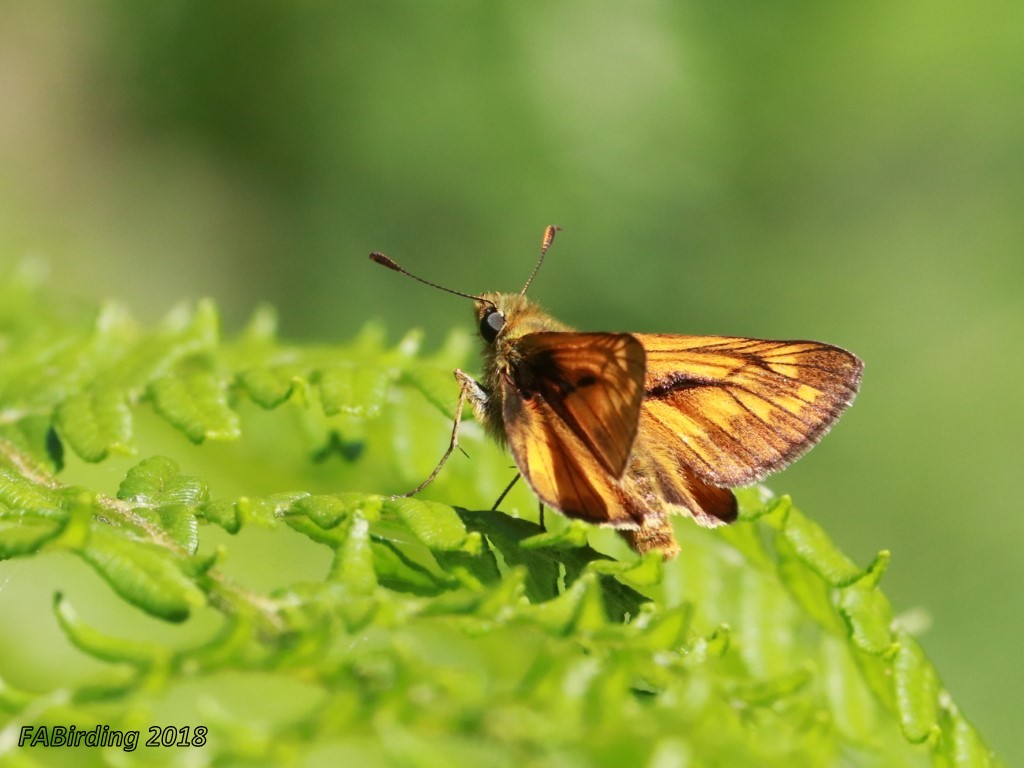
Week 14 produced the highest count of 11 Large Skipper (above) so far this year.


Whilst I logged sightings of 9 Small/Essex Skippers I was only able to clearly identify 4 individuals as Essex Skippers (above).

As expected the most prominent species seen were Ringlets (above) with a total of 171 recorded over the two visits and Week 15 saw the emergence of the Gatekeepers (below). 


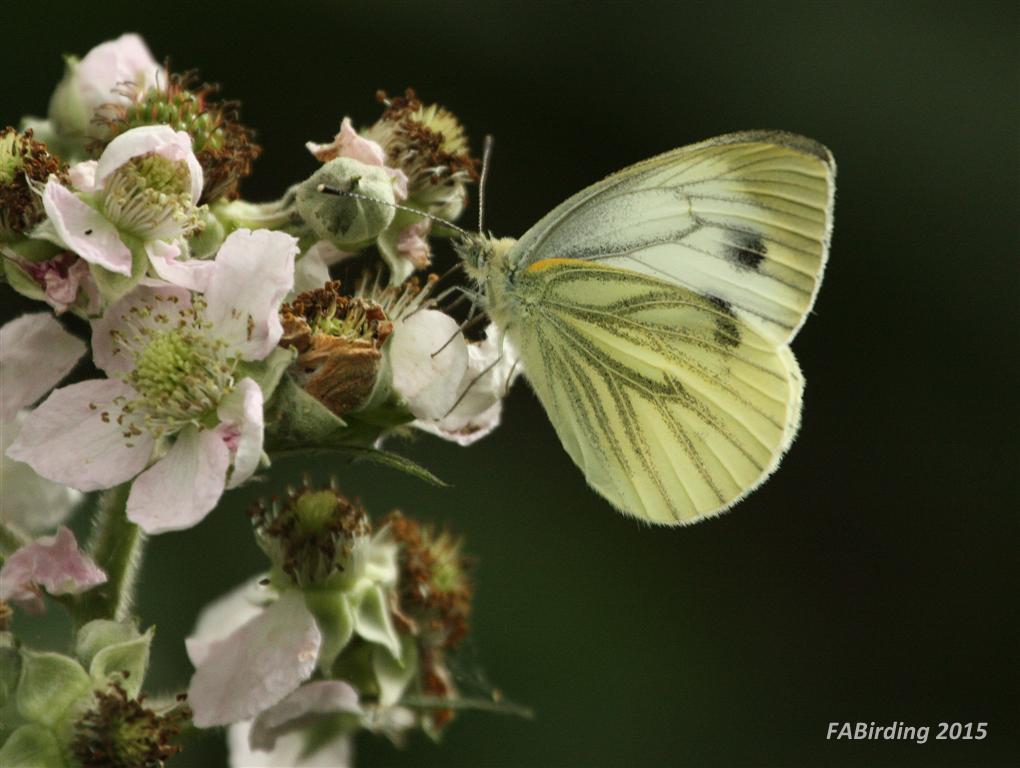
I recorded Large, Small and Green-veined Whites on both walks with the former producing 14 sightings and was also the only species that stopped long enough to be captured by the lens.

Large White.

I also recorded my highest count of 26 Purple Hairstreaks in Week 14 and the highest overall annual total so far of 39 easily exceeding any of the previous three years records. The White Admiral tally for this season stands at 40 to date and is double the sightings recorded over the last four years, 


Conversely sightings of Silver-washed Fritillary has so far been much lower than last year.

Three new species for this season were seen in the last two weeks:

Holly Blue.

Peacock.

A female Brown Argus. This is only the second time in four years that I have recorded this species on the transect.

Linking to:

Saturday, 7 May 2016

Friday Flutters: A Blue and Green Day.


With much higher temperatures today the hour spent on my Ashtead Common transect turned out to be mainly a blue and green affair. The first butterfly recorded was a Holly Blue (above) but the most predominant species was the Brimstone (below) with 12 individuals logged in addition to Small White (1), Speckled Wood (1) and a very flighty single Green Hairstreak.

A few of the ancient oaks are in full leaf but many of the very old pollarded veterans are still waking up. It was very quiet at Flag Pond and in case you wondered that is the muddy colour of the water all year round due to the underlying clay and it plays host to three species of Newt.

A slight detour off my prescribed route provided a few views of two regular woodland species; the Treecreeper (left) and the Nuthatch which was particularly vocal today.Another surprise while watching these 'creepers; was the single hoot call of a Tawny Owl somewhere high on the ridge ... most unusual for the time of day!

Back at home I spent an hour or two doing a few tidy up jobs in the garden while listening and watching three Swifts screaming high overhead plus visits by a Holly Blue and a Small White butterfly.

I am not a fan of non-native species but these 'Spanish' Bluebells do provide a splash of colour at the moment. These invaders will have to be removed when I find the time and replaced with our native stock. Elsewhere a few different varieties of Tulip are hanging on and the herbaceous greenery is bulking up very fast.


Nesting Update:
One final good bit of news today is that we finally have evidence that a pair of Blue Tits are using the nest box in the Birch at the bottom of the garden. 


I will be monitoring their progress and hope to get some better images over the coming weeks. FAB.


Linking to:
Saturday's Critters

Today's Flowers
Nature Notes 

Saturday, 18 July 2015

Butterfly Foray on Ashtead Common.

On Thursday morning I paid a brief visit to the ponds on Epsom Common where this fresh Holly Blue (Celastrina argiolus) was flitting and briefly resting on the waterside vegetation. Not a great deal of avian activity but I did log Mallard (1), Moorhen (1), Grey Heron (2), Canada Geese (21) plus one Greylag Goose with a few Swallows and Swifts in the air.

An hour later after trudging right across Ashtead Common I joined a Butterfly Conservation walk under a very cloudy sky and with very little to catch our attention as we crossed the main meadow until someone spotted this Painted Lady (Vanessa cardui) hiding deep in the grass.

A slow walk ascending one of the main open rides towards the wooded ridge produced good numbers of Ringlet, Meadow Brown, Gatekeeper, Large and Small Skippers and eventually a few high flying Purple Hairstreak plus our first sightings of Silver-washed Fritillary, White Admiral and Purple Emperor.

After our lunch stop another Painted Lady (above) was spotted and nearby I grabbed a shot (below) of one of many freshly emerged male Gatekeepers (Pyronia tithonus).


A totally unexpected find (below) was this Clouded Border (Lomaspilis marginata), a moth that is commonly found in woodland but is a night time flyer.


Other butterflies logged during this walk included Comma, Marbled White, Speckled Wood. Holly Blue, Red Admiral and (below) a Green-veined White (Pieris napi).
I was asked to navigate part of the walk along the ridge which took us through several sections of my regular transect and this ultimately provided us all with very close views (below) of a male Purple Emperor (Apatura iris) down on the ground. This was totally unexpected as it was 3 p.m. when you would normally expect to only see this species flying high above a favoured Oak tree. [You can just make out the purple sheen on the left hand wing that clearly distinguishes it from a female]

All in all an interesting walk and with more sunshine promised for later today I'll be hoping for a another decent list when I carry out this week's recording session.  FAB.

Linking to Saturday's Critters hosted by Eileen.

Friday, 10 July 2015

Friday Flutters

My week started on Monday with a wander around the chalk hillside above Juniper Bottom in fairly windy conditions where hundreds of Marble Whites (Melanargia galathea) were flitting hither and thither.

On Tuesday I attended a Butterfly Conservation field trip to Sheepleas; comprising a mosaic of ancient and recent woodland, scrub and open grassland; lying on the chalk slopes of the North Downs. 

A nettle rich field produced good views of many species including Small Tortoiseshell (Aglais urticae). It was interesting to note that many individuals looked a lot smaller than normal.


A sunny glade in the woodland produced our best sightings of Silver-washed Fritillary (Argynnis paphia) with several males perched on umbillifers ...

... followed by a slightly more distant view of a mating pair, with the much darker coloured female above the male.
During this walk I logged 13 species including, after a long wait due to very gusty winds and intermittent showers, a high tree top view of a Purple Emperor.


On Thursday morning I made a brief check of the wildlife around the ponds on my local birding patch at Epsom Common and managed to get my first record shot of a Downy Emerald (Cordulia aenea) perched in the shaded vegetation above the water.


On my way back to the car park to join another Butterfly Conservation walk I recorded my first sighting of a Purple Emperor at this site (see my previous post "A Purple Day"), initially perched with its wings closed on a post before moving onto the ground to seek out some nutrients.


Purple Emperor (Apatura iris).

After everyone spent time enjoying the close views of the Purple Emperor we had a very pleasant two hour stroll around Epsom Common led by Alison Gilry, another transect recorder, enabling me to add Marbled White and Purple Hairstreak to my patch list sightings for this year.

Holly Blue (Celastrina argiolus)

Purple Hairstreak
After a lunch break three other butterfly enthusiasts joined me on my weekly transect walk on nearby Ashtead Common. 

Having those extra pairs of eyes and experience certainly helped with identification including an unexpected further sighting of two male Purple Emperor and a Purple Hairstreak (Neozephyrus quercus) both too far away for the lens so I have inserted a shot of the latter species taken last year.


Once again the transect produced sightings of eleven species; Small Skipper (4), Small/Essex Skipper (3), Large Skipper (3), Large White (1), Purple Hairstreak (2), White Admiral (3), Purple Emperor (2), Comma (2), Silver-washed Fritillary (1), Speckled Wood (2), Marbled White (1), Gatekeeper (5), Meadow Brown (41) and the most numerous was Ringlet (53).  FAB.

Ringlet (Aphantopus hyperantus).

Linking to:
Saturday's Critters hosted by Eileen and  
Nature Notes hosted by Michelle.

Friday, 8 May 2015

Butterfly Transect Update.

Following up on a post last August entitled 'A New Transect for 2015' I am pleased to say that my offer to carry out a new butterfly recording transect on Ashtead Common National Nature Reserve, managed by the City of London Corporation, has now been confirmed. This involves a weekly stroll over a fixed route from April to September, a total of 26 weeks, in suitable weather between 10.45 and 15.45 to record the variety and numbers of species seen throughout each of the 8 dedicated sections.

Whilst I have carried out three surveys so far the weather hasn't been particularly brilliant with gusty winds on most days between 8-20 mph combined with temperatures barely acceptable for the flutters so it is perhaps not surprising that I have only recorded 7 species; Brimstone (6), Large White (3), Small White (3), Green-veined White (1), Orange Tip (6), Peacock (2) and Speckled Wood (6).

Speckled Wood


Peacock

Throughout the 500 acres (200 hectares) of Ashtead Common there are over 2,300 ancient oak pollards, many over 400 years old, which play host to a surprising variety of wildlife. Continual management is required to maintain the health of these veteran Oaks by reducing their crowns, clearing away the understory growth and where appropriate allowing younger trees to thrive so they can eventually take over from their forefathers.


In the open wooded pasture glades many old trees remain standing, weathered by the passage of time with shattered and torn limbs but continuing to play their part in the landscape as hideaways for numerous tiny creatures and nesting cavities for the birds and mammals.


During my most recent survey I noticed this sign stating that three weeks ago there had been six fires within the wooded pasture areas on the common all thought to have been deliberately lit. Fortunately through prompt action of the public and the Fire Brigade the overall damage was minimised.

I had previously seen evidence of a similar situation on my nearby birding patch at Epsom Common and have to wonder at the mentality of the idiots that  think this behaviour is acceptable.


Hyacinthoides non-scripta
Throughout the transect there are numerous patches of our native Bluebells and as soon as more wild flowers come into flower I'm sure other species of butterfly will be seen. One very majestic veteran that I walk pass is the King Oak which at the moment is still to come into leaf.

The King Oak

One species I was hoping to record along the transect is the Holly Blue but although I eventually found one resting it was seen elsewhere and therefore hasn't yet figured in the statistics.

Holly Blue

Linking to Saturday's Critters hosted by Eileen.

Friday, 17 April 2015

Friday Flutters.

Brimstone (Gonepteryx rhamni)
With the warmer temperatures the butterflies are beginning to show themselves during my regular wildlife wanderings so I thought it was time to resurrect 'Friday Flutters' to highlight what species I have been seeing.

During a patch walk at Epsom Common on 27th March I encountered at least 5 Brimstone on the wing throughout the open woodland. Unfortunately they weren't very cooperative when it came to getting any clear shots.


Just over a week ago at Tices Meadows I saw my first Small Tortoiseshell of the year but was unable to get any shots.

Typically the easily recognised Peacock has been on the wing locally since at least late February having awoken from hibernation. As you can see this individual is already well frayed around the edges!
Peacock (Inachis io)

Two weeks ago a Holly Blue dashed past me at Epsom Common Stew Pond and yesterday one was flying around the garden. Today, possibly the same female with its heavy black wing tips, was spotted by Anita in the garden resting on a rose leaf so I couldn't pass up the opportunity of a few shots and more images will be posted on FABirding.

Holly Blue [female] (Celastrina argiolus)


During an early morning patch walk today I came across at least 15 Bee Flies with their very distinctive hairy body and long proboscis resting at the edge of a dry path.
Bee Fly (Bombylius major)

And my other first sighting was a Specked Wood resting on the leaf litter in the woodland.

Speckled Wood (Pararge aegeria)
Linking to Saturday's Critters hosted by Eileen.

Thursday, 21 August 2014

Behind the Pond Fence.


Recent strolls around my patch at Epsom Common Great Pond haven't produced much in the way of bird sightings apart from the usual Grey Heron, Mallard, Moorhen, Coot, an increasing number of visiting Canada Geese, Black-headed Gull, one Swallow and the occasional soaring Common Buzzard so the lens has been focused on other wildlife.

A Ruddy Darter sunning itself on the top fence rail.

White Admiral nectaring on the other side of the fence.

A very fresh 2nd brooded Holly Blue.

Access to the far side of the pond via the main gate proved a little problematical!! The odds were definitely stacked against me as the cattle, brought in during late Spring to help manage the landscape, weren't going to give up their tiny spot of shade plus the underfoot conditions were very unsavory so I decided to seek out another way. 

The alternative route to access the rear of the reed bed hidden behind the Gorse also provided its own particular challenge! Fortunately I managed to overcome this obstacle without getting 'hot wired'.

 Common Blue Damselflies in mating wheel.

Keeled Skimmer.

Finally a reverse view across the pond from within the reed bed towards my usual viewing point.  FAB.

Linking to Good Fences hosted by TexWisGirl.

LinkWithin

Related Posts with Thumbnails