Showing posts with label Painted Lady. Show all posts

Monday, 24 August 2015

Migrant Lady.

While ascending some steps on the slopes of Denbies Hillside last week I was delighted to have another encounter with a migrant Painted Lady (Vanessa cardui) taking advantage of a break in the clouds to bask in the brief sunshine.


With some six generations each year this species completes an astonishing 15,000km round trip between North Africa and Northern Europe. The numbers appearing in Britain depends on suitable winds and fluctuates dramatically from year to year with the most recent major migration seen in 2009 when around 4 million were detected by radar crossing the English Channel between the 25 and 29 May. 
So far this year the data from UK Butterfly Monitoring Scheme indicates that the Painted Lady has been recorded at 424 different sites.

Life Cycle: From egg to adult takes 7-9 weeks, depending on temperatures, and the adults live between 10 to 24 days.
Larval Foodplants: Mainly thistle species but also Mallow, Nettle and Viper's-bugloss.

Linking to:
Nature Notes hosted by Michelle

Thursday, 13 August 2015

Friday Flutters - Weekly Update.


Despite the lack of sunshine over recent days the collage above proves there are still a few colourful butterflies to be found around my local birding patch, providing some photo opportunities, in lieu of the avian species that are all still hiding from my lens.

First up was a single Small Copper (Lycaena phlaeas) that alighted briefly beneath my feet before moving onto another leaf and then promptly closing its wings!

A few male Common Blue (Polyommatus icarus) were obvious as they flitted hither and thither before disappearing deep into the grasses to rest briefly before their next territorial foray.


I saw a few Meadow Browns but as expected the Gatekeepers (Pyronia tithonus) were far more numerous but not very active under a cloudy sky. The undersides of both sexes are very similar but this one opened its wings (below) to reveal a female.

A very fresh Red Admiral (Vanessa atalanta) landed on a old tree stump and provided a different splash of colour.


As I walked over the upper grassy meadow a couple of male Small Heath (Coenonympha pamphilus) were chasing one another and this was one of the few occasions I have managed to get a shot as this tiny flutter that is so well camouflaged when it settles deep amoungst the grasses.

The star find of the week was a resting Painted Lady (Vanessa cardui), a migrant species that visits our shores from North Africa. Interestingly I photographed this individual within 50 yards of a single sighting I recorded here during August last year.

With the present unsettled weather pattern it might be a while before I get some more photo opportunities.

Saturday, 18 July 2015

Butterfly Foray on Ashtead Common.

On Thursday morning I paid a brief visit to the ponds on Epsom Common where this fresh Holly Blue (Celastrina argiolus) was flitting and briefly resting on the waterside vegetation. Not a great deal of avian activity but I did log Mallard (1), Moorhen (1), Grey Heron (2), Canada Geese (21) plus one Greylag Goose with a few Swallows and Swifts in the air.

An hour later after trudging right across Ashtead Common I joined a Butterfly Conservation walk under a very cloudy sky and with very little to catch our attention as we crossed the main meadow until someone spotted this Painted Lady (Vanessa cardui) hiding deep in the grass.

A slow walk ascending one of the main open rides towards the wooded ridge produced good numbers of Ringlet, Meadow Brown, Gatekeeper, Large and Small Skippers and eventually a few high flying Purple Hairstreak plus our first sightings of Silver-washed Fritillary, White Admiral and Purple Emperor.

After our lunch stop another Painted Lady (above) was spotted and nearby I grabbed a shot (below) of one of many freshly emerged male Gatekeepers (Pyronia tithonus).


A totally unexpected find (below) was this Clouded Border (Lomaspilis marginata), a moth that is commonly found in woodland but is a night time flyer.


Other butterflies logged during this walk included Comma, Marbled White, Speckled Wood. Holly Blue, Red Admiral and (below) a Green-veined White (Pieris napi).
I was asked to navigate part of the walk along the ridge which took us through several sections of my regular transect and this ultimately provided us all with very close views (below) of a male Purple Emperor (Apatura iris) down on the ground. This was totally unexpected as it was 3 p.m. when you would normally expect to only see this species flying high above a favoured Oak tree. [You can just make out the purple sheen on the left hand wing that clearly distinguishes it from a female]

All in all an interesting walk and with more sunshine promised for later today I'll be hoping for a another decent list when I carry out this week's recording session.  FAB.

Linking to Saturday's Critters hosted by Eileen.

Friday, 19 September 2014

Some Recent Wildlife.

A few images of the wildlife I've seen recently.

A distant, cropped shot of three in a row on the muddy margins of the Ferry Pool at Siddlesham. (The green smudges were foliage close to the lens!)
From left to right .. Avocet, Black-tailed Godwit and an Oystercatcher.

The Avocet adults were happy to let the Godwit pass by their resting youngster BUT the Oystercatcher was definitely not a welcome intruder. The defiant sideways glance was enough to deter the Oystercatcher treading any closer.

During a butterfly foray near Ewhurst, Surrey I watched a Red Kite being harassed by several Crows.

A Magpie at Tices Meadows where I also caught up with a Little Stint and my 4th only UK sighting of a Pectoral Sandpiper in the last 10 years. Unfortunately both these waders were too far distant for the lens.

A regular resident on my local patch walks ... Great-spotted Woodpecker.
 
A Painted Lady at rest on the perimeter of the disused Wisley Airfield.

While wandering alongside a watercourse in Bushy Park a Red Doe very quietly emerged from the lush green foliage, continued to feed and totally ignored my presence. After about 10 minutes she slowly wandered away but still kept a beady eye on you know who!

Wishing everyone a glorious wildlife watching weekend, wherever you are. FAB.

Linking to I'D-Rather-B-Birdin', Saturday's Critters and Camera Critters.

Thursday, 22 August 2013

Vanessa cardui.

I have only had one view of a Painted Lady (Vanessa cardui) so far this year. A totally unexpected sighting during our trip to Norfolk. Unfortunately it didn't perch for long so just a few quick shots.


According to my hard drive I appear to be amassing a plethora of unsorted flutter pics from recent wanderings so I'll have to knuckle down in order to up some more species in the near future. FAB.

Sunday, 18 August 2013

Cley Marshes NWT Reserve.


During our recent long weekend on the North Norfolk Coast we made regular visits to Cley Marshes NWT Reserve but often only stopping off at Bishops Hide to scan over Pats Pools before heading elsewhere along the coast. 

More often than not any waders present were always too far away but there was always a few other species that ventured a little closer to the hide.


Avocet constantly feeding, Shelduck parents aggressively chasing off anything that got close to any of their 15 goslings and Coot just showing off.

Throughout our numerous visits over the years it has been unusual for us not to see Marsh Harriers quartering over the extensive reed beds but this activity is often interspersed with long periods when individuals perch atop one of the few trees as they monitor their options for their next foray.

Fortunately our visits coincided with the flight of this majestic species so the opportunity was grabbed to capture a few images as one individual effortlessly glided close to the hide.


(Western) Marsh Harrier (Circus aeruginosus)


These brief forays by the Harriers often result in pushing the various waders into the air and on more than one occasion it was a decent sized flock of Black-tailed Godwits (Limosa limosa) that felt threatened but it didn't take them too long to resettle on the far side of the pool. 
During this frenetic activity I did notice that there was one Godwit feeding alone much closer to the hide and it decided not to take to the sky so my attention turned to it as it's particular colouring suggested that it might just be a different sub species.


What struck me about this particular individual was that its rufous summer plumage extended much further down the breast suggesting that this could be an Icelandic Black-tailed Godwit (Limosa limosa ssp. islandica). Unfortunately it's legs, which should be shorter, were never fully exposed but everything else including the slightly shorter bill length indicated 'islandica'. [I would be interested to here what any of my readers think about its ID].

On one particular day we decided to spend longer at Cley and undertook a leisurely anticlockwise circuit of the whole reserve. 

After leaving Bishops Hide we headed up onto the East Bank towards Arnold's Marsh where a Black-winged Stilt had reportedly been seen but we couldn't find it. However we did get views of  four Spoonbills and a hastily taken shot as three of them they decided to move location. Scanning the marsh did produced Spotted Redshank, Greenshank and Ringed Plover.


Dropping off the bank to get some relief from the stiffening breeze I was totally surprised when I found a Painted Lady and managed a couple of shots before it flew away. (My first sighting this year.)

Climbing up onto the shingle sea defence bank provides a good spot to scan all over the reserve and across the sea but there was little activity apart from a few gulls, Cormorant and the occasional flypast of Sandwich and Common Terns returning from fishing trips with food for their growing youngsters.
Anita, always ready to help carry the gear, has often commented that she would never have thought 40 yeas ago that, as a 'townie', she would ever be interested in birding and wildlife but that's why I admire her so much as we continue to enjoy our life together.

 
A brief visit to the North Scrape hide didn't produce any more photo opportunities so we strolled on past the beach car park and then along the West Bank, watching flying Little Egrets, before returning to the boardwalk  and back to the Visitor Centre for some much needed refreshments.


Once again a very enjoyable visit to Cley Marshes and I'm sure it won't be our last.  FAB.


Linking to Camera Critters and I'D-Rather-B-Birdin' 

Friday, 10 September 2010

Flutter Review (Part 2).

During a recent visit to Bookham Common I just managed a record image of the Brown Hairstreak. This species is not often seen at low level so I'll need to keep a beady eye out for this one in the future in the hope of some better shots.

As a follow up to Part 1 here are the final montages of some of the other species seen this year.

Large, Small and Silver Spotted Skippers, Painted Lady, Peacock and Small Tortoiseshell.

Ringlet, Small Copper, White Admiral, Speckled Wood, Wall Brown and Red Admiral

Just a few more of my favourite the Silver-washed Fritillary.

Other species seen but not yet captured are Purple Emperor, Clouded Yellow and Marbled White. With a bit of luck and some travelling I might be able to expand the list next year.  FAB.

Monday, 28 June 2010

Norfolk Review (Part 3) - Cley Marshes

On day 4 we met up with our friends Tony and Jean for an anti-clockwise walk around Cley Marshes.
At least the sun shone for most of our walk although again there was no protection from the strong north-easterly wind except for when we dived into two of the hides to view the usual ducks but very few waders.
Male Marsh Harrier. (Circus aeruginosus)
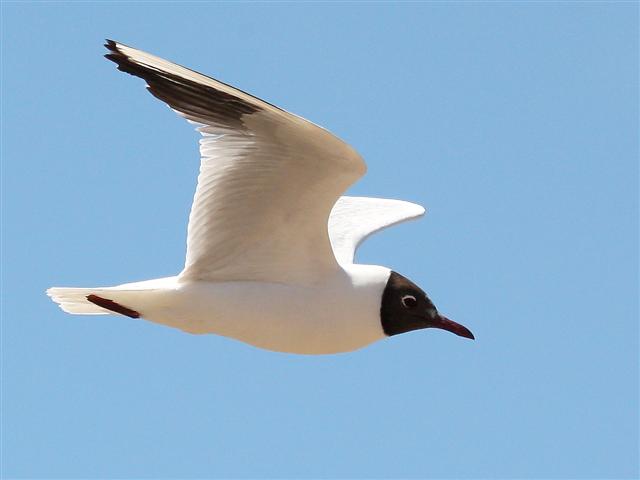
Black-headed Gull. (Chroicocephalus ridibundus)
Distant shot of a male Bearded (Tit) Reedling. (Panurus biarmicus)
Happy family of Mute Swans.
I need more shade Mummy!
Common Tern. (Sterna hirundo)
Barn Swallow (Hirundo rustica) taking a brief rest from catching insects.
No apologies for posting another (Pied) Avocet. (Recurvirostra avosetta)
Painted Lady. (Vanessa cardui) looking a little worn.
After a late lunch [I had a baked tatty with cheese and a mixed salad] in the eco-friendly Information Centre we headed off to to CleySpy in Glandford for some retail therapy. Tony wanted to look for a new harness for his bins but we both ended up buying a new hat to shade us from the sun....or the rain!
Anita and I took a short walk through the model village, built by Sir Alfred Jodrell a century ago, admiring the reddish-pink waves of Valerian; the buildings including the Shell Museum, (regretfully closed)  built using local Norfolk red brick and flint with Flemish gables.We then headed down to the River Glaven, overlooked by the watermill (built in 1907), and then onto the water meadows.....
......where I finally got a chance to capture a resting male Orange Tip (Anthocharis cardamines).....FAB.

LinkWithin

Related Posts with Thumbnails