Showing posts with label WWT Barnes. Show all posts

Wednesday, 20 April 2016

Ring Ouzel at WWT Barnes.

On Monday morning I decided on a visit to WWT Barnes in the hope of adding one or two common species to my current Surrey year list plus the possibility of seeing a Ring Ouzel that had been reported there over the weekend. 

My luck was in as a slight detour from the entrance bridge eventually provided a distant view through the bins as this thrush was feeding on a grass slope (way beyond the fence above Sir Peter Scott's head) but too far away for my limited gear to capture. Needless to say I was just happy to have seen this species and made my way onto the reserve and added Kingfisher, Sedge Warbler and Redshank to my Surrey year list.

After an hour or so the blue sky turned very grey and on exiting the Scrape Hide I met up with fellow birder and photographer Dave Carlsson. He showed me a image of the Ouzel he had taken and suggested that as there was little else of photographic interest that we head out and see if the bird was still showing and very kindly offered me the use of his 500mm lens. Well as you can guess I was delighted to get the chance of a possible record shot.


Unfortunately the Ring Ouzel wasn't quite as obliging as it had been earlier in the morning plus handling a 500mm lens for the first time was quite an experience. The image above is what I saw through the viewfinder and below is the cropped version. Not too shabby for a first attempt!

A male Ring Ouzel (Turdus torquatus) on its migration to breed on the uplands of northern UK and finally added to my Surrey list.

Dave had previously agreed to e-mail me a copy of the image he had taken earlier that morning and with his approval I am posting, for comparison, two of his quality shots below so you get a better view of its distinctive white crescent.


 Once again, many thanks Dave for the use of your big lens. FAB.

 Linking to: I'D-Rather-B-Birdin' 

Friday, 19 February 2016

London Wetland Centre.


With a forecast of a few hours of decent weather on Friday morning I paid another visit to the London Wetland Centre at Barnes in the hope of catching up with a Bittern but it was not to be. Nevertheless there was still plenty of birds on view, both wild and captured species.


My southerly route towards the main reed-beds provided an opportunity to snap a few of the captive species including Hooded Merganser, Marbled Teal and White-headed Duck.


A male Tufted Duck

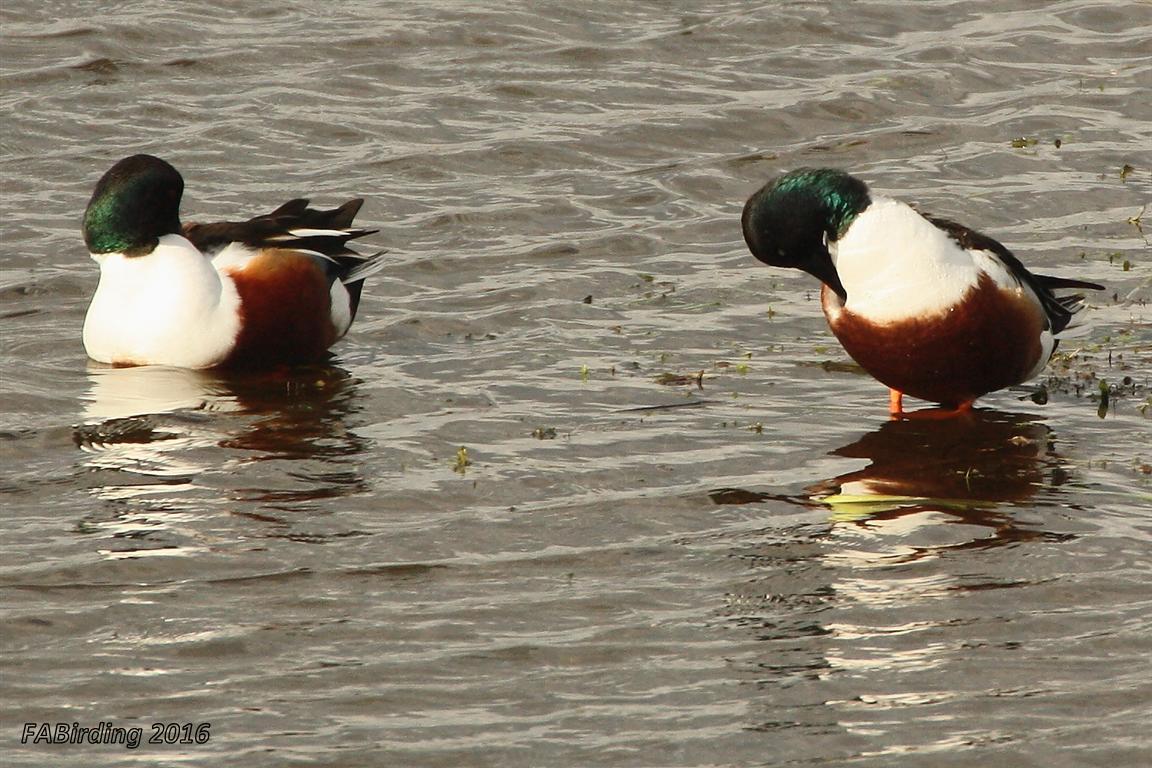
A scan over the flooded grazing marsh produced Grey Heron, Mute Swan, Cormorant, Wigeon, Gadwall, Pochard, Coot, Moorhen, Mallard, Teal, Canada Geese, a single Egyptian Goose plus numerous Northern Shoveler, many enjoying a preening session in the sunshine.


The centre which opened in 2000 occupies the site of the former Barn Elms reservoirs covering a total area of about 100 acres including open water, muddy banks, grazing marsh, some woodland and an extensive reedbed right in the heart of the south London urban landscape. Three quarters of the site was designated an Site of Scientific Interest in 2002.


My route back to the centre only produced one additional sighting, an over flying Little Egret. The northern part of the reserve has several hides overlooking the open water enabling decent views, albeit often distant of the ducks, gulls and and a much reduced number of Northern Lapwing.


My only raptor sighting was a male Sparrowhawk who made a brief appearance on one of the small islands and from the first floor of the Peacock Hide I spotted a male Pintail (below) in its elegant finery fortunately within reach of the lens.

Despite the lack of a Bittern sighting (again!) it was a joy to be out in the winter sunshine enjoying our native wildlife. FAB.

Linking to Saturday's Critters and I'D-Rather-B-Birdin' 

Tuesday, 16 December 2014

Bittern at Barnes.


It was a chilly but clear morning on Sunday when I joined a Surrey Bird Club field-trip to the London Wetland Centre at Barnes. Some of the shallower parts of the extensive pools showed how cold it had been overnight with a thin layer of ice enabling this Coot to 'walk on the water'.

There were a number of species on our wish list and it wasn't long before the star attraction, a [Eurasian]  Bittern, (Botaurus stellaris) was located on the edge of a distant reed bed.

Typical of this well camouflaged species it stood stock still for many minutes before adopting its upright pose to scan the vicinity for a possible meal before disappearing into the reeds.


Other species logged included Lapwing, Mallard, Teal, Pochard, Gadwall, Northern Pintail, Tufted Duck, Moorhen, Cormorant, Little Grebe, Northern Shoveler, Wigeon, Mute Swan, Canada, Greylag and Egyptian  Geese, Gulls (Herring, Black-headed, Common and Lesser Black-backed), Grey Heron, Robin, Stonechat, Tits (Blue, Great and Long-tailed), Chaffinch, Goldfinch, Ring-necked Parakeet, Carrion Crow, Magpie and Blackbird.


Whilst high up in the Peacock Hide I watched a male Sparrowhawk dashing low over the marsh scattering the wildfowl, Pigeons and Starlings before coming to rest in a tree close by but getting a clear shot through the foliage was near impossible.

On returning to the WWT Hide with one of my colleagues we were both fortunate to get another view of the Bittern that had reappeared in almost the same spot.

After walking up through the reeds it eventually decided to fly off to another distant reed bed. 
For many of my fellow birders this was probably the best ever views they had experienced of this elusive species and I'm pleased to have got a few record images to share for this weeks edition of Wild Bird Wednesday.  FAB.

Thursday, 11 September 2014

London Wetland Centre.


A location that I often visit throughout the year is The London Wetland Centre at Barnes. As you cross the bridge astride the entrance pools the statue of Sir Peter Scott always serves as a reminder of his dedication to education, research and the conservation of wildlife. His establishment of the Wildfowl Trust in 1946 has allowed millions of people to enjoy getting close to living wildfowl from all round the world.

A mix of habitats throughout the 'World Wetlands' area provides an opportunity to watch and photograph species such as White-faced Whistling Duck, Black-bellied Whistling Ducks chilling out, Ferruginous Duck, plus Red-breasted and Barnacle Geese. Just a a few of the many and varied captive species.

The various hides around the 'Wildside' areas produce an array of our native and migrating avian species throughout the year. A few regulars depicted here .. Tufted Duck, Black-headed Gulls, Canada Goose, Moorhen And Coot.

During a break for coffee and cake during a visit earlier this week we were joined by a young Carrion Crow constantly opening and closing its beak but not uttering a sound. It hung around for a while before flying off to another table to pick up a discarded scrap.

Elsewhere there was interest from colour in the wildlife garden, Frogs and resting Common Darter.

 But all too soon it was time to head home via the entrance bridge.  FAB.

Linking to Good Fences hosted by TexWisGirl.

Tuesday, 29 January 2013

Bittern at WWT Barnes.

So here is the scenario which I'm sure many of us have experienced. You enter a bird hide and one or more of the occupants says "There's a Bittern out here" (inwardly I think great ... that's one of the reasons why I came here today) and then one of two options ... either you are left to scan everywhere or you are given some sort of directions ... such as "It's in the reeds, over there on the right".

So above is the general view that greeted me out of a hide window at W.W.T. Barnes today and a similar greeting (as detailed above) from another visitor, who then waited a few moments before adding "Have you found it?". Well for anyone who knows what a Bittern looks like (it is  one of the ultimate camouflage species) you then scan the reed margins for a slightly darker shape that is usually absolutely stationary within the similarly coloured reed stems.

It didn't take me long to locate my quarry but the dull overcast conditions and distance were far from ideal for my set up but I'll share these 'record' shots (heavily cropped) just to show how difficult this species can be to locate for the inexperienced. 
One day I'll capture one out in the open on a nice sunny day ... lol!

Needless to say that when some other visitors joined me in the hide I was more than happy to provide them with far easier instructions in order to locate this winter visitor and one guy was overjoyed to get a close up view through my scope.
Of course there were plenty of other species on view including lots of Northern Lapwings plus a distant view of a single female 'red-headed' Smew.

Male Gadwall (Anas strepera)
For more information on this species, please CLICK here.

Northern Shoveler (Anas clypeata).

Well at least a couple of ducks came close enough for the lens before the dark clouds rolled in. The forecast doesn't look particularly promising for the next few days so I may have to revert to looking through some of last years images for the next post.   FAB.

Linking up to WILD BIRD WEDNESDAY.

Saturday, 12 March 2011

Barnes WWT bathed in sunshine.

Earlier this week (Tuesday) I enjoyed a few hours in the sunshine at WWT Barnes. 
Whilst the centre was alive with school children enjoying various activities including pond dipping the hides were very quiet probably because most of the birds were fairly distant. 

After half an hour in the hide overlooking the waterlogged scrape the only close visitors were a pair of Canada Geese who settled for a few minutes before taking flight.

and a couple of male Tufties.

The view from the Peacock Tower over the grazing marsh was somewhat similar so I headed towards 'Wildside' on the other side of the reserve.

Coot with some damaged feathers strutting across the grass.

Moorhen enjoying a cool drink.

I stopped for a while to capture some of the 'collection' species including Red-crested Pochard, a male White-headed Duck and the Goldeneye with a red head Smew in tow. As I wandered the pathways the striking call of a Cetti's Warbler pierced the air and Goldfinches twittered above my head.

Once again there was very little activity from the furthest hide apart from a couple of Dabchicks (Little Grebe). On my return route there was a small collection of people staring across one of the water channels at the distant reedbed. A search through the bins (I'd decided to leave the scope at home!) and I eventually located the distinctive brown camouflaged outline of a BITTERN well hidden in the reeds. It maintained its station while occasionally preening for some 20 minutes but then decided to move out into the open.

Unfortunately it was really too far for the 70-300 lens and the overhead sun didn't help focussing but I managed a cropped record shot that will have to do for the time being. Within a few moments this elusive species was out of sight .... until another day perhaps.  FAB.

Friday, 22 October 2010

Barnes WWT.

On Wednesday I visited Barnes WWT around midday. The bright blue sky reflected in the colour of the water but out of the sun the cold northerly breeze quickly chilled the fingers. The buildings in the background are on the other side of the River Thames which forms part of the boundary to this urban wetland reserve acknowledged to be the best in Europe. So here are a few images of some of the species that were around.
 A Little Grebe continually pointed its behind towards the sun
 Only spotted a few Common Pochard but I guess more will appear as winter approaches.
 A female Tufted Duck taking a midday nap.   
 A male Northern Shoveller with its distinctive spatulate bill and puffed out white breast. 
 Time to tidy up those feathers.
 Mrs. Shoveller floats by totally unimpressed by the males.

Shortly after entering the Dulverton Hide I surveyed the distant reeds on the northern side of the main lake through the bins and eventually locked onto a brown shape ... one of the two Bitterns that arrived, probably from Norther Europe, about a week ago. Sorry, no photos as it was far too far away!  Other sightings included Mallard, Teal, Gadwall, Coot, Moorhen, Mute Swan, Canada Geese, Cormorant, Grey Heron, Common, Black-headed and Great Black-backed Gulls, Starling, Blackbird, Blue Tit, Great Tit, Cetti's Warbler (heard only), Great Crested Grebe, Lapwing, Jackdaw, Crow and Parakeet.
After some patient waiting a couple of Common Snipe appeared from the vegetation on a nearby island and spent a short time feeding before disappearing again, probably for their afternoon snooze. (Not the sharpest of shots as these guys were really too far away for the lens so original cropped.)
Finally from the first floor in the Peacock Hide I watched these Highland Cattle, which are being used to graze the grassland, slowly move to a fresh feeding location. Certainly no indication that they were feeling any effect from the biting wind!   FAB. 

LinkWithin

Related Posts with Thumbnails