Showing posts with label Bird Song. Show all posts

Monday, 9 May 2016

Troglodytes troglodytes.


On any of my walks it would be very unusual not to encounter this small active brown bird with its cocked tail often just announcing its presence with its loud voice before promptly disappearing into deep cover.

The [Eurasian] Wren (Troglodytes troglodytes), otherwise known as 'Jenny Wren' is our commonest UK breeding bird, although it does suffer declines during prolonged, severely cold winters. Currently the local population is in very healthy.

The scientific name is taken from the Greek word "troglodytes" (from "trogle" a hole, and "dyein" to creep), meaning "cave-dweller", and refers to its habit of disappearing into cavities or crevices whilst hunting arthropods or to roost.

Click below to check out its remarkably loud voice: 


If there are any problems with the sonogram here is the direct link: http://www.xeno-canto.org/313805


This individual was very obliging during a recent early morning stroll around Castle Hill LNR.

Linking to:
Through My Lens
image-in-ing
Wild Bird Wednesday

Sunday, 13 March 2016

Dunnock.


The Dunnock (Prunella modularis), also known as the 'Hedge Sparrow', is described as a small, plain looking brown and grey member of the Accentors family that tends to go unnoticed as it nervously forages beneath bushes and shrubs both in gardens and the wider countryside.

However its drab plumage and quiet, unobtrusive manner belies its actual social and sexual behaviours which you can read more about HERE. [An article written by Mike Toms].


This species is also commonly ‘brood parasitised’ by the Cuckoo and way back in 2004 I was fortunate to witness a Dunnock feeding a juvenile Cuckoo in the gardens at RHS Wisley.


The typical lifespan of a Dunnock is only two years and their breeding season runs from March to August. I have recently started to hear its even pitch, shuttling song which is often described as sounding like a 'squeaking gate'.


Linking to: Wild Bird Wednesday.

Friday, 8 January 2016

Winter Songster.


Despite the inclement weather this past week at least one species, the Robin, was in full song.  FAB.


Tuesday, 7 July 2015

The Twittering Linnet.

The [Common] Linnet (Carduelis cannabina) is a small slim finch that I occasionally encounter on my local patch but a species I associate with coastal, farmland and heathland habitat. This individual was photographed during a visit to Thursley Common in late April so not in full breeding plumage when the forehead and breast is much more predominately red.
 
This delightful little finch with its melodious twittering (see recording below) was once very popular as a caged bird but the UK population has seen a dramatic breeding decline over the past few decades and hence it has been on the Red Status list since the mid 60's.


Linking to Wild Bird Wednesday.

Tuesday, 16 June 2015

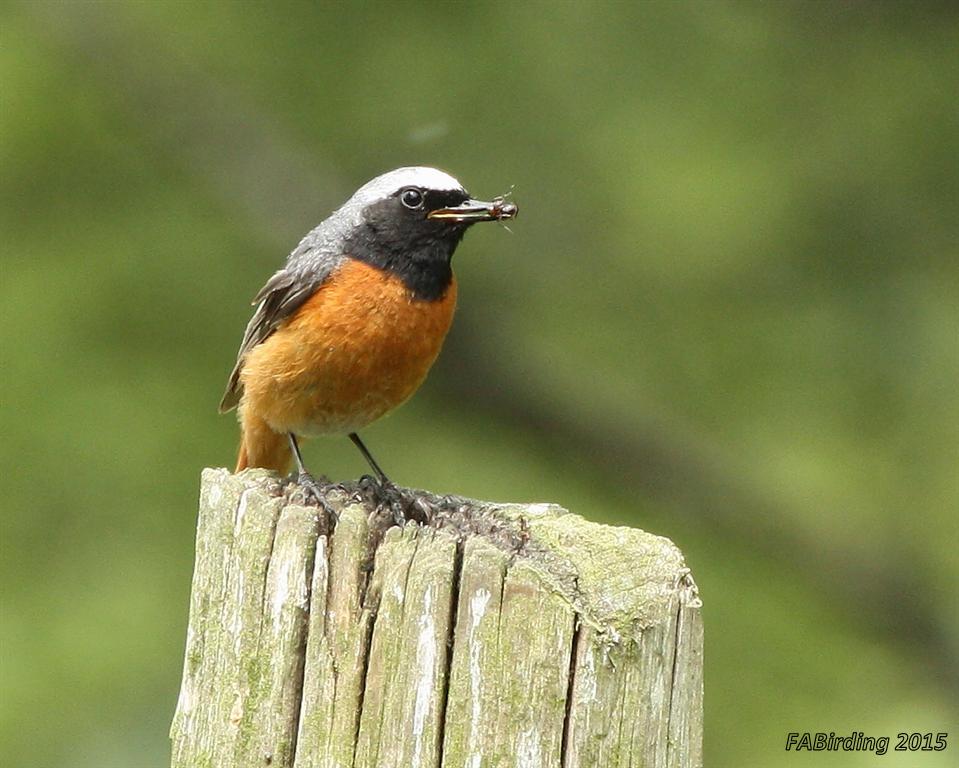
Obliging Redstart.

Last Friday morning we drove into East Sussex to enable Anita to attend a craft event at Crowborough and with the chance of some half decent weather I took the opportunity to revisit Old Lodge Nature Reserve.

With views across the Ashdown Forest the reserve habitat is a mixture of heathland, woodland and small pools that support a very varied selection of wildlife including a dozen species of Odonata.
On this visit I saw one or two damselflies and views of any dragonflies were also scarce as they tend to emerge here some three or four weeks later due to the colder temperature of the water.


This site is a stronghold for several avian species, including Tree Pipit and Common Redstart and while listening to Chiffchaff and Willow Warblers I saw both my target species within the first 15 minutes but it took another hour before one special species provided an opportunity to enjoy a close encounter.

As I climbed out of the deep valley I noticed a male Common Redstart (Phoenicurus phoenicurus) using a fence post as a perch in between its search for insects so I promptly found a spot to park myself and waited and watched.

On a couple of occasions it flew away from the fence line and used a dead snag as a perch, just a little too far away for a really good close up, but after a while that situation changed.

This delightful but 'Amber listed' bird gets its name from its fiery-red tail which it constantly flicks and also fans out during its courtship displays.

Originally categorised within the Chat and Thrush (Turdidae) family it is now considered to belong to the Old world flycatchers (Muscicapidae).

This male was obviously feeding a young brood by finding plenty of insects in the grass beneath its perch then flying off but regularly returning to the same spot providing me with some of the best views I've ever enjoyed.

Every so often he would just stop and rest on one of the fence posts and occasionally treat me to a burst of song so I have included below a sonogram by Patrick Aberg in Sweden and you will also hear Willow Warbler and Chaffinch in the background.


More images from this session can be seen HERE and I'll be sharing some other wildlife seen during this brief visit in a future post. FAB.

Tuesday, 12 May 2015

The Blackbird.

The [Common] Blackbird (Turdus merula), a true thrush,  is one of our commonest garden species. Our resident mature male is easily recognisable in his glossy black coat with orange-yellow bill and eye ring as he regularly uses a high open perch nearby to survey his territory.


Whenever I see him I am often reminded of the initial verses of the nursery rhyme:

  Sing a song of sixpence a pocket full of rye
Four-and-twenty Blackbirds baked in a pie
When the pie was opened the birds begin to sing
Oh wasn't that a dainty dish to set before the King.


During the winter he can be heard uttering his quiet sub-song from a hidden perch in an ivy clad tree but once spring arrives his calls become loud and varied.

Throughout the breeding season his song is rich, varied and flute-like, often finishing with a squeaky phrase.


William Henley wrote:
The nightingale has a lyre of gold,
The lark's is a clarion call,
And the blackbird plays but a boxwood flute,
But I love him best of all.

For his song is all of the joy of life,
And we in the mad, spring weather,
We two have listened till he sang
Our hearts and lips together.

If you are unfamiliar with its song that we hear most mornings, starting long before dawn awakens, then please listen to the sonogram below.


Linking to Wild Bird Wednesday.

Wednesday, 6 May 2015

Troglodytes troglodytes.


During my wanderings I am often spied upon by one of our tiniest residents, the Wren (Troglodytes troglodytes) and on a recent chilly early morning stroll this individual was lit up by the rising sun

For a very tiny bird, just 9-10.5 cm in length, it produces one of the loudest songs.


Whether uttered from deep cover or out in the open there is no mistaking the presence of a Wren.  FAB.

Monday, 27 April 2015

Foggy Birding.

Last Friday I took a break from wielding the paintbrush and paid a very early morning visit to Tices Meadows. During my drive south-westwards across the county the dawn sunshine at home soon changed to patches of fog and on arrival it was obvious that the meadows where almost totally shrouded in a foggy blanket.
Fortunately there was compensation as I walked into this site from the varied bird song including Blackbird, Dunnock, Song Thrush, Wren, Robin, Chiffchaff, Chaffinch, Blackcap, Willow Warbler and Nightingale.

Just above a dense patch of scrub where a hidden Nightingale was singing a male Blackcap (Sylvia atricapilla) perched nearby and repeatedly sang.


With little to see on the water through the fog I strolled slowly along a track between the reed beds and a male Sparrowhawk jinked through the sallows and when I turned around it was perched on a fence post. As you can see the conditions weren't particularly conducive for getting any quality images so just a record shot! 
Nearby I listened to my first Reed Warbler of the year and then spotted the male being joined by a potential partner and the singing abruptly stopped as the pair disappeared deep into the reeds together. A little further on I also heard the scratchy songs of at least two Sedge Warblers. Eventually some of the fog dissipated enabling me to add two Little Ringed Plover and House Martin to my year and county lists.

When I retraced my route back towards the car I watched several Common Whitethroat and a Chiffchaff (Phylloscopus collybita) managed to get within reach of the lens.

Once again I stopped close to the spot where I had earlier heard a Nightingale (Luscinia megarhynchos) and eventually one popped into the open and sang its beautiful verses. Not the sharpest of images but it will do for the time being!


All in all, a very interesting morning despite the foggy conditions. FAB.

Linking to Nature Notes and Wild Bird Wednesday. 

LinkWithin

Related Posts with Thumbnails