Showing posts with label Marbled White. Show all posts

Friday, 27 July 2018

Transect Update - Weeks 16 and 17.


The temperatures during my Week 16 and 17 transect walks varied between 24 and 28 deg.C definitely the hottest and most humid so far this season with the total number of sightings dropping slightly in the higher temperature last week.

Gatekeepers continued to be the highest recorded species over the last two weeks.

Gatekeeper


Sightings of all the three Skipper species recorded on the transect has shown a downward trend for the last three years. The reasons could be weather related at the larval stage; the timing when the grass rides are mown plus the ever increasing spread of bracken outcompeting the grasses.

Essex Skipper
Although the number of Meadow Brown and Ringlet logged during weeks 16 and 17 have fallen they continue to be the top two annual recorded species for this transect.

Ringlet
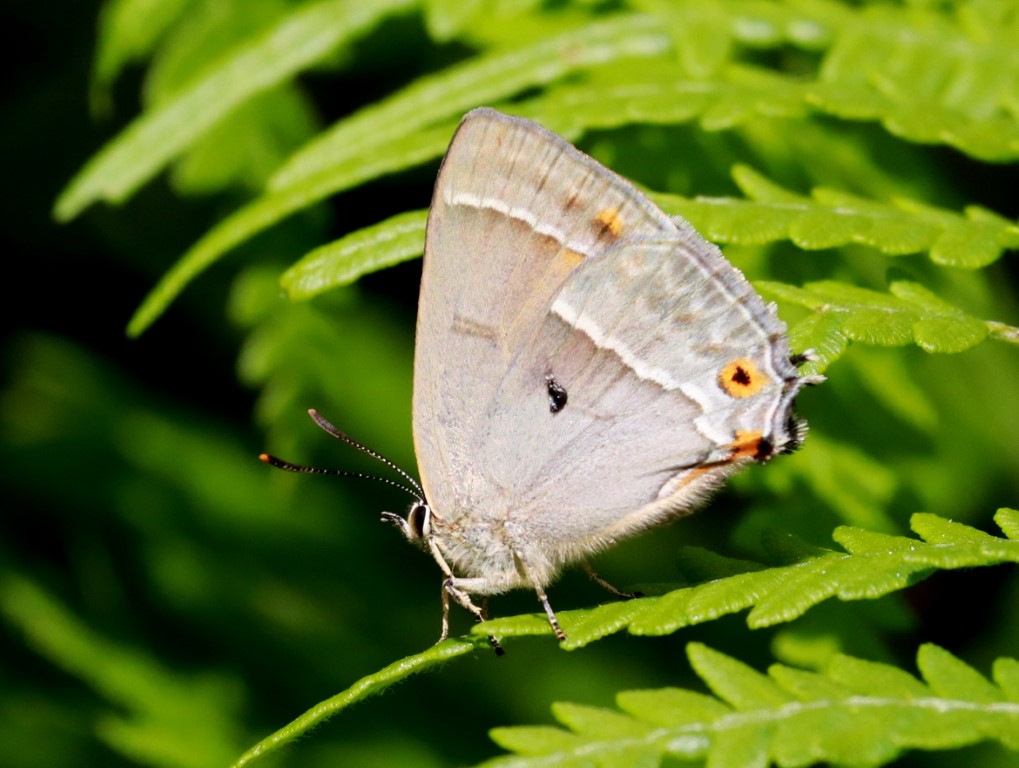
Perhaps not unexpectedly for this oak woodland site the one species that has done exceptionally well this year is the Purple Hairstreak. On the 21 July I recorded 26 and last week I logged 43 with many other sightings away from the transect.

Purple Hairstreak


Just one Marbled White seen again in Section 4 last week.

Marbled White

Two other species that has definitely caught my eye this season are the diminutive Brown Argus with nine individuals recorded last week plus six Common Blue.

Common Blue - Female (left) Male (right)

Brown Argus

Over the last 17 weeks I have now recorded 1024 separate sightings of 21 species. This total to date far exceeds any of the previous three years annual counts BUT this does not infer that some of these flutters are doing well just that the recent lengthy period of warmer conditions has brought them out of hiding and made it easier to find and count them.

Linking to:

Friday, 29 June 2018

Transect Update - Week 13.

Once again I chose Sunday 24th to undertake my 'Week 13' transect walk on Ashtead Common under a cloudless sky and a temperature of around 24 deg. C so I was thankful for the overhead green canopy providing some respite from the sun.

On the quarter mile walk to the start of the transect I always stop at a sunny open spot where there is an area of brambles and this often provides an indication of what I may record on the actual transect.


On this occasion there were several Meadow Browns, Ringlet, Large Skippers and a single Marbled White (left) made a brief nectar stop. Unfortunately no Marbled Whites turned up during my timed walk. 

One of the resident Common Buzzards made a fly past as I started my timed walk.


Section 1 produced three new species for this year. First was the Ringlet (above) and ultimately I saw them in all 8 sections recording a total of 58 individuals. Next was a single Purple Hairstreak flying up through one of the oaks.

At the beginning of Section 3 I found another Purple Hairstreak settled on the bracken and when it turned around I noticed a black addition (see below) to the centre of its underwing. I am guessing this may be some form of tick that has attached itself. Sections 4 and 8 also produced single sightings of this species.


The third new addition seen in Sections 1 and 3 was the Silver-washed Fritillary and I logged a total of just four males with only one stopping long enough for a photo call.

As expected the most prominent species was the Meadow Brown again recorded in all sections of the transect with a total of 73 logged.

White Admiral (above) turned up in 5 out of 8 sections with a total of 10 recorded during my walk. With a cumulative count of 27 individuals on my last two walks makes 2018 the best year for this species.

Finally the walk produced sightings of 10 species including Small/Essex Skippers, Large Skipper, Large White and Green-veined White with an overall total of 166 individual butterflies recorded.

Thursday, 20 July 2017

Getting to grips with new gear.


At long last I finally decided it was time to upgrade from my trusty Canon 450D that has served me well for many years to something with a great deal more fire power and also add a macro lens to my tool box.

So earlier this week I paid an early morning visit to the lower chalk downland slopes at Juniper Bottom together with my new 80D and a 100mm f2.8L Macro lens in anticipation of finding some 'flutters' to photograph.

Whilst the temperature was a reasonable 19 deg.C there was a blustery wind and nothing appeared to be on the wing until I spotted a lonely male Marbled White hunkered down in the grass.

Over the following twenty minutes it constantly flitted around the hillside rarely stopping to perch for a second or two but finally came to rest long enough to test the new set up.


As the morning wore on I found a few other species.

A male Common Blue.


And fairly close by was a female Common Blue (below).


When the sun disappeared behind the clouds I turned my attention to the varied selection of wild flowers scattered over the grassland.


Attaching an extension tube to the macro lens gave me an opportunity to test its use with some close-ups of Knapweed bracts (below).


A male Small Skipper.

A chance find was this Silver-Spotted Skipper hiding close to my feet and I only managed one shot before it flew away never to be seen again!

There were plenty of Six-spot Burnets all over the grassland.
 
One species I was hopeful of seeing was the Dark Green Fritillary (below). I followed several up and down the slope for what seemed ages before getting just one shot of this individual as it perched briefly.


Having reviewed all the images taken during this test excursion I am very pleased with the outcome and performance of the new gear ... just need to get used to the different button layout on the 80D and maybe read the instruction manual. FAB.

Thursday, 7 July 2016

Butterfly Forays.

A visit at the end of June, albeit on a slightly overcast and windy morning, to Juniper Bottom enabled me to catch up with a few more butterfly species on the chalk downland slopes.

The most obvious flutter on the wing when the sun chose to briefly show itself was the Marbled White (Melanargia galathea ) often stopping to nectar for a few moments on the wild privet.

It is quite common to find Marbled Whites with red parasitic mites clinging to the thorax, head or abdomen. Studies indicate that these mites Trombidium breei are harmless to the butterfly, and have no detectable effect on the flight performance, orientation ability or lifespan. The same species of mite parasitises several other grassland butterflies including Meadow Brown, Gatekeeper, Common Blue, Chalkhill Blue, Adonis Blue and Small Skipper.


The images above and below are the female Marbled White.


After a little searching I finally located a pair mating (see below) deep down in the grasses.

This view shows the distinctive difference between the sexes by comparing the dark peppered patterns on the under wings; a neutral grey colour on the male, while in the female they are a warm grey brown.

Small Skipper(Thymelicus sylvestris).

Small Tortoiseshell (Aglais urticae).

Dark Green Fritillary (Argynnis aglaja).

Today I co-led a walk on Epsom Common where Large Skipper, Large White, Brimstone, Marbled White, Small Tortoiseshell, Comma, Red Admiral, White Admiral, Silver-washed Fritillary, Purple Hairstreak, Speckled Wood, Meadow Brown, and Ringlet were seen. 

 Comma (Polygonia c-album).

However I suspect the star species for most of the 27 participants was the Purple Emperor. Whilst we had two sightings of males flying fairly high during our walk the bonus was a male fluttering around us at head height at the end of the walk. It then decided to rest at our feet for over 45 minutes. Just a pity it didn't open its wings!

Purple Emperor (Apatura iris).

Next Thursday I have agreed to lead a walk on Ashtead Common so providing the weather obliges we should have more sightings of Purple Emperor and I might get the opportunity to grab some images of Purple Hairstreak, White Admiral and Silver-washed Fritillary. FAB.

Linking to:
Saturday's Critters

Wednesday, 15 July 2015

Butterfly Forays.

It is rare for me to walk anywhere locally where I don't have to negotiate a fence or gate and there is always the anticipation of what may be found on the other side.

The semi-shaded track (above) is one route that takes me steadily upwards onto the chalk slopes of the North Downs where I recently spent a few hours in the company of hundreds of delightful black and white butterflies, the Marbled White (Melanargia galathea).

With Common Knapweed everywhere it wasn't too difficult, even with a gusty wind, to find a few obliging subjects and a seat conveniently placed to rest the weary legs and admire the wild Orchids.


Earlier this week on a dull, muggy day I decided to wander around the tracks and pathways within Horton Country Park. There are lots of fences here bordering the horse paddocks where the polo ponies and other breeds spend their time chilling out in between being ridden by their owners.


On the far side of one of the paddocks I again found the resident Little Owl (below), just discernible with the naked eye, perched on top of a fence post. [N.B. Original image heavily cropped].


The main purpose of my visit was to see what might be flying or perched in a meadow just beyond another gate and I wasn't to be disappointed. Despite the lack of sunshine there were good numbers of the expected grassland butterfly species with a few others perched on the field boundary vegetation.

Clockwise from bottom left: Small Skipper, Speckled Wood, Ringlet, Meadow Brown, Gatekeeper and Comma.

Good numbers of the aptly named Gatekeeper (Pyronia tithonus) were spotted dancing unhurriedly around the field margins and gateways often jostling with each other to find a sunny perch on the bramble leaves.

While back at home the first of the lilies, Lilium 'Lady Alice' are starting to open up and the resident Robin watches from his preferred fence perch.

I'll be wandering the tracks around Ashtead Common today in the hope of catching up with some other species that might come in range of the lens. FAB.

Linking to Good Fences hosted by Theresa.

Friday, 10 July 2015

Friday Flutters

My week started on Monday with a wander around the chalk hillside above Juniper Bottom in fairly windy conditions where hundreds of Marble Whites (Melanargia galathea) were flitting hither and thither.

On Tuesday I attended a Butterfly Conservation field trip to Sheepleas; comprising a mosaic of ancient and recent woodland, scrub and open grassland; lying on the chalk slopes of the North Downs. 

A nettle rich field produced good views of many species including Small Tortoiseshell (Aglais urticae). It was interesting to note that many individuals looked a lot smaller than normal.


A sunny glade in the woodland produced our best sightings of Silver-washed Fritillary (Argynnis paphia) with several males perched on umbillifers ...

... followed by a slightly more distant view of a mating pair, with the much darker coloured female above the male.
During this walk I logged 13 species including, after a long wait due to very gusty winds and intermittent showers, a high tree top view of a Purple Emperor.


On Thursday morning I made a brief check of the wildlife around the ponds on my local birding patch at Epsom Common and managed to get my first record shot of a Downy Emerald (Cordulia aenea) perched in the shaded vegetation above the water.


On my way back to the car park to join another Butterfly Conservation walk I recorded my first sighting of a Purple Emperor at this site (see my previous post "A Purple Day"), initially perched with its wings closed on a post before moving onto the ground to seek out some nutrients.


Purple Emperor (Apatura iris).

After everyone spent time enjoying the close views of the Purple Emperor we had a very pleasant two hour stroll around Epsom Common led by Alison Gilry, another transect recorder, enabling me to add Marbled White and Purple Hairstreak to my patch list sightings for this year.

Holly Blue (Celastrina argiolus)

Purple Hairstreak
After a lunch break three other butterfly enthusiasts joined me on my weekly transect walk on nearby Ashtead Common. 

Having those extra pairs of eyes and experience certainly helped with identification including an unexpected further sighting of two male Purple Emperor and a Purple Hairstreak (Neozephyrus quercus) both too far away for the lens so I have inserted a shot of the latter species taken last year.


Once again the transect produced sightings of eleven species; Small Skipper (4), Small/Essex Skipper (3), Large Skipper (3), Large White (1), Purple Hairstreak (2), White Admiral (3), Purple Emperor (2), Comma (2), Silver-washed Fritillary (1), Speckled Wood (2), Marbled White (1), Gatekeeper (5), Meadow Brown (41) and the most numerous was Ringlet (53).  FAB.

Ringlet (Aphantopus hyperantus).

Linking to:
Saturday's Critters hosted by Eileen and  
Nature Notes hosted by Michelle.

LinkWithin

Related Posts with Thumbnails