Showing posts with label Shelduck. Show all posts

Friday, 25 May 2018

Farlington Marshes - Winter Birding.


Earlier this year I made three visits to Farlington Marshes, one of my favourite sites on the south coast, to enjoy the spectacle of winter birding.

 
One of the main attractions being the thousands of Dark-bellied Brent Geese that migrate southwards from their arctic breeding grounds in late September to spend the winter months in and around Langstone Harbour.


The reserve and surrounding harbour attracts large numbers of waders, including Dunlin, Knot, Grey Plover and Oystercatchers (above) plus Ringed Plover, Turnstone and Black-tailed Godwit (below) in their drab grey winter plumage.


Wildfowl increase through the winter months with particularly high numbers of Teal and Northern Pintail (above) plus Shelduck (below).

During these winter visits I have logged 64 species including Avocet, Marsh Harrier, Peregrine, Water Rail, Water Pipit, Short-eared Owl, Bearded Reedling and one of several Spoonbill (below) that irregularly visit this site.

I will be revisiting this area throughout the year and hope to share the diversity of species that can be seen here.  FAB.

Linking to:
Saturday's Critters
I'D-Rather-B-Birdin'

Friday, 13 March 2015

Sunshine Birding.


We have been fortunate weather wise in the south-east with warmer temperatures and the long awaited appearance of some blue skies. This prompted me about a week ago to make another visit to Thursley Common in the hope of catching the over-wintering Great Grey Shrike in the lens.

Just after crossing the short boardwalk another birder indicated with hand signals that he had the bird in view.


Over the following two hours this bird was very mobile and in the company of 'Geordie' I made several circuits of Shrike Hill as we both attempted to get some photos. Typically the bird never got really close enough so a distant record shot (below) had to suffice for now.

A cropped shot of the perched Great Grey Shrike. Later during my wanderings around the common I was entertained by the flight displays and songs of several Woodlark.

A Woodlark showing its distinctive broad supercilia and stubby tail perched briefly for the watcher.

On Tuesday Anita and I made a late morning decision to drive southwards to the coast and took a leisurely stroll around Farlington Marshes under a sunny sky. 
Unfortunately the tide was well in so we missed most of the wildfowl and wader movement from the harbour onto the grazing marsh but we still  enjoyed the spectacle of the thousands of Brent Geese. 


I also added Rock Pipit to my year list while listening to the glorious song of the Skylarks as they soared high up into the blue sky.

Brent Geese feeding and flying in every direction and then we spotted one individual (below) that had been colour-ringed and has probably faithfully returned to the UK every winter for the past 10-15 years.


Several species were seen flying out across the harbour including Shelduck (above) and Wigeon (below). You can view more images of flying Shelduck by visiting FABirding.

And finally, any trip here wouldn't be the same without decent views of a Little Egret (below) feeding in one of the small pools. More images of this species to follow in due course.

Wishing everyone a glorious wildlife watching weekend, wherever you are.  FAB.

Linking to Saturday's Critters and I'D-Rather-B-Birdin' ,

Saturday, 21 February 2015

Birding Farlington Marshes.

As a continuation to 'Geese Galore', which focused on the over-wintering migrant geese that take up residence in Langstone Harbour, this post will highlight just a few of the 53 species logged during last Sunday's visit to Farlington Marshes.

When I arrived at 9 am after a 56 mile drive the high tide was on the turn but there were still small groups of Brent Geese on the water.

Brent Geese (Branta bernicla ssp. bernicla).
Whilst most of the waders, including Redshank, Black-tailed Godwit, Curlew, Avocet, Turnstone, Dunlin, Oystercatcher and Grey Plover were feeding way out in the harbour on the slowly expanding areas of mud I did manage to locate a lonesome (Common) Redshank close by the sea-wall.

Redshank (Tringa totanus).


Once the party of a dozen birders from the Surrey Bird Club were assembled we commenced our anti-clockwise circuit of the 153 hectares of Farlington Marshes by following the track around the seawall. 

After scanning the harbour and adding Mallard, Shelduck, Wigeon, Teal, Shoveler, Pintail, Little Egret and the usual Gull species our attention turned to the nearby pool.


With typically high water levels at this time of year there weren't many waders present, just a few Godwit and Dunlin but we added Grey Heron, Little Grebe, Coot, Moorhen, Gadwall and one of my favourite winter ducks the Northern Pintail with the males sporting their elegant breeding plumage. I also located a Snipe hiding in the grass, bobbing slightly as it moved, but it turned out to be just the common variety!

Northern Pintail (Anus acuta).
I have previously mentioned that this site is internationally important as it plays host to particularly large populations of the Dark-bellied Brent Goose, Black-tailed Godwit and Dunlin.

Some of the Icelandic Black-tailed Godwits can be seen wearing coloured rings in various combinations on the tibia  (above the ‘knee’ joint) and the tarsus (below the ‘knee’ joint), and each scheme has one ring of a particular colour in a constant position. The Farlington Ringing Group plays an important role in this and you can find out more about the coding and schemes here. 

Black-tailed Godwit (Limosa limosa).
As you can see it can be difficult to clearly identify all the rings on some individuals especially when they are walking in the water but every sighting record submitted helps to build up a picture of each bird's location history. One of our group diligently documented our combined sightings.

During a visit here in January 2009 I digiscoped my first colour ringed BTG and you can see the images and some of its life its history in a previous post entitled 'Godwit Sighting History'.

Little Egret (Egretta garzetta).
One of a handful of Little Egrets seen searching for a meal during our walk. Amazing to recall that any sighting 26 years ago was considered a rare event.

Herring Gull
After one full circuit my colleagues walked back to their vehicles for lunch but I decided to spend some time wandering along the stream to capture some flight shots and while scanning the extensive adjacent reed bed two Bearded Reedlings zipped in and out of view and a Cetti's Warbler called from a nearby shrub.
I also obtained a few shots of Gulls and Shelduck flying to and from the harbour.


Shelduck (Tadorna tadorna).


Northern Lapwing (Vanellus vanellus).
Every now and then the flock of Lapwings took flight, probably disturbed by over-flying noisy helicopters, and so distinctive with their two tone wing pattern, shape and shrill 'pwaay-eech' call.


Very surprisingly the only raptor I spotted was a hovering Kestrel. 

Further round the circuit a small flock of Linnets passed overhead. Skylarks were heard and then two seen chasing one another. Stonechats popped into view at several spots.

With the tide receding further we had distant scoped views of Common Ringed Plover, Great Crested Grebe, Goldeneye and several pairs of Red-breasted Merganser.

The grazing marsh was, of course, littered with hundreds of Brent Geese (up to 4,000 recently recorded on site), 28 Barnacle Geese, and numerous Shelduck plus a few Tufted Ducks amoungst all the other duck species already logged.
 

Barnacle and Brent Geese.

After some six hours of glorious coastal birding under a chilly winter sun I had added a dozen species to my year list to take the total to 101. So with final views of the Barnacle and Brent Geese in flight it was time to wend my weary way home.  FAB.

Linking to:
Saturday's Critters 
I'D-Rather-B-Birdin' 
Wild Bird Wednesday 

Sunday, 18 August 2013

Cley Marshes NWT Reserve.


During our recent long weekend on the North Norfolk Coast we made regular visits to Cley Marshes NWT Reserve but often only stopping off at Bishops Hide to scan over Pats Pools before heading elsewhere along the coast. 

More often than not any waders present were always too far away but there was always a few other species that ventured a little closer to the hide.


Avocet constantly feeding, Shelduck parents aggressively chasing off anything that got close to any of their 15 goslings and Coot just showing off.

Throughout our numerous visits over the years it has been unusual for us not to see Marsh Harriers quartering over the extensive reed beds but this activity is often interspersed with long periods when individuals perch atop one of the few trees as they monitor their options for their next foray.

Fortunately our visits coincided with the flight of this majestic species so the opportunity was grabbed to capture a few images as one individual effortlessly glided close to the hide.


(Western) Marsh Harrier (Circus aeruginosus)


These brief forays by the Harriers often result in pushing the various waders into the air and on more than one occasion it was a decent sized flock of Black-tailed Godwits (Limosa limosa) that felt threatened but it didn't take them too long to resettle on the far side of the pool. 
During this frenetic activity I did notice that there was one Godwit feeding alone much closer to the hide and it decided not to take to the sky so my attention turned to it as it's particular colouring suggested that it might just be a different sub species.


What struck me about this particular individual was that its rufous summer plumage extended much further down the breast suggesting that this could be an Icelandic Black-tailed Godwit (Limosa limosa ssp. islandica). Unfortunately it's legs, which should be shorter, were never fully exposed but everything else including the slightly shorter bill length indicated 'islandica'. [I would be interested to here what any of my readers think about its ID].

On one particular day we decided to spend longer at Cley and undertook a leisurely anticlockwise circuit of the whole reserve. 

After leaving Bishops Hide we headed up onto the East Bank towards Arnold's Marsh where a Black-winged Stilt had reportedly been seen but we couldn't find it. However we did get views of  four Spoonbills and a hastily taken shot as three of them they decided to move location. Scanning the marsh did produced Spotted Redshank, Greenshank and Ringed Plover.


Dropping off the bank to get some relief from the stiffening breeze I was totally surprised when I found a Painted Lady and managed a couple of shots before it flew away. (My first sighting this year.)

Climbing up onto the shingle sea defence bank provides a good spot to scan all over the reserve and across the sea but there was little activity apart from a few gulls, Cormorant and the occasional flypast of Sandwich and Common Terns returning from fishing trips with food for their growing youngsters.
Anita, always ready to help carry the gear, has often commented that she would never have thought 40 yeas ago that, as a 'townie', she would ever be interested in birding and wildlife but that's why I admire her so much as we continue to enjoy our life together.

 
A brief visit to the North Scrape hide didn't produce any more photo opportunities so we strolled on past the beach car park and then along the West Bank, watching flying Little Egrets, before returning to the boardwalk  and back to the Visitor Centre for some much needed refreshments.


Once again a very enjoyable visit to Cley Marshes and I'm sure it won't be our last.  FAB.


Linking to Camera Critters and I'D-Rather-B-Birdin' 

Tuesday, 13 August 2013

Norfolk Weekend Preview.

On 2nd August we headed off to the North Norfolk Coast for an extended long weekend to celebrate our 40th Wedding Anniversary. Our hotel at Kelling had recently been refurbished and provided excellent accommodation, superb meals and was, of course, ideally situated to enable us to do some very relaxed birding nearby at Cley Marshes and a few other locations a bit further along the coast.

I won't bore you with a list of species seen during our four days away but here is is just a taster of some of the birds we enjoyed watching.

 Black-tailed Godwit in its glorious rusty-orange breeding plumage.

 Shelduck family with 15 ducklings.

One of the many highlights at Cley Marshes was watching the Marsh Harriers quartering the reed beds, occasionally putting any waders into the air and often being mobbed by one of the Black-headed Gulls.
 Marsh Harrier.

At Titchwell Marsh one of the older hides enabled us to get closer views of some species, including Northern Lapwing and many of the juvenile Avocets plus distant views of Dunlin, Ruff, Knot, Common Snipe and 3 Spoonbills.
 Northern Lapwing.

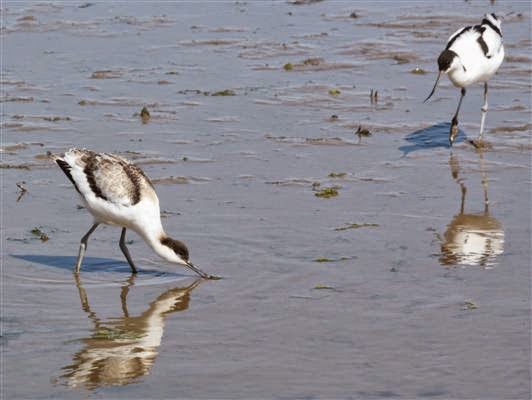
 Avocets (Adult keeping a watchful eye on a juvenile feeding).

Juvenile Avocet.

On the day of our Anniversary I booked a place on one of the boat trips from Morston Quay so we could view the Grey and Common Seals out on Blakeney Point with the added bonus of watching Common, Sandwich and Little Terns fishing fairly close to the boat.

Lazy Seals on Blakeney Point.

I will be sharing a few more images from this very enjoyable and relaxing trip in some future posts.  FAB.


Sunday, 16 December 2012

A Frosty Morning Stroll.


Last week I decided to take a stroll in Richmond Park on a cold and very frosty morning. Initially the landscape  seemed deserted of any wildlife but it wasn't long before I spotted a small group of Fallow Deer exceptionally well camouflaged amongst the frosty grasses.

A Fallow Buck showing its distinctive rear view.

A much younger buck gave me a brief glance before heading of into the frosty undergrowth.

As usual there were plenty of squawking Ring-necked Parakeets flying around and while I snapped a quiet individual perched overhead I also noticed Song Thrushes, Redwings and Blackbirds dropping down to feed around the base of the trees. Bearing in mind the recent drop in temperatures I wasn't surprised to find that most of the water on the two main ponds was frozen over with many of the ducks; Mallard, Tufted, Wigeon, Gadwall and Pochard plus Coot occupying a distant patch of clear water close to the central island.
 A female Shelduck decided to brave the thin ice in order to get a drink.


While nearby a Carrion Crow kept a beady eye on me!
Other sightings included Jackdaw, Magpie, Great Spotted Woodpecker, Green Woodpecker, Cormorant, Black-headed Gull, Common Gull, Little Grebe, Egyptian Geese and Kestrel. It was good to get out in the fresh, frosty air with the camera again.

Reason for my blogging absence: A little while ago I experienced an very unusual event which led to an unplanned early morning trip by ambulance to a local hospital. Some four hours later I was eventually allowed home but referred to a Respiratory Specialist. After various tests including a C.A.T. scan and a Bronchoscopy I finally received the 'all clear' last week but still no clear explanation as to the cause of the initial problem. So with my mind put at ease everything should now return to normal with some minor adjustments to my lifestyle and hopefully some more regular blog posts in the future.    FAB.

LinkWithin

Related Posts with Thumbnails