Showing posts with label Dragonfly. Show all posts

Tuesday, 31 July 2018

There be Dragons here.


Many of my readers will know of my regular visits, throughout the seasons, to the acidic heathland, bog, ponds and woodlands at Thursley Common National Nature Reserve  for its wealth of wildlife, notably its special birds and a habitat that also supports over 20 species of Odonata.

A carved sign alongside the boardwalk depicts some of the delights that can be found here and this post serves to illustrate the dragon species I have seen here during the past month.

Four-spotted Chaser (Libellula quadrimaculata).

Four-spotted Chaser (Above and below)


Black-tailed Skimmer (Orthetrum cancellatum) [Male above - Female below]


Keeled Skimmer (Orthetrum coerulescens) [Male above - Female below]


Keeled Skimmer - Mating pair.

Common Darter (Sympetrum striolatum) [Male above - Female below]
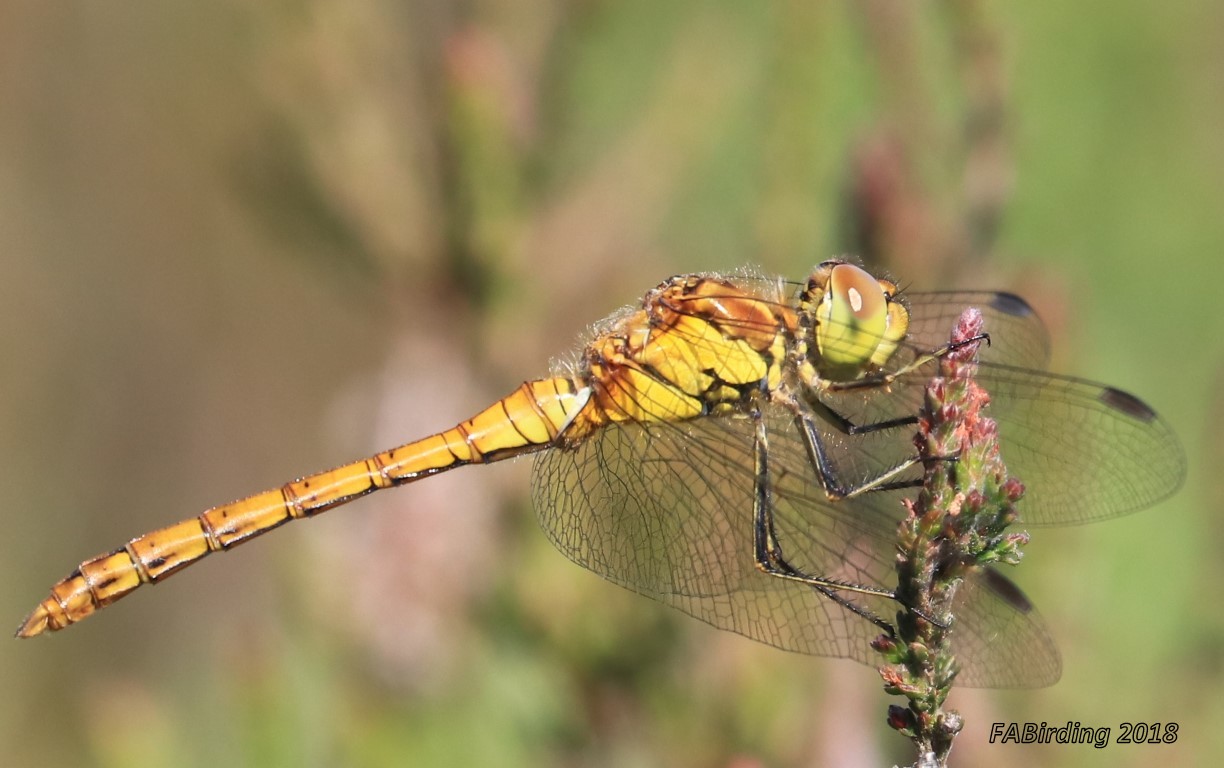


Black Darter (Sympetrum danae) [Male above - Female below]


The Damsels will feature in a future post.

Wednesday, 25 July 2018

Ruddy Darter.


I took a late morning stroll on Epsom Common yesterday in hot, muggy conditions hoping to grab some more butterfly images but instead came home with something entirely different.

A male Ruddy Darter (Sympetrum sanguineum) decided to land on a strand of the electric fencing, erected to isolate the Belted Galloway that are used for habitat management, without any ill effect. Now if I had touched it there would have been at least a few unforgettable tingles!!

The male didn't hang around for any close-ups but I found a female that was far more cooperative.


Thursday, 27 July 2017

Lowland Heath Specialities.


During a butterfly foray on Chobham Common last weekend despite being plagued by inclement weather I managed to get a few images of some of the special species that can be found on this very important lowland heath habitat.


A female Common Darter (Sympetrum striolatum).

Small Red Damselfly (Ceriagrion tenellum).

Emerald Damselfly [female] (Lestes sponsa).

Emerald Damselfly [male] (Lestes sponsa).

A male Keeled Skimmer (Orthetrum coerulescens).

Other species seen were Common Blue and Azure Damselflies.

Due to the intermittent rain showers only a few butterfly species clearly seen by me were Gatekeeper, Meadow Brown, Ringlet, Speckled Wood, Large Skipper and Brimstone plus probably one of the most cryptically camouflaged species, the Grayling.

 Grayling (Hipparchia Semele).


Tuesday, 23 May 2017

Northern Greece - Dragons And Damsels.

During our birding trip to Northern Greece I recorded eleven species of Odonata but only managed to get images of the following varieties.

Scarlet [Broad] Darter (Crocothemis erythraea). Above is the brightly coloured male and below is the female.


Common [Club-tailed] Clubtail (Gomphus vulgatissimus). This individual was soaking up the sunshine  at the roadside.

White-legged Damselfly (Platycnemis pennipes).

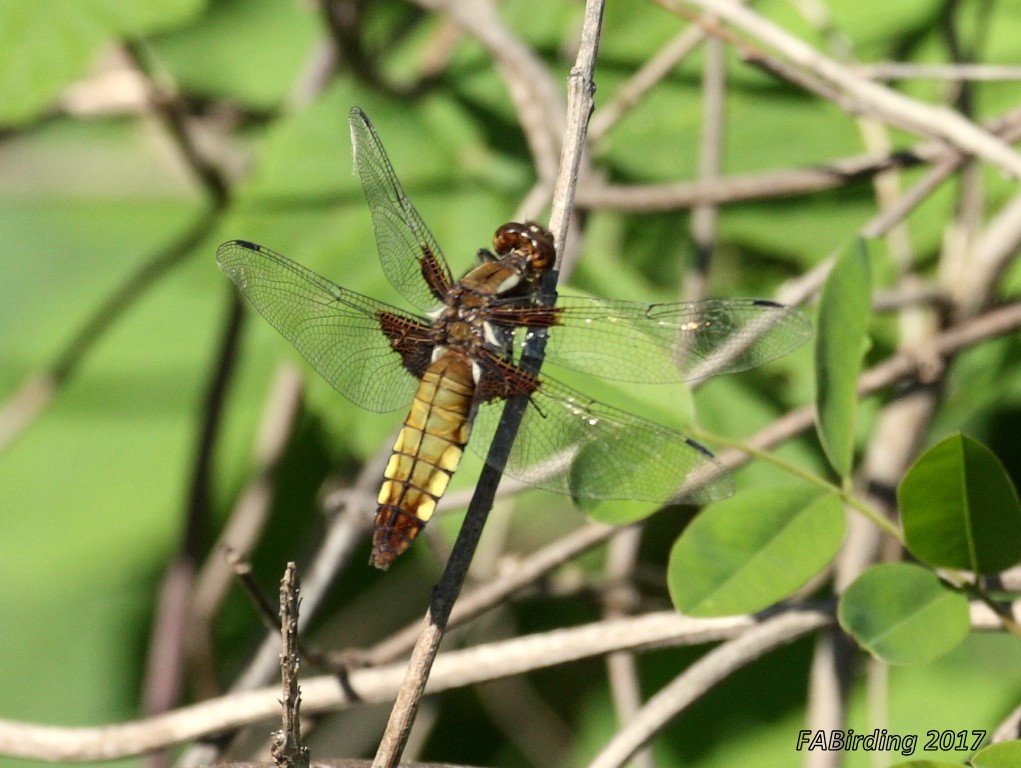
Broad-bodied Chaser (Libellula depressa).

Male (above) and female (below) of Beautiful Demoiselle (Calopteryx virgo). Both seen during a woodland walk close to a river.


Blue [Scarce] Chaser (Libellula fulva)..Above and below are shots of the male.


Above and below are images of the teneral or immature male Blue [Scarce] Chaser with its very distinctive wing markings.

Linking to:
Nature Notes

Friday, 23 September 2016

Waterside Wildlife.


A recent leisurely stroll along the towpath beside the River Wey Navigation on a warm sunny day provided the following wildlife encounters.


 Common Darter.

Brown Hawker.

At one spot I watched at least half a dozen Migrant Hawkers in flight over the water and then managed to locate one individual resting overhead.


Just a few butterfly species were seen including a single Small Copper, several Green-veined Whites plus a Comma and Red Admirals.

Comma.

 Red Admiral.


Linking to:
Saturday's Critters

Thursday, 28 July 2016

Landscape Enhancement.

For as far back as I can remember; that is from the late 1960's; the heathland landscape at Thursley NNR was dominated by 11 metal pylons carrying thirty three thousand volt overhead power lines plus twice as many wooden electricity poles carrying eleven thousand volts.

From my perspective they never detracted from the wealth of wildlife seen here over many years. The metal structures, all individually numbered, provided perching places for many bird species and sighting records often mentioned the pylon number as an aid to finding a particular bird for local and visiting birders.

The views have now dramatically changed.

After a two year-long £400,000 project funded by a special allowance granted by industry regulator Ofgem, completed last November, involving Natural England, Surrey Hills Area of Outstanding Natural Beauty (AONB) and Southern Electric Power Distribution (SEPD) over three kilometres of overhead power lines have now been placed underground, with the intention of restoring and enhancing Surrey’s rare, historic heathland landscape and re-creating a sense of partial wilderness rarely found in South East England.


During my most recent visit I noticed that a sculpture has been erected, paying homage to Pylon 36, and when completed will feature a dragonfly perched on top of the structure. I'll have to wait and see which species they decide on.

Throughout the project I understand that every effort was made to avoid areas used by rare nesting birds such as Woodlark and Dartford Warbler and to protect the Reserve’s varied habitats. Here are just some of the wildlife species I encountered during the past week.

Stonechat.

A male Keeled Skimmer.

A juvenile Green Woodpecker.

Common Lizard.

Common Darter.
 
A male Black Darter.

Other bird species seen included Woodlark, Dartford Warbler, Common Redstart, Goldfinch, Swift, Swallow and Kestrel. Butterfly species recorded were Large White, Brimstone, Red Admiral, Comma, Gatekeeper and Small Copper. The Reserve is well known for the abundance of Odonata and apart from the three images above I also saw Emerald, Blue-tailed together with Small and Large Red Damselflies plus a few other dragonfly species, namely Emperor, Four-spotted Chaser and Ruddy Darter. (Some of these varied species will feature in future posts both here and on my photo blog.)  

A location I will never tire of visiting at any time of the year for its varied wildlife. FAB.

Linking to:
Saturday's Critters 

LinkWithin

Related Posts with Thumbnails