Showing posts with label Ruddy Darter. Show all posts

Wednesday, 25 July 2018

Ruddy Darter.


I took a late morning stroll on Epsom Common yesterday in hot, muggy conditions hoping to grab some more butterfly images but instead came home with something entirely different.

A male Ruddy Darter (Sympetrum sanguineum) decided to land on a strand of the electric fencing, erected to isolate the Belted Galloway that are used for habitat management, without any ill effect. Now if I had touched it there would have been at least a few unforgettable tingles!!

The male didn't hang around for any close-ups but I found a female that was far more cooperative.


Friday, 22 August 2014

A New Transect for 2015.

Adjacent to my regular patch circuit around Epsom Common Ponds is Ashtead Common National Nature Reserve, extending over 500 acres of ancient woodland owned and managed by the City of London Corporation. In the 1870's the City was concerned that access to the open countryside was being threatened, and as a result promoted two Acts of Parliament to enable it to acquire and protect various open spaces from development.

Last month during a walk with one of the Wardens I offered my services to carry out Butterfly recording over a new fixed route (transect) starting in April 2015. I have walked the proposed route on several occasions recently and this post provides an insight to the varied wildlife I have already encountered.
 
The start of the transect begins at 'Chessington View' overlooking the fields above Rushett Farm, a good spot to listen to Skylarks in the Spring and to locate Nuthatch at almost any time of the year. During the winter large flocks of Redwing and Fieldfare congregate in the trees in between their feeding forays onto the nearby fields. Carrion Crows, Jackdaws and Magpies are fairly numerous throughout most of the year.
 
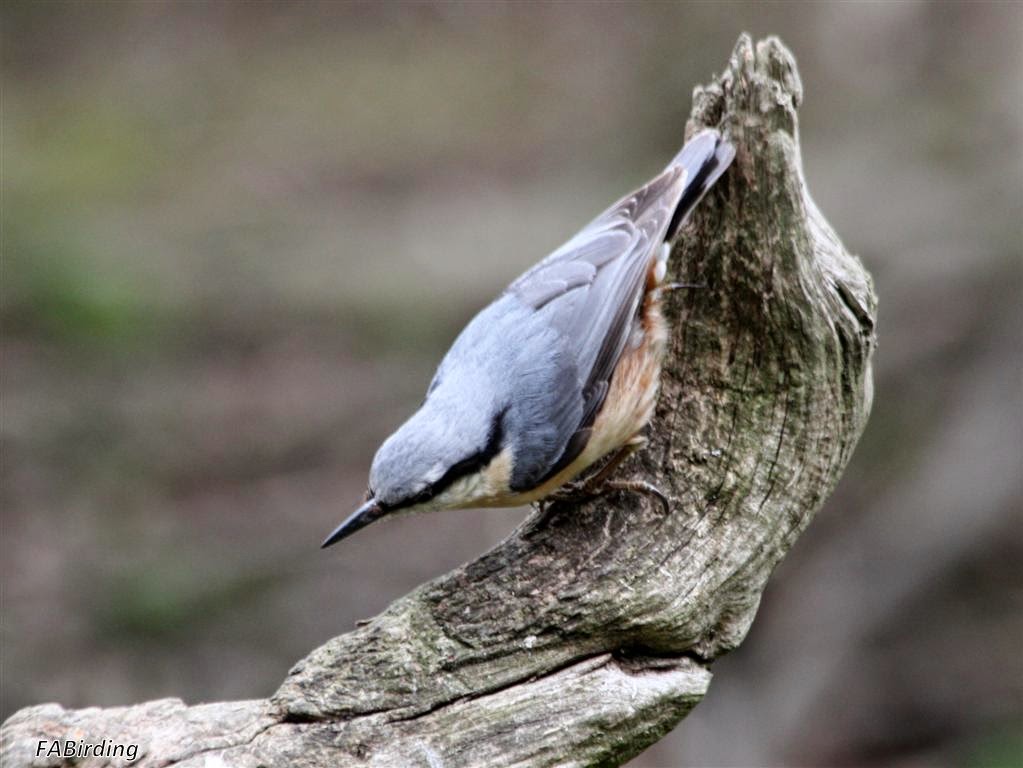
[Eurasian] Nuthatch. (Sitta europaea)

The route climbs gently upwards following one of the main rides through the woodland passing an area that was cleared some time ago and the coppiced Hazel was protected by woven rustic barriers to prevent it being browsed by Deer and it appears to have been sucessful.

This 1st section has already produced recent sightings of Brimstone, Green-veined White, Speckled Wood, Meadow Brown, Comma and Silver-washed Fritillary. Bird species seen or heard here include Great-spotted Woodpecker, Robin, Blackbird, Song Thrush, Blackcap, Chiffchaff, Chaffinch, Treecreeper, Blue, Great and Long Tailed Tits, Goldcrest and the very noisy Ring-necked Parakeets.

Speckled Wood.


Section 2 is over similar terrain and passes a very muddy coloured pool called Flag Pond where all three species of Newt; Common, Palmate and Great crested have been recorded.

This is a good place to search for Dragonflies and Damselflies.
Ruddy Darter. (Sympetrum sanguineum)

There are over 2,300 ancient pollarded Oaks across the common which play host to an amazing variety of wildlife; bugs, insects and nesting opportunities for many species of birds. A year ago I noticed that some of the Birch trees had been 'ring-barked' which prevents the sap flowing upwards and now a few have felled themselves ... just one of the many simple and natural methods employed in managing the woodlands.

The woodlands can often be surprisingly quiet until the peace is shattered by the very distinctive loud burst of song from one of the many resident Wrens.

A juvenile Wren. (Troglodytes troglodytes)

My route then passes around an area of archeological significance, the site of a 1st and 2nd Century AD Roman Villa, Bath House with adjacent tile works.

Excavations were first carried out between 1924 to 1929 and again in 1966, 2006 and more recently during August to September 2013 by the Surrey Archaeological Society. As expected nature has very quickly recolonized the diggings with grasses, nettles, ferns and brambles providing dense ground cover.


The open area below the 'King Oak' should be a very good spot for butterfly species. I have already logged Meadow Brown, Ringlet, Gatekeeper, Small and Large Skippers, Comma and Peacock. This part of the common with its mix of Oaks and Sallows is also an excellent place to see Purple Hairstreak and the handsome Purple Emperor.


As my boots brushed past the grasses lining the narrow path numerous Grasshoppers of different sizes and colours hopped from stem to stem.

I don't know if this is typical but every time the lens got close they all tried to move around the grass stem to hide!
 

A young Roe Deer patiently watched my progress before heading off into the undergrowth.


There are a number of seats along my route providing convenient spots to rest awhile and watch the wildlife. 

Sometime I find someone has also used it for other purposes ... the remains of a recent Hazelnut snack by a Grey Squirrel.


At the end of section 6 close to my rest stop I spotted a Hornet and a resting Migrant Hawker.

Various gates and fences are encountered all over the common and many of the latter form the boundaries to specific areas that are grazed by cattle on a rotation basis to maintain this special landscape.

Some of the main open rides are designated bridleways but access to many other pathways is restricted by the use of natural Birch filled barriers that need to be regularly topped up during the year. 

Silver-washed Fritillary.

The final two sections of the transect follow part of the north-western  boundary overlooking Rushett Farm where it is not uncommon for me to find a Common Buzzard, which nest in the adjacent wood, perched on one of the old Oaks or soaring above the fields.

If all goes well with the arrangements for next year I'll look forward to providing weekly wildlife updates between April and September from this interesting location.  FAB.

I'm linking this post to:
Saturday's Critters hosted by Eileen
Camera Critters hosted by Misty
I'D-Rather-B-Birdin' hosted by Anni

Thursday, 21 August 2014

Behind the Pond Fence.


Recent strolls around my patch at Epsom Common Great Pond haven't produced much in the way of bird sightings apart from the usual Grey Heron, Mallard, Moorhen, Coot, an increasing number of visiting Canada Geese, Black-headed Gull, one Swallow and the occasional soaring Common Buzzard so the lens has been focused on other wildlife.

A Ruddy Darter sunning itself on the top fence rail.

White Admiral nectaring on the other side of the fence.

A very fresh 2nd brooded Holly Blue.

Access to the far side of the pond via the main gate proved a little problematical!! The odds were definitely stacked against me as the cattle, brought in during late Spring to help manage the landscape, weren't going to give up their tiny spot of shade plus the underfoot conditions were very unsavory so I decided to seek out another way. 

The alternative route to access the rear of the reed bed hidden behind the Gorse also provided its own particular challenge! Fortunately I managed to overcome this obstacle without getting 'hot wired'.

 Common Blue Damselflies in mating wheel.

Keeled Skimmer.

Finally a reverse view across the pond from within the reed bed towards my usual viewing point.  FAB.

Linking to Good Fences hosted by TexWisGirl.

Friday, 25 July 2014

Boots still walking.

Exactly four years ago I published a post entitled 'Boots are made for ....' and reported on the wildlife I encountered on a particular walk so I thought it would be interesting to repeat the walk, which I did today, and review any changes. Well, of course, the boots have changed ... the others wore out some time ago but my shadow is still the same! However the introduction to the original post (see below) is still relevant today.

"These boots are made for walking, and that's just what they'll do".

The repeated lyrics of the well known song by Nancy Sinatra released in 1966, when I was somewhat younger, and subsequently covered by many other artists including Jessica Simpson's own rewritten version. The rest of the original lyrics bear no relationship to my daily life but without boots I wouldn't have got anywhere. As a youngster I explored the local common and woodlands; as a teenager I hill-walked (often with my father in places such as the Brecon Beacons), hiked, rock scrambled and even climbed a bit with a close friend (Snowdonia, North Wales in the depths of a snow and ice filled winter was fun); I cycled a lot (even owned a tandem for a few years which won the heart of one young lady ... for a short time!) and also canoed along various rivers and canals; then car ownership enabled me to explore other parts of the UK testing the boots over mountains,  moorlands, valley floors, clifftops and beaches. In more recent times the boots now usually carry me over less treacherous terrain as I stroll here and there often stopping to watch our native wildlife or to just soak up my surroundings at a much more leisurely pace.

So are you ready boots? Start walkin'! An anti-clockwise circuit of Banks Common (connected to Bookham Common which has featured in numerous posts). The first thing I notice is that the vegetation is a lot thicker and higher than July 2010 as a Great-spotted Woodpecker repeatedly utters its distinctive 'kick .. kick' call and a male Blackcap flies across my path while a Goldfinch converses with its companions beyond my immediate view. The PowerShot SX50 HS focuses on the first of numerous Gatekeepers nectaring on Lesser Burdock. 

As I head towards the bridge a passing dog walker advises me that the path ahead is very overgrown and muddy underfoot .. I'm not deterred, I'm wearing boots! I am however conscious of the ever present danger of being stung by the overhanging large nettles as a tiny insect takes a nip somewhere above my bare ankle. As in the past the hedgerows were full of Bindweed, their white trumpets glowing like light bulbs amongst the dark green foliage where a 2nd brooded Small White Butterfly was resting. Natures colour palette of  greens, blues, purples, yellows and reddish-browns was provided by Teasels, Bittersweet, Tufted Vetch, Agrimony, Tansy, Grasses, Thistles, Ragwort, Honeysuckle and Common Sorrel just to name but a few.

Silver-washed Fritillary where thin on the ground with only two individuals seen during my whole walk. With the relatively high temperature I was glad of the shaded areas throughout my walk but they afforded little in the way of wildlife activity. However as soon as the view opened up that changed dramatically

On the opposite side of the meadow a single Common Buzzard drifted above the tree line constantly issuing its mewing 'piiyay..piiyay' call while Large Skippers, Meadow Browns and Common Damselflies rested nearby. The fence post is still standing but the moss has invaded its crown.

The view over the style hasn't changed but in the opposite direction the hay field has long since been converted into horse paddocks for expensive bloodstock. At this point I heard the calls of both a Chiffchaff and a distant Nuthatch as a number of Blue Tits flitted through the hedgerow. I also noticed that a Dragonfly had landed 15 feet high up on a bare branch but totally inaccessible for a photo. Using my bins I ascertained it was a Common Hawker and then a Ladybird landed and without a 'by your leave' hitched a ride on my arm for a while.

There were one or two fresh Brimstone getting a nectar fix.

Surprisingly I didn't come across any horse riders during this leisurely stroll but I did watch a Kestrel hunting on the far side of the meadow for over 15 minutes, constantly dropping into the long grass and then rising up again to hover while looking for a tasty meal. I think it was eventually sucessful as it flew to its regular tree and didn't reappear. 

During the walk I saw several male Darters frantically chasing one another during their territorial battles and towards the end of my circuit I found one male Ruddy Dater taking a well earned rest.

As I returned to my vehicle the final wildlife colours were provided by a beautiful Peacock showing off its brilliant upper wing patterns and its cryptic under wing camouflage.

In conclusion, a few changes to the landscape, a lack of sightings of any White Admiral butterflies (a typical scenario on most of my recent forays) and certainly fewer birds seen or heard with the notable absence of any colourful Yellowhammers. 

However one thing doesn't change ... on my exit route the traffic on the 'magic roundabout' (M25) was at a standstill but the trains were still running!  


I make no apologies for the length of this post but do hope you will join me again sometime when the boots go walkin'. FAB.

Linking to Saturday's Critters hosted by Eileen.

Thursday, 1 August 2013

Orange, Red and Yellow.

During a very hot, humid and therefore a brief visit to Bookham Common this morning nearly everything in front of the lens was, one of three main colours, either orange, red or yellow.

 Silver-washed Fritillary [Male] (Argynnis paphia)


Peacock (Inachis io)

Common Darter [female] (Sympetrum striolatum)
ID Tips: Outer sides of the black legs are striped yellow and the black line across the top of the frons does not continue down the side of the eye as in most other Sympetrum species.


Ruddy Darter [Male] (Sympetrum sanguineum)
ID Tips: Waisted blood-red abdomen and entirely black legs.

Other species seen were White Admiral, Red Admiral, Comma, Speckled Wood, Meadow Brown, Gatekeeper, Ringlet, Holly Blue, Brimstone and Large White plus numerous blue damselflies which added a few other colours to my morning stroll.

You may not hear from me for a while as we are taking an extended weekend trip to somewhere on the North Norfolk Coast. Hopefully the weather will stay fair enough for us to wander around one or two of our favourite wildlife locations.  FAB.

Friday, 6 July 2012

Bookham Common.

While I was waiting on Bookham Common for the Silver-washed Frits to appear (see previous post) a few other species kept me entertained.

 Meadow Brown (Maniola jurtina)

 Ringlet (Aphantopus hyperantus)

 Comma (Polygonia c-album)

 An immature female Beautiful Demoiselle (Calopteryx virgo). Note the very distinctive white pseudo-pterostigma near the tip of each wing.

 Broad-bodied Chaser (Libellula depressa)

Ruddy Darter (Sympetrum sanguineum). Distinguished from the Common Darter by the totally black legs and lack of a darker middle segment on the side of the thorax.
.
 Bumble Bee (Bombus hortorum)

And then just like the Bee it was time for me for to move on to pastures new ... an afternoon visit to Thursley Common where the insect life was subtly different. (Details to follow soon).

Wherever you are ..... have an interesting wildlife weekend (if the weather permits!) ..... FAB.

LinkWithin

Related Posts with Thumbnails