Showing posts with label Curlew. Show all posts

Friday, 8 June 2018

Thursley Common - Residents and Migrants.


From late April into May I made several visits to Thursley Common NNR to check out both the resident and migrant species that inhabit this very important lowland site with its mix of heathland, acidic bog, pools and woodland.

A resident male Stonechat on sentry duty.

Over the years the population of Dartford Warbler (above) has ebbed and flowed due to the occasional severe winters and the devastating fires that have ruined their breeding habitats from time to time. Currently their numbers seem fairly stable and any opportunity to get a shot of an adult in its glorious breeding plumage is a bonus.

On one early morning visit I was fortunate to come across five Northern Wheatear (above) that had dropped in to refuel on their migratory northward journey from Africa. With the lack of cover I had to be content with a distant shot of just two individuals. 

Hearing the distinctive 'cour-lii' calls of a species that I frequently encounter on the south coast I turned my attention skywards to watch one of a pair of Curlew that regularly inhabit this site from April through to August. 


Moving further across the common to a stand of mixed woodland I found one of several male [Common] Redstart (below) that had just arrived from Africa and were setting up territories in preparation for the slightly later arrival of the females.


I spent some time in this spot watching the males chase one another and eventually grabbed a shot of one male that came a little closer, perching briefly, before continuing its aerial antics. 


Another Summer visitor from Africa is the Tree Pipit (above) typically vocalising from a high open perch.

Other species seen and or heard have included Blue, Great, Long-tailed and Coal Tits, Goldfinch, Meadow Pipit, Linnet, Skylark, Woodlark, Great-spotted Woodpecker, Swallow, Kestrel, Common Buzzard, Hobby plus several views of single and pairs of Cuckoo. 

I often end any visit by returning to the boardwalk overlooking Pudmore Pond in order to catch a glimpse of one of any number of Hobby, (above) another migrant from Africa, hawking for their prey. I hope to share more images of this consummate aerial acrobat in a future post. 

Linking to:
Saturday's Critters
I'D-Rather-B-Birdin'
Nature Notes
Wild Bird Wednesday


Saturday, 12 March 2016

Coastal Birding.


Today I am raiding the recent archives for some more images of the birds seen during my visits to the coastal marshes around Langstone Harbour last month.


I enjoy watching large numbers of any species and the overwintering Dark-bellied Brent Geese always put on a good display as they fly in from their tidal roost to feed on the grazing marsh. Their gargling, guttural calls are very distinctive as they chatter amongst themselves while feeding. 

A very dapper looking goose.


The evocative call of a Curlew is another common sound as it passes overhead to seek out another feeding location.

A pair of Common Buzzard make a brief appearance, lazily floating above the marsh.


A lonesome male Teal makes its way across the harbour at high tide.


Little Egrets fly in and out of the reed fringed pools where they can be seen waggling their bright yellow feet to disturb their likely prey.

Linking to:
Saturday's Critters

Sunday, 21 February 2016

Red Listed Curlew.


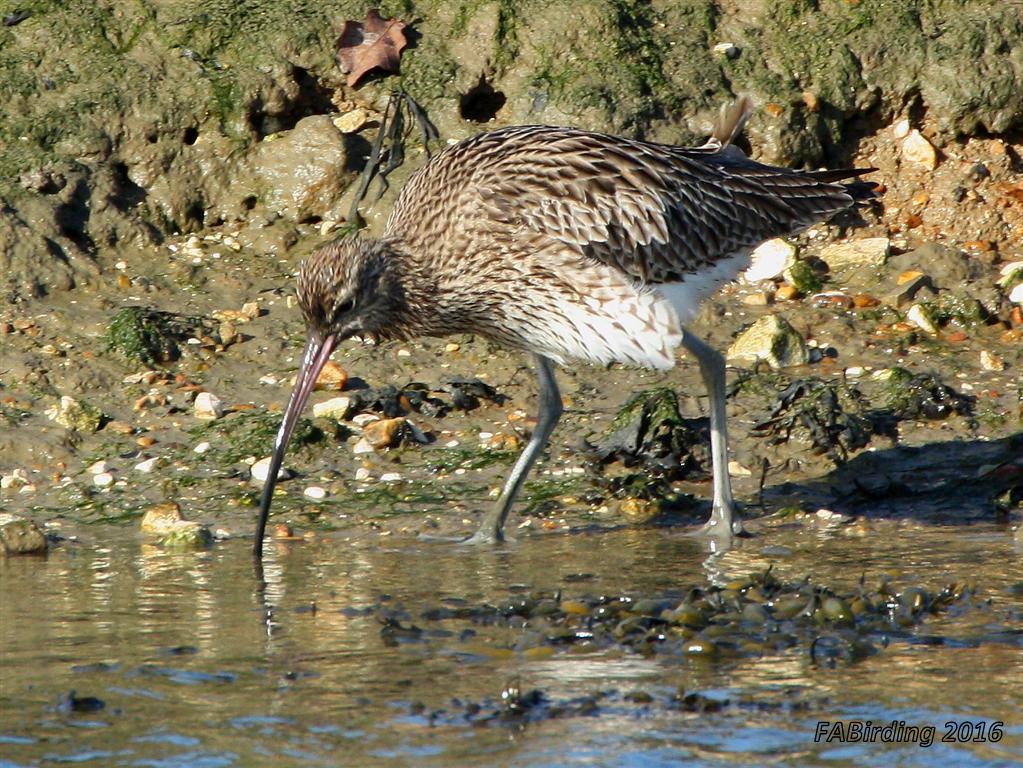
For me any visit to a coastal marsh or inter-tidal mudflats would not be the same without the evocative and distinctive rhythmic, rippling flight song or far-carrying whistling "cour-lii" call of our largest wader the [Eurasian] Curlew (Numenius arquata).

During a recent wander, on a very cold and extremely windy morning, around the disused oyster beds on Hayling Island  I was fortunate to find this individual in a water filled gully below my feet thus enabling me to get a few images without disturbing its feeding activities.

Its diet is principally invertebrates located by the sensitive bill tip as it constantly probes the mud.

Due to the continued rapid declining trends of its wintering / breeding range and overall population numbers (1969 - 2010) within the European part of its extremely large global range this species is now classed as vulnerable and has now been placed on the 'RED List'. For more information click here.


All images taken 'handheld' with 70-300mm lens plus 1.4x converter. [ISO 400; f/11; 1/320 - 1/400 @ 420mm].

Linking to:
Through My Lens
Nature Notes

Wild Bird Wednesday

Monday, 4 May 2015

Some Spring Migrants on Thursley Common.


Just over a week ago, taking a well earned break from the decorating,  I paid another early morning visit to Thursley Common to see what other Spring migrants might have turned up on this special lowland heath habitat with its acidic bog and woodland.

Stonechat (Saxicola torquatus)
Looking across the open landscape the first bird of the day was a resident male Stonechat perched high on the remnants of an old tree. I also listened and scanned for any sign of any of the four Curlew that had recently been reported (at least one pair turn up most years in early spring) but didn't find one. Maybe I'd be lucky on my return route.
As I walked through Pine Island I heard and the caught sight of several twittering Goldfinch with a Chiffchaff singing nearby.

Tree Pipit (Anthus trivialis)

As I headed up over Shrike Hill a Woodlark flew overhead and a singing Skylark ascended high into the blue sky. 

Descending the southern slope I heard the distinctive song of a Tree Pipit but initially couldn't find it until I spotted a likely candidate fly up from the heather and land in one of the lonesome conifers. A cropped record shot was the best I could achieve before this migrant moved onto another song perch much further away.


Most of the Gorse is now in full flower and some of the larger stands are good spots to find a Dartford Warbler .. I saw one fly but it promptly disappeared into the dense greenery. 

Close to one of the large sandy tracks I thought my ears had deceived me when I heard the croaking call of a Nightingale and on being joined by another birder, who has carried out the BTO bird surveys here for at least the last 20 years, we joyfully listened to not one but two Nightingales singing. I was told that this is the second Spring that a this species has been recorded at this particular spot on the common. 

On the other side of the track a returning Willow Warbler (Phylloscopus trochilus) whistled softly.

In the nearby wooded area, at a similar spot to my previous visit, a male [Common] Redstart (Phoenicurus phoenicurus) made a welcome brief appearance. After their initial arrival from Africa in April they tend to disperse across the common to separate territories within the various wooded areas.

As I walked through the field I heard the repeated call of a Cuckoo and immediately quickened my steps in the hope of locating another migrant visitor that has successfully returned from overwintering in Africa.

Since 2011 we’ve been satellite-tracking Cuckoos to find out why - See more at: http://www.bto.org/science/migration/tracking-studies/cuckoo-tracking#sthash.gPHwnzWS.dpuf
Since 2011 the BTO has been satellite-tracking this 'Red Status' species to try and find out why half the numbers in the UK have been lost over the past 20 years.


So following the calls I finally caught up with this iconic species but kept a substantial distance away so as not to disturb him as he changed position from time to time.

Cuckoo (Cuculus canorus)
 
On my return route with a pair of Common Buzzard wheeling overhead I also added Linnet and Common Whitethroat to my photo list as well as seeing Blackcap, Blackbird, Wren, Crow, Chaffinch, Long-tailed Tit, Song Thrush and Reed Bunting.

While snapping a reflective shot of one of a dozen or so Canada Geese present on the pools, as I returned to the boardwalk, I heard the distinctive call of a Curlew but was a little slow to react as a single bird flew high overhead only to drop down and disappear amongst the damp grasses. Well at least I was finally able to add it to my 2015 County year list!

And the grand finale. as I trod the boardwalk, was a brief visit by a Hobby (Falco subbuteo), another returning migrant, but only allowing just another distant record image. FAB.

Thursday, 9 May 2013

Sights and sounds on Thursley Common.


Yesterday I made a return visit to one of my favorite heathland locations, Thursley Common. It is one of the largest remaining fragments of Surrey heath and includes areas of lowland heath, mire and woodland. The site supports a range of typical heathland wildlife including large invertebrate populations. The reserve's mixture of mire and wet heath is one of the finest examples of its type in southern England. The views above were taken in mid February and show the open and somewhat bleak nature of this very important habitat.

Last year the boardwalk which winds out across one of the many wetter areas towards Pine Island was replaced  and provides an excellent place to scan around for some of the resident and migrant wildlife.

While focusing on a male Stonechat (back-lit by the strong sunshine) perched atop a young pine tree I heard the very distinctive calls of a Curlew and just managed a couple of hurried shots as one individual flew low across the heath and disappeared amongst the heathers and grasses. I eventually logged 4 individuals feeding and calling to one another. Scanning overhead produced views of at least 5 Hobby hawking insects very high over the common for about 15 minutes before they also disappeared northwards.

Curlews were very regular winter visitors in the 19th century with breeding first recorded at Chobham Common in 1893 and the number of breeding pairs peaked at 12 - 14 pairs at various Surrey sites in the 1940's. As far as I am aware, Thursley/Ockley Commons is now the only location within Surrey where at least one pair has attempted to breed since 1970. They usually arrive in mid February and depart during July.

This wide open landscape is dominated by plants such as Heathers, Gorse and heathland grasses and punctuated by scattered trees such as Silver Birch and Pines. In July 2006 around 60% of the habitat was destroyed by fire but slowly nature is returning although sightings of Dartford Warbler which were previously relatively easy to locate are now very scare and I didn't hear or see one during this walk. Apart from some habitat loss, the recent cold, wet winters have obviously had a dramatic effect on this species but hopefully their numbers will increase so we can all enjoy this charismatic little bird.


On sunny days the wide open sandy tracks are a good spot to locate butterflies soaking up the warmth. While I saw Brimstone, Peacock and Green Hairstreak (images saved for another post) the only species that stopped for a photo-call was this Speckled Wood.


Bird sightings during my walk were not particularly numerous but included several Common Buzzard, including one perched on the remains of a Birch tree, Kestrel, Sparrowhawk, Woodlark, Meadow Pipit, Tree Pipit, Green and Great Spotted Woodpecker, a couple of male Redstarts, Chaffinch, Goldfinch, Willow Warbler, Common Whitethroat, Crow, Jay, Grey Heron, Greylag Geese, Mallard, Tufted Duck and a male Cuckoo. 
 Another Stonechat.

And finally my four hour stroll ended back at the boardwalk were I noticed my first 'dragons and damsels' .. a number of Large Red Damselflies and one recently emerged Four-spotted Chaser but never close enough to capture an image. Never fear I will be back over the coming months.  FAB.

Friday, 10 September 2010

Coastal Visit.

Yesterday morning I headed southwards to Pagham Harbour and arrived just under two hour before high tide so most of the wildlife was very distant but would slowly get closer as the day wore on.
Little Egret fishing on the Lagoon Pool.
Other species included Little and Great Crested Grebe, Tufted Ducks, Mute Swan and Coots.
As I headed inland there were the usual Black-headed Gulls, Black-tailed Godwits and Curlew feeding plus a few Magpies. Lots of  Swallows were skimming the water and feeding up before their long journey south for the winter. Linnets, Goldfinches and Chiffchaffs were also seen.
As I approached the North Wall two Common Sandpipers called as they flew off but fortunately one returned but it was well camouflaged amongst all the tidal sludge! During the next 45 minutes I added Grey Wagtail, Teal, Wigeon, Canada Geese, Lapwing, Oystercatcher, Dunlin, Redshank, Spotted Redshank, Grey Plover, Ringed Plover, Grey Heron, Reed Warbler, Great Black-backed Gull, Herring Gull, Robin, Woodpigeons and Carrion Crow.  
I then joined up with a group of birders who were watching a WRYNECK and just managed a distant record shot (heavily cropped) before it flew out of sight.

While scoffing my packed lunch several Little Egrets flew overhead, a Cetti's Warbler called out several times and I also added Reed Buning, Greenftinch, Common Whitethroat, Chaffinch, Starlings, Common Buzzard and Kestrel to my day list.
The only real 'full frame' shot of the day...a Migrant Hawker sunning itself.
On the return journey back to the car a Northern Wheatear provided one of the last photo opportunities.
I slowly crept closer and closer before it decided to find another resting post. Won't be long before it takes off and heads southwards towards Africa.
Finally it was time to stop 'swanning around' and head home.   FAB

LinkWithin

Related Posts with Thumbnails