Showing posts with label Hayling Is Oyster Beds. Show all posts

Saturday, 19 March 2016

More Coastal Birding.


Whenever we visit my father-in-law on Hayling Island I usually manage to wangle an hour or two to wander part of the shoreline overlooking Langstone Harbour and yesterday I was able to extend my time by walking part of the 'Billy Trail'. With the tide well on the ebb most of the waders; Curlew, Godwit, Redshank, Dunlin, Grey Plover and Knot; were specks out on the expanding mudflats with large numbers of Brent Geese also seen flying to other parts of the harbour.


Looking inland this Little Egret was sitting quietly by the edge of a stream that crosses one of fields which is also often frequented by a Kingfisher but no sighting during this walk. A Common Buzzard (below) made a brief appearance overhead before disappearing beyond the nearby woodland.
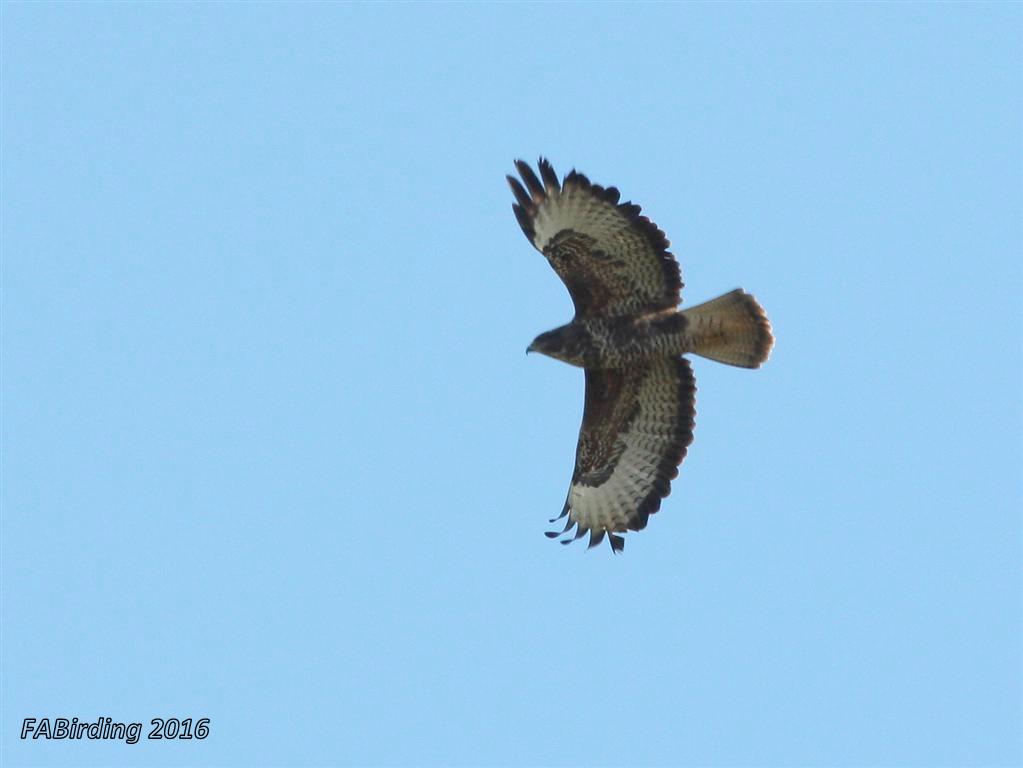


With little else catching my attention I retraced my steps and made my way towards the old Oyster Beds with the strident calls of hundreds of gulls increasing in volume the closer I got to their nesting site. A month ago there were just a handful of Black-headed and one or two Mediterranean Gulls but now the colony was alive with activity as they jostled one another for their allotted spaces.

I will feature some additional images taken of the Mediterranean Gull in a separate post very soon. 

Close to the path I disturbed a Rock Pipit while out in the harbour I also spotted a pair of Shelduck and a single Red-breasted Merganser.


One of a pair of Brent Geese wandering around the edge of the tidal pool and close by a couple of Oystercatchers (below) were seeking out morsels from the muddy margins.


Now if my visit yesterday had coincided with a high tide I might well have experienced the joy of watching mixed gatherings of thousands of waders; usually Dunlin, Grey Plover, Redshank and Knot; taking refuge on the much depleted shingle shoreline. The images below were taken just about a month ago.

Linking to:
Saturday's Critters
I'D-Rather-B-Birdin'

Tuesday, 8 September 2015

Oyster-chatter.


When I'm at the coast overlooking the vast expanses of tidal mudflats typical of the shoreline at low tide near the old Oyster beds on Hayling Island the distinctive calls of certain waders such as Redshank and Curlew are always simple indicator of the species far away on the distant mud even when my eyes can't distinguish who is who.  

During a recent visit the unmistakable, noisy and far carrying, shrill 'peep' or 'k-peep' call, increasing in volume as it heads in my direction heralds an overflying [Eurasian] Oystercatcher (Haematopus ostralegus) and provided an opportunity to capture some flight shots of this very distinctive black and white wader.


Constantly chattering as it flew by.

Linking to
Wild Bird Wednesday
Through My Lens

Saturday, 22 August 2015

Hunting Terns.

A trip to Hayling Island a few days ago to visit my father-in-law provided an opportunity for me to take a wander around the disused oyster beds. With high tide some hours away and a strong south-westerly blowing darkening clouds overhead I wasn't too hopeful of capturing any images until I spotted a pair of Common Tern (Sterna hirundo) dashing across the water and hunting for food for a youngster hidden  in the vegetation on one of the remaining bund walls.

I stood for a while monitoring their regular sorties across the water. As they seemed to be favouring two particular areas not too far away from one of the existing sea defence walls I decided  to pick a spot, park my bottom, and make myself as comfortable as possible and see if I could obtain some closer images.

I had to ramp up the ISO setting from 800 to 1600 in order to catch these very quick flying acrobatic terns so some of the shots are a bit grainy.


Amazing to see how they manage to spot their prey from so high above the surface, twisting their head from side to side, and maintain their position while being buffeted by the strong wind.

My efforts to catch them as they hovered very briefly before plunging into the water was far more sucessful than trying to get a shot of one lifting off with its prey in its bill where I failed dismally!


With very little other activity on or above the water, apart from one or two loafing Black-headed Gulls and overflying Oystercatcher and Little Egret, this pair were constantly chatting to one another until a Crow showed some interest in the nest site and then the noise levels increased dramatically as they wheeled, dived while screaming to defended their air space and promptly drove it away.  


With this final image I thought I had finally managed to capture one adult with prey in its bill but on closer inspection it turned out to be just a feather! 

For previous posts about this site and its history please click HERE.

Linking to:
Camera Critters
I'D-Rather-B-Birdin' hosted by Anni
Through My Lens hosted by Mersad
Wild Bird Wednesday hosted by Stewart

Saturday, 10 March 2012

Windy Coastal Birding.

During a visit to my parents-in-law today on Hayling Island I was able to squeeze in an hour of birding around the old Oyster Beds before lunch. As it was already close to high tide I missed most of the wader movements and the very strong wind made hand-held photography practically impossible .... but you have to try ..... so here are some of the species seen.  
 A distant view of a flock waders, mainly Dunlin, moving to a fresh resting spot at high tide.

Distant Peregrine Falcon perched on one of the small islands still above water in the main harbour channel.

Little Egret hunkered down out of the wind.

There were at least half a dozen Red-breasted Mergansers seen inside one of the disused oyster bed 'bunds' and I waited for what seemed ages in the hope that one might drift closer but as usual that didn't happen so here are a few of the cropped shots.

Other species seen were Grey Heron, Brent Geese, Mallard, Wigeon, Little Grebes, Oystercatcher, Curlew, Black-tailed Godwit, Dunnock, Greenfinch, plus of course a lot of very noisy gulls .... Black-headed, Herring and Mediterranean.

Wherever you are, have an enjoyable wildlife watching weekend.   FAB.

Sunday, 13 March 2011

Gulls Galore.

A drive southwards to Hayling Island on Friday to visit Anita's parents provided an opportunity for me to take a stroll at the disused Oyster Beds.

The early 19th century was probably the hey day of the Hayling Island oyster beds but in 1902 when new drainage / sewerage pipes were laid to meet increasing housing development the outfall into the harbour nearby caused major pollution and the oyster business failed. In the 1980's a large volume of rubble was 'dumped' into the beds. Many of the 'bunds' have been breached so nearly all of this previously protected area is now tidal. 

Despite high tide being some hours away there was very little on the water apart from two species of gulls: the more common Black-headed (Larus ridibundus) [bottom RH image] which is poorly named as in breeding plumage it has a dark chocolate brown head and the gull that does sport a black head, the MEDITERRANEAN (Larus melanocephalus) plus a thicker and blood red bill with its distinctive white eye. When this species stretches its head the black cap can appear to extend much further down the neck.

With a very strong westerly wind I attempted a couple of digiscoped shots [above and below] of  the Meds out on the closest bund and  estimated that at least 30 individuals were encamped on this rubble island and constantly moving the Black-headed Gulls away from their space. 


Eventually an opportunity arose to capture this special species in flight with the DSLR and 70-300 lens.


Other species sighted included Grey Heron, Little Egret, Cormorant, Mallard, Red-breasted Mergansers, Little Grebe, Oystercatcher, Redshank, Greenshank, Common Ringed Plover, Turnstone, Grey Plover, Curlew and the usual Dark-bellied Brent Geese plus Kestrel, Crow, Magpie, Greenfinch, Mistle Thrush and Great Spotted Woodpecker.   FAB.

Sunday, 3 January 2010

New Year's Day Birding!

On the 1st Jan we headed south towards Hayling Island to make a surprise visit to A's parents but decided to stop for a walk at Broadmarsh Park that overlooks Langstone Harbour. Unfortunately the view is somewhat industrial but regardless we followed the Hermitage Stream and found Mallard, Moorhen and a few Little Grebes. A Kestrel made a brief appearance but with freezing cold fingers I couldn't hold the camera still enough for a postable picture.   
Pied Wagtails in the car park were my next quarry but they were constantly disturbed by many other 'New Year's Day' walkers. The only option was to capture a Mute Swan having a clean up.
Mute Swan preening.
Once over Langstone Bridge we found a parking spot and prepared for our planned walk around Hayling Island Oyster Beds. As you can see it was high tide and nothing on the harbour water but eventually we found a few Brent Geese, Shelduck, Curlew, Wigeon and Cormorant.


Brent Geese heading away...as usual!
Remains of the old Oyster Beds at high tide where we located a lonesome male Goldeneye, a single flying Redshank, Black-headed and Herring Gulls. All the other waders, Dunlin, Grey Plover and Knot were hiding on the furthest rubble ridge and only showed their outlines as the flocks moved in formation to a new location further away. Our return walk overlooked the damp pastures where we spied Blackbird, Mistle Thrush, several Song Thrushes, Sparrowhawk resting in a distant tree plus one of the resident Little Egrets.
Little Egret on a hunting mission.
I just like looking in the mirror!

Other sightings, including garden visitors, meant our new year list was a dismal 31 species so I can only hope we do better when we spend a day out with friends in Kent on 2nd January!!    FAB

Friday, 16 January 2009

A day at the coast with Tony

A not so early start for 'The Early Birder' today (Friday 16th) as I picked up Tony for a day birding at his request on the south coast at Farlington Marshes.

Farlington Marshes is 125 hectares (308 acres) of flower rich grazing marsh on the northern shore of Langstone Harbour. This is an internationally important site for wintering Brent Geese & Black-tailed Godwit plus a breeding site for Redshank, Lapwing & Skylark in the summer.
Mucky Ducks! (Teal)

Crow

A view of the freshwater lagoon

A confiding Little Egret
This is what we expected to see - 000's of overwintering 'Dark-bellied' Brent Geese

Close to the information hut we located this 'leg ringed' wader with it's head buried in the grass. Can you guess what it is?

Other notable sightings were Common Snipe (12), Kingfisher, Stonechat, Avocet (12+), Little & Great-crested Grebes, Grey Heron, Lapwing, Curlew, Knot, Dunlin (000's), Grey Plover, Oystercatcher, Pintail, Wigeon, Teal, Shoveller, Shelduck and a Water Rail [heard screaming]. A male Marsh Harrier was seen quartering above the extensive reed bed.

The afternoon was spent on Hayling Island at the old 'oyster beds'.

The early 19th century was probably the hey day of the Hayling Island oyster beds but in 1902 when new drainage / sewerage pipes were laid to meet increasing housing development the outfall into the harbour nearby caused major pollution and the oyster business failed. In the 1980's a large volume of rubble was 'dumped' into the beds. Some of the 'bunds' have been breached so nearly all of this previously protected area is now tidal. The rising tide breaks through the opening in the bunds.

Resting Redshanks & Shelducks

Most of the afternoon was spent watching displaying Red-breasted Mergansers (40?) and Goldeneye (15) plus we also added Turnstone & Ringed Plover to our day list.

And finally another Little Egret experiencing a bad hair day!

The final total for the day was 46, but the highlights were definitely the large numbers of Brent Geese, Red-breasted Mergansers & Goldeneye plus of course being able to get close to a confiding Black-tailed Godwit. Did you guess correctly?

LinkWithin

Related Posts with Thumbnails