Showing posts with label Green Woodpecker. Show all posts

Thursday, 28 July 2016

Landscape Enhancement.

For as far back as I can remember; that is from the late 1960's; the heathland landscape at Thursley NNR was dominated by 11 metal pylons carrying thirty three thousand volt overhead power lines plus twice as many wooden electricity poles carrying eleven thousand volts.

From my perspective they never detracted from the wealth of wildlife seen here over many years. The metal structures, all individually numbered, provided perching places for many bird species and sighting records often mentioned the pylon number as an aid to finding a particular bird for local and visiting birders.

The views have now dramatically changed.

After a two year-long £400,000 project funded by a special allowance granted by industry regulator Ofgem, completed last November, involving Natural England, Surrey Hills Area of Outstanding Natural Beauty (AONB) and Southern Electric Power Distribution (SEPD) over three kilometres of overhead power lines have now been placed underground, with the intention of restoring and enhancing Surrey’s rare, historic heathland landscape and re-creating a sense of partial wilderness rarely found in South East England.


During my most recent visit I noticed that a sculpture has been erected, paying homage to Pylon 36, and when completed will feature a dragonfly perched on top of the structure. I'll have to wait and see which species they decide on.

Throughout the project I understand that every effort was made to avoid areas used by rare nesting birds such as Woodlark and Dartford Warbler and to protect the Reserve’s varied habitats. Here are just some of the wildlife species I encountered during the past week.

Stonechat.

A male Keeled Skimmer.

A juvenile Green Woodpecker.

Common Lizard.

Common Darter.
 
A male Black Darter.

Other bird species seen included Woodlark, Dartford Warbler, Common Redstart, Goldfinch, Swift, Swallow and Kestrel. Butterfly species recorded were Large White, Brimstone, Red Admiral, Comma, Gatekeeper and Small Copper. The Reserve is well known for the abundance of Odonata and apart from the three images above I also saw Emerald, Blue-tailed together with Small and Large Red Damselflies plus a few other dragonfly species, namely Emperor, Four-spotted Chaser and Ruddy Darter. (Some of these varied species will feature in future posts both here and on my photo blog.)  

A location I will never tire of visiting at any time of the year for its varied wildlife. FAB.

Linking to:
Saturday's Critters 

Friday, 6 May 2016

All Fenced In.

When I visited my local birding patch early this week this was the scene that greeted me. The posts have been erected and electric tape strung between them to act as a barrier for the cattle that will shortly arrive as part of the annual land management scheme. 

Unfortunately this means that my previously 'free' access is now restricted to the static gateways and 'squeeze' openings unless I grow some longer legs! 


This season they have extended the fenced area to include a small part of the woodland boundary presumably so the cattle will trample and grub out some of the unwanted undergrowth.


Not very much has changed in the way of bird life except I monitored a few more Common Whitethroats flitting in and out of the dense scrub and logged my first patch sighting for this year of a Garden Warbler.

With the increase in greenery this migrant 'LBJ' was difficult to lock onto as it moved around in-between bouts of singing and feeding. 

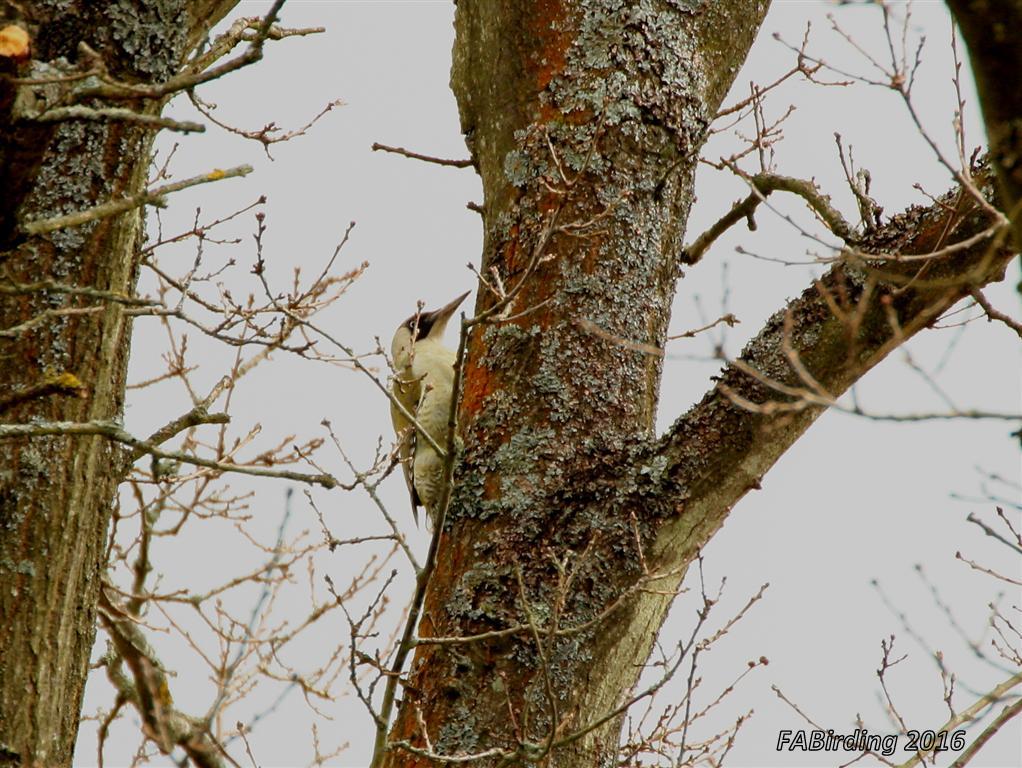
I often hear the 'yaffle' of a Green Woodpecker but they typically fly off as soon as they detect an intruder getting too close. Fortunately I managed a quick shot before this individual (below) moved into hiding behind the tree trunk.


In the past few weeks this gate, where I often watch the large gatherings of winter thrushes in the paddocks of one of the local riding stables,  has gained some additional woodwork presumably to deter unwanted guests.


The stables also use a system of tape fencing to cordon off separate sections for the horses and one of the taller posts was being used by a Mistle Thrush.


The gate above is where I listen to Skylarks singing and also provides an excellent viewpoint over Rushett Farm to look out for soaring Common Buzzards and the occasional fly by of a Red Kite. This week the young cereal crop was being sprayed and not too far away I spotted my first Speckled Wood and was also pleased to see that the Lapwings (possibly 3 or 4 pairs) are still defending their nesting territories from the large population of resident corvids.

Linking to:
Good Fences
I'D-Rather-B-Birdin'

Wednesday, 18 June 2014

Encounter with Arthur

As I began another stroll on the boardwalk at Thursley Common yesterday I bumped into (not literally!) a very interesting gentleman called Arthur, a Yorkshire man who is 75 years young and an experienced and passionate photographer of Odonata.
While watching the dragonflies zipping over the water in a very strong breeze we chatted for over 30 minutes and my brain had to work a little harder than normal as Arthur only referred to any of the various Odonata by their Latin names! I soaked up his enthusiastic knowledge and if I learned anything about photography from him it was just get out and practice, practice and learn from your mistakes ... excellent advice.

  
As we both agreed the conditions (he called it a bit 'thin') were not really conducive to getting decent low down images of the dragonflies I headed onwards through Pine Island and out onto the heathland. While watching a singing Skylark soaring up high into the sky I was aware of the calls of a warbler close by. After a little searching I found the individual and took a quick shot before it moved deeper into cover.


The soft contact call sounded like a Chiffchaff or a Willow Warbler but I think the paler cheek pattern, the thicker albeit pale supercilium, paler legs and longer primary projection indicate that this is a juvenile Willow Warbler (Phylloscopus trochilus). [I'm sure someone will correct me if I'm totally wrong].


A few of the other species seen and snapped, often at a distance, included Woodlark (6), Cuckoo (3), Stonechat (5) and Green Woodpecker. In addition I also saw Great Spotted Woodpecker, Tree Pipit, Skylark, Common Redstart, Chaffinch, Common Whitethroat, Magpie, Crow, Jackdaw, Common Buzzard, Tufted Duck, Canada Geese, Blackbird, Chiffchaff, Willow Warbler, Linnet, Long-tailed Tit, Great and Blue Tit and heard the resident Curlews calling. 
 

While following a path through an area of flowering Bell Heather I spotted a blue butterfly. Initially I didn't pay much attention to which species this might be but after it flew away I reviewed the images to reveal it was a male Silver-studded Blue (Plebeius argus) and my first sighting for this year.


One image of its under wing pattern revealed the distinctive silvery-blue centre within the black marginal spots.

After passing the 'lazy' gate I spent a little time capturing a few images of a Small Tortoiseshell (Aglais urticae) enjoying a nectar feed in the sunshine.

On my way back across the common while making a detour through one of the pine plantations I met up with Arthur again. He had decided to take a stroll away from the boardwalk as the stiff breeze was still hindering him getting any more shots of the Odonata. This time our discussions turned to past occupations and he was intrigued to learn that I had worked for the Royal Horticultural Society (RHS) and we both knew a number of people who had also worked there ... it's a small world.

Back along the boardwalk it was still fairly breezy but I managed a few captures of resting Libellula quadrimaculata (Four-spotted Chasers).
  
Another interesting encounter. Stay well Arthur and maybe our paths will cross again.  FAB.

LinkWithin

Related Posts with Thumbnails