Showing posts with label Northern Shoveler. Show all posts

Friday, 26 February 2016

Farlington Marshes LNR.

On Sunday (28 Feb) I will be leading a field trip for the Surrey Bird Club (SBC) to Farlington Marshes LNR that comprises around 300 acres of coastal grazing marsh, reed beds, scrub, with both freshwater and brackish pools. The land was first reclaimed from Langstone harbour between 1769 and 1773 by building a clay and timber wall to provide grazing land for cattle. The sea wall has been much improved and provides an ideal route around the reserve to view the wildlife both within the marshes and on the sea or extensive mudflats at low tide. 


On Tuesday I made a recce visit to check out the wildlife and to get some images of the species that can be seen here just in case the windy weather that is forecast for Sunday doesn't provide me with many photo opportunities.

During the winter months one of the main attractions are the very large flocks of Dark-bellied Brent Geese that feed on the grazing marsh.

At this time of year the marsh also supports good numbers of Curlew, Northern Pintail, Oystercatchers, Lapwing and Teal plus I was also fortunate to get several sightings of two Short-eared Owls.

During my recent visit I also saw three species of Grebe, Red-breasted Merganser, Shelduck, Shoveler, Wigeon, Gadwall, Dunlin, Redshank, Grey Plover, Knot and Turnstone plus good numbers of Black-tailed Godwits (see below) disturbed from feeding by a low flying Common Buzzard.


At high tide I also watched the spectacle of many hundreds of Dunlin streaming close above the water seeking out a suitable spot to roost and wait for the mud to reappear while inland there is always something else to capture one's attention such as ....

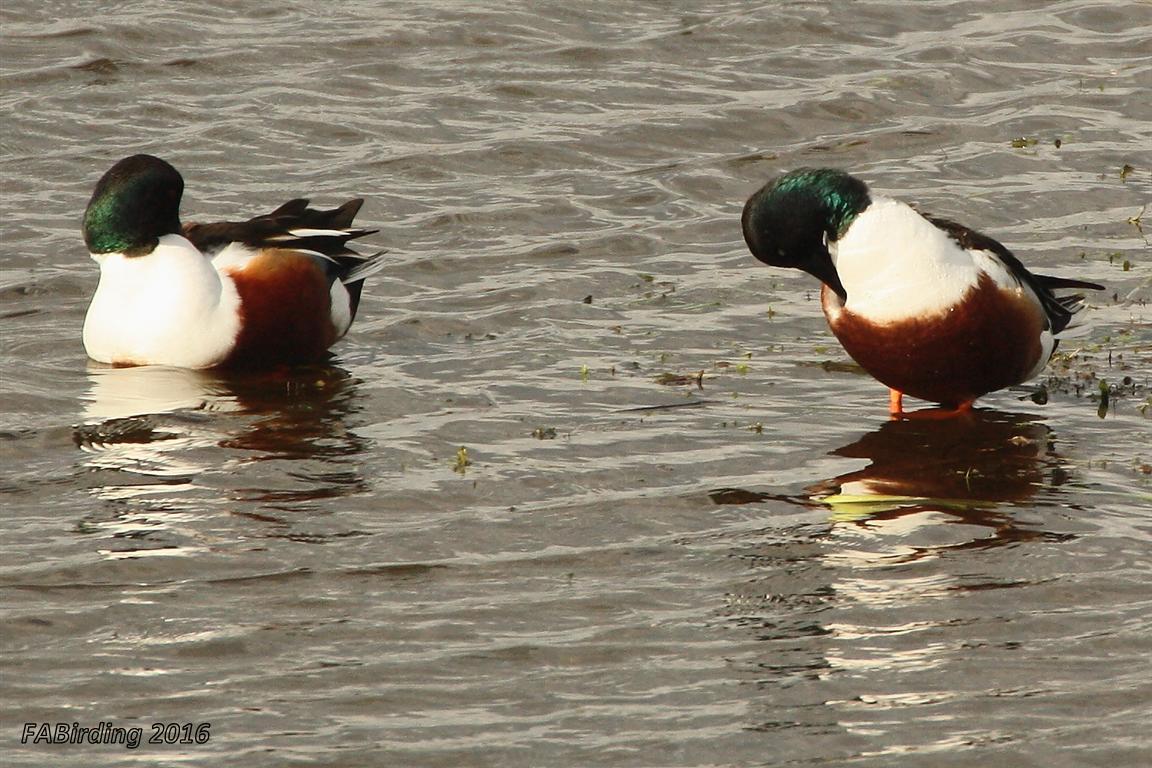
a perching Stonechat, one of many Northern Shoveler in their full breeding plumage and the various gull species including the Black-headed Gull. The site also hosts reasonable numbers of Little Egret (see below).

During my wandering I logged about 50 species but with more eyes on Sunday it is possible to add a few more including Kingfisher, Peregrine, Merlin, Water Rail, Rock Pipit, and the elusive Bearded Tits. FAB.

Linking to: Saturday's Critters, I'D-Rather-B-Birdin' and Through My Lens.

Friday, 19 February 2016

London Wetland Centre.


With a forecast of a few hours of decent weather on Friday morning I paid another visit to the London Wetland Centre at Barnes in the hope of catching up with a Bittern but it was not to be. Nevertheless there was still plenty of birds on view, both wild and captured species.


My southerly route towards the main reed-beds provided an opportunity to snap a few of the captive species including Hooded Merganser, Marbled Teal and White-headed Duck.


A male Tufted Duck

A scan over the flooded grazing marsh produced Grey Heron, Mute Swan, Cormorant, Wigeon, Gadwall, Pochard, Coot, Moorhen, Mallard, Teal, Canada Geese, a single Egyptian Goose plus numerous Northern Shoveler, many enjoying a preening session in the sunshine.


The centre which opened in 2000 occupies the site of the former Barn Elms reservoirs covering a total area of about 100 acres including open water, muddy banks, grazing marsh, some woodland and an extensive reedbed right in the heart of the south London urban landscape. Three quarters of the site was designated an Site of Scientific Interest in 2002.


My route back to the centre only produced one additional sighting, an over flying Little Egret. The northern part of the reserve has several hides overlooking the open water enabling decent views, albeit often distant of the ducks, gulls and and a much reduced number of Northern Lapwing.


My only raptor sighting was a male Sparrowhawk who made a brief appearance on one of the small islands and from the first floor of the Peacock Hide I spotted a male Pintail (below) in its elegant finery fortunately within reach of the lens.

Despite the lack of a Bittern sighting (again!) it was a joy to be out in the winter sunshine enjoying our native wildlife. FAB.

Linking to Saturday's Critters and I'D-Rather-B-Birdin' 

Saturday, 31 January 2015

January Patch Birds.

My wildlife watching got off to a slow start this year due to a virus contracted over the Christmas period that laid me low for a couple of weeks. Local patch water fowl sightings have been thin on the ground due to the pond freezing over a week ago and everything appeared to be in hiding.

Fortunately four Northern Shoveler present on the pond since early December were still around prior to the water freezing up and one male in full breeding plumage was close enough during one patch visit to provide an opportunity for a few images.
Other sightings have included up to six Teal; with four males displaying to two females; and two pairs of Mandarin Duck plus the resident Mallard and Moorhens.


Northern Shoveler

Moorhen

At this time of year it is not unusual to see large parties of Long-tailed Tits foraging through the woodland but obtaining a clear shot as they flit from perch to to perch is another challenge! On a few occasions the flocks have included one or two Goldcrests but I have still to capture a decent image of this tiny species.


Long-tailed Tit.


One species that rarely allows a close approach is the Jay but I was fortunate recently to catch one searching through the leaf litter and totally oblivious to me creeping close enough for this cropped shot.

During this continued cold and wet weather raptor sightings have included Kestrel, a Sparrowhawk darting through a large flock of Redwing, Common Buzzard and an over flying Red Kite. 


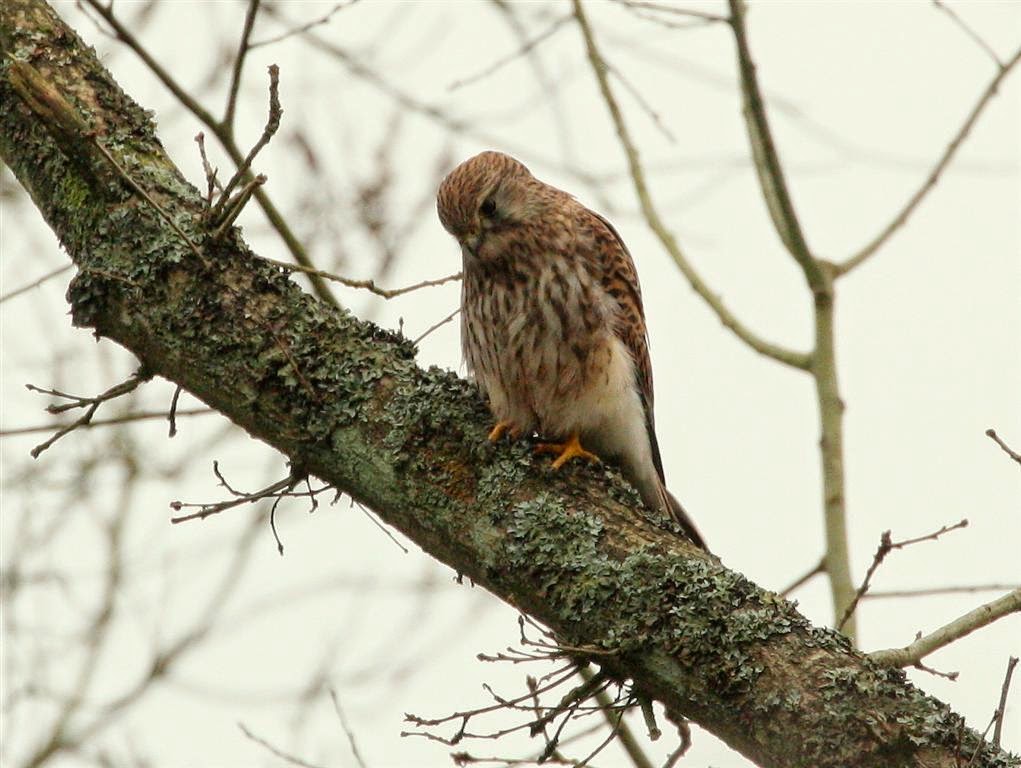
I spotted this (juvenile or female) Kestrel perched in a tree close to one of the main paths and watched it surveying the ground below for a possible meal. After a few minutes it flew to another perch to continue its vigil before eventually flying away.


One Black-headed Gull has taken up residence on the main pond and regularly takes flight when another interloper flies in and chases off any competition!


My patch tally for January has now reached 40 species and you can view the full list on my Bird Sightings page. FAB.

Linking to Saturday's Critters hosted by Eileen.

Saturday, 6 December 2014

Recent Patch Birds.

Another damp and dreary week so very limited opportunities for photos during my local patch walks around Epsom Common Pond but here are a few of the recent visitors and residents.
A single Greylag Goose. A fairly infrequent visitor on the patch who decided to keep its distance.

I have counted up to six Northern Shoveler on the pond this last week. The males were in various plumage's but often hidden away while feeding in the waterside vegetation. Occasional forays across the water always seem to be a long way away from my viewing point hence this cropped record shot.  

One of the resident Mallard flying over in the hope of not missing out on a hand-out!

Kestrel taking a well earned rest from its hunting activities.

A 1st winter Mistle Thrush, perched in the open, showing off its distinctive rounded black breast spots and the paler outer coverts.

One of the many Ring-necked Parakeets inspecting a possible roosting hole. This is now a common resident breeding species but more often seen and heard when flying over the woodland.

Back at home there has been far more activity around the feeders including Blue Tit (above image shot through the window), Great Tits, Coal Tit, Greenfinch, Chaffinch, House Sparrows, Starling, Dunnock, Robin, Blackbird and Ring-necked Parakeets making sure I keep the larder well stocked.  FAB.

Sunday, 16 November 2014

Damp Patch Birding.

The current weather pattern, windy, damp and heavily overcast skies, has not been conducive for photography during my recent patch walks. Most of the small birds have stayed in hiding so just a few images of the larger species seen on or around the pond.

Coot still collecting material to build up or repair the nest.
 
A couple of Cormorants called in for a few days and one spent some time trying to capture some warmth from the limited sunshine.

Earlier this month a male Northern Shoveler turned up on the Great Pond but typically kept a long way away from the lens. I subsequently spotted him with his mate who spent most of her time in hiding.

Eventually managed to capture him out of the water.

Mute Swans don't turn up on the patch very often so it was nice to see a pair drop in if only very briefly.

A single Black-headed Gull takes a rest from its aerial circuits around the pond.

Moorhen .... and it's time to dig out the wet weather gear!  Linking to I'D-Rather-B-Birdin'.

Wishing everyone a wonderful wildlife watching weekend, wherever you are.  FAB.

Saturday, 18 October 2014

Wildlife around Heron Pond.

A very mixed week weather wise so here is a small selection of the wildlife seen during my visits to Heron Pond in Bushy Park.

As usual one of the very approachable Grey Heron was waiting near the car park.

Black-headed Gulls, in various stages of their winter plumage, waiting for a handout.


Ducks on the water included the bright eyed Tufted, Gadwall with its finely vermiculated grey body and a single (Northern) Shoveler all slowly changing into their full breeding plumage.

A surprising find this week was a juvenile Herring Gull in its mottled plumage resting on the remains of a floating nest.

 The pond also supports a small but healthy population of Red-crested Pochard.

Large numbers of Jackdaw frequent the park. They are fairly friendly and always willing to pose.

The local residents also include these two introduced species, Canada and Egyptian Geese. 

At this time of year one is never far away from a Red Stag wandering through the bracken on the lookout for hinds or protecting his existing harem often resting and hidden deep in the vegetation.

During the rut the general advice is to keep at least 50 metres from any of the deer, especially the stags but sometimes they just appear and let everyone know their intentions!

And then he sauntered away to be camouflaged once again by the autumnal hues of the ferny landscape.

All these three images are cropped so I wasn't that close and always respect the boundaries when photographing any wildlife. FAB.

Linking to Camera Critters, Saturday's Critters and I'D-Rather-B-Birdin'.

Tuesday, 29 January 2013

Bittern at WWT Barnes.

So here is the scenario which I'm sure many of us have experienced. You enter a bird hide and one or more of the occupants says "There's a Bittern out here" (inwardly I think great ... that's one of the reasons why I came here today) and then one of two options ... either you are left to scan everywhere or you are given some sort of directions ... such as "It's in the reeds, over there on the right".

So above is the general view that greeted me out of a hide window at W.W.T. Barnes today and a similar greeting (as detailed above) from another visitor, who then waited a few moments before adding "Have you found it?". Well for anyone who knows what a Bittern looks like (it is  one of the ultimate camouflage species) you then scan the reed margins for a slightly darker shape that is usually absolutely stationary within the similarly coloured reed stems.

It didn't take me long to locate my quarry but the dull overcast conditions and distance were far from ideal for my set up but I'll share these 'record' shots (heavily cropped) just to show how difficult this species can be to locate for the inexperienced. 
One day I'll capture one out in the open on a nice sunny day ... lol!

Needless to say that when some other visitors joined me in the hide I was more than happy to provide them with far easier instructions in order to locate this winter visitor and one guy was overjoyed to get a close up view through my scope.
Of course there were plenty of other species on view including lots of Northern Lapwings plus a distant view of a single female 'red-headed' Smew.

Male Gadwall (Anas strepera)
For more information on this species, please CLICK here.

Northern Shoveler (Anas clypeata).

Well at least a couple of ducks came close enough for the lens before the dark clouds rolled in. The forecast doesn't look particularly promising for the next few days so I may have to revert to looking through some of last years images for the next post.   FAB.

Linking up to WILD BIRD WEDNESDAY.

LinkWithin

Related Posts with Thumbnails