Showing posts with label Oystercatcher. Show all posts

Friday, 25 May 2018

Farlington Marshes - Winter Birding.


Earlier this year I made three visits to Farlington Marshes, one of my favourite sites on the south coast, to enjoy the spectacle of winter birding.

 
One of the main attractions being the thousands of Dark-bellied Brent Geese that migrate southwards from their arctic breeding grounds in late September to spend the winter months in and around Langstone Harbour.


The reserve and surrounding harbour attracts large numbers of waders, including Dunlin, Knot, Grey Plover and Oystercatchers (above) plus Ringed Plover, Turnstone and Black-tailed Godwit (below) in their drab grey winter plumage.


Wildfowl increase through the winter months with particularly high numbers of Teal and Northern Pintail (above) plus Shelduck (below).

During these winter visits I have logged 64 species including Avocet, Marsh Harrier, Peregrine, Water Rail, Water Pipit, Short-eared Owl, Bearded Reedling and one of several Spoonbill (below) that irregularly visit this site.

I will be revisiting this area throughout the year and hope to share the diversity of species that can be seen here.  FAB.

Linking to:
Saturday's Critters
I'D-Rather-B-Birdin'

Tuesday, 14 March 2017

Farlington Marshes Fieldtrip.

On Sunday I drove southwards to lead a Surrey Bird Club field trip at Farlington Marshes.

The weather forecast was not promising with heavy rain predicted for most of the morning but fortunately this failed to materialize with any significance. Under an overcast sky and light drizzle just two members, Trevor and Victoria, joined me at 9am for the planned walk around the reserve.

High tide was due at around 11.30 so we started by scanning the extensive mudflats locating numerous Dark-bellied Brent Geese plus good numbers of Shelduck that traditionally overwinter around Langstone Harbour. Small groups of Northern Pintail with the elegant males in their full finery were spotted together with a few waders; Dunlin, Grey Plover, Redshank, Black-tailed Godwit, Oystercatcher and Curlew.

As the tide rises the Brent Geese leave the harbour to fly into the grazing marsh.

Heading inland towards the stream the first of several Cetti’s Warblers boldly called from the nearby vegetation, typically moving ahead of us out of sight! Amongst a small group of gulls we found two Mediterranean Gulls enabling a clear comparison with their Black-headed companions. A few Lapwing briefly appeared in the sky above the reed bed. Due to the damp conditions, not surprisingly, we failed to see any Bearded Reedlings near the information building where we sheltered briefly from the constant drizzle. At this point Victoria unfortunately decided it was time to return home.

The sun eventually tried to make an appearance and the drizzle finally abated so under a lightening sky and hopeful for an interesting afternoon Trevor and I walked out to rejoin the sea wall path.

Oystercatchers flying across the harbour. This image was taken just a week earlier under better lighting conditions.

With flat calm waters on the falling tide we finally spotted a small flotilla of Red-breasted Merganser, a single female Goldeneye and Great Crested Grebe. An LBJ flitting through the field edge shrubbery was eventually identified as a Chiffchaff. Walking towards The Deeps we added Wigeon, Shoveler plus a distant perched Kestrel eating its prey.

Another image shot a week earlier shows a collection of waders; Dunlin, Grey Plover, Turnstone and Knot: taking refuge on a tiny reducing island at high tide.

At the Deeps, a winnowing Little Grebe failed to make an appearance but a pair of Reed Buntings and Tufted Duck were added to our day list. Several more Skylarks were seen and heard. Having earlier heard a Meadow Pipit calling in flight we located 2 Rock Pipits feeding in and out of the grass margins on the sea wall path.

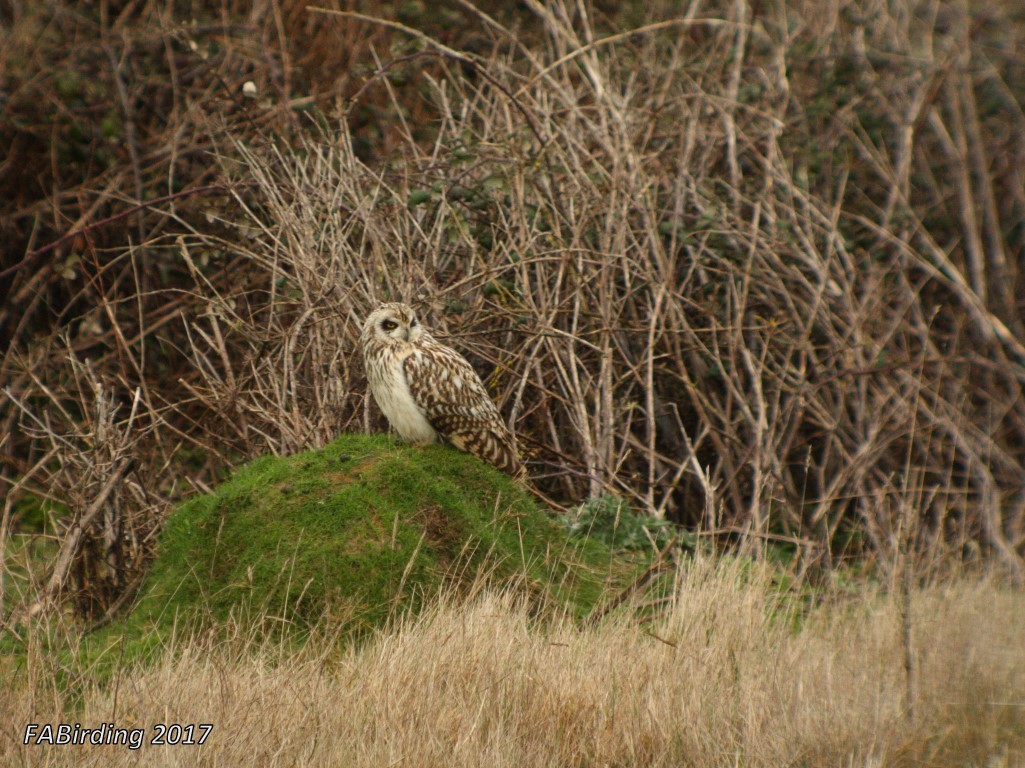
At around 1.30pm while watching various flocks of waders moving out across the harbour I turned around only to find a Short-eared Owl hunting over the Point and then disappearing out of view. We retraced our steps and relocated this individual sitting on a fence post before it eventually flew of east towards North Binness Island.

Chatting to another birder helped us to get scoped views of a preening Spoonbill at the back of the distant reed bed. A definite rarity for this site and an excellent addition to the trip list. Shamefully I had previously spotted and discounted an unmoving white blob well-hidden way out in the grass as probably a plastic bag!!

Moving further around the Point and thinking that having seen one ‘Shortie’ was a bonus we were delighted to have even closer views of a second bird who after briefly flying around perched on a grassy mound allowing for another photo opportunity.


Short-eared Owl. 

Returning full circle back to the main pool we enjoyed close views of a feeding Little Egret and Common Snipe and logged 5 Greenshank and a single Spotted Redshank in its typical grey winter garb.

Little Egret.

My thanks to Victoria and Trevor for their company and making this a worthwhile trip to the coast with a final tally of 60 species. FAB.

Linking to:
I'D-Rather-B-Birdin'

Saturday, 19 March 2016

More Coastal Birding.


Whenever we visit my father-in-law on Hayling Island I usually manage to wangle an hour or two to wander part of the shoreline overlooking Langstone Harbour and yesterday I was able to extend my time by walking part of the 'Billy Trail'. With the tide well on the ebb most of the waders; Curlew, Godwit, Redshank, Dunlin, Grey Plover and Knot; were specks out on the expanding mudflats with large numbers of Brent Geese also seen flying to other parts of the harbour.


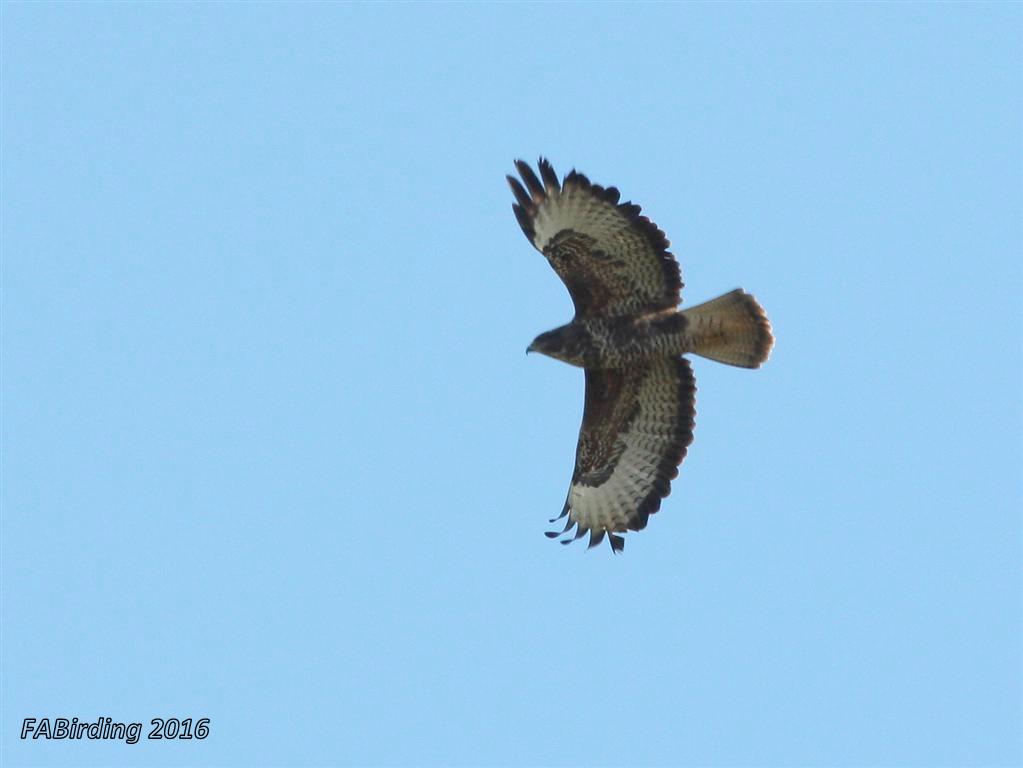
Looking inland this Little Egret was sitting quietly by the edge of a stream that crosses one of fields which is also often frequented by a Kingfisher but no sighting during this walk. A Common Buzzard (below) made a brief appearance overhead before disappearing beyond the nearby woodland.


With little else catching my attention I retraced my steps and made my way towards the old Oyster Beds with the strident calls of hundreds of gulls increasing in volume the closer I got to their nesting site. A month ago there were just a handful of Black-headed and one or two Mediterranean Gulls but now the colony was alive with activity as they jostled one another for their allotted spaces.

I will feature some additional images taken of the Mediterranean Gull in a separate post very soon. 

Close to the path I disturbed a Rock Pipit while out in the harbour I also spotted a pair of Shelduck and a single Red-breasted Merganser.


One of a pair of Brent Geese wandering around the edge of the tidal pool and close by a couple of Oystercatchers (below) were seeking out morsels from the muddy margins.


Now if my visit yesterday had coincided with a high tide I might well have experienced the joy of watching mixed gatherings of thousands of waders; usually Dunlin, Grey Plover, Redshank and Knot; taking refuge on the much depleted shingle shoreline. The images below were taken just about a month ago.

Linking to:
Saturday's Critters
I'D-Rather-B-Birdin'

Tuesday, 8 September 2015

Oyster-chatter.


When I'm at the coast overlooking the vast expanses of tidal mudflats typical of the shoreline at low tide near the old Oyster beds on Hayling Island the distinctive calls of certain waders such as Redshank and Curlew are always simple indicator of the species far away on the distant mud even when my eyes can't distinguish who is who.  

During a recent visit the unmistakable, noisy and far carrying, shrill 'peep' or 'k-peep' call, increasing in volume as it heads in my direction heralds an overflying [Eurasian] Oystercatcher (Haematopus ostralegus) and provided an opportunity to capture some flight shots of this very distinctive black and white wader.


Constantly chattering as it flew by.

Linking to
Wild Bird Wednesday
Through My Lens

Tuesday, 9 June 2015

Oystercatcher.

One species of wader that I don't very often see in my land-locked county of Surrey; although they do regularly turn up on various reservoir sites in the spring; is the [Eurasian] Oystercatcher (Haematopus ostralegus).
So when I spotted a pair on the roof of a hide overlooking the River Arun that also houses the Sand Martin nests at the Wildfowl and Wetlands Trust, Arundel during a visit last month it was an opportunity to grab a few shots for the album.


Linking to Wild Bird Wednesday.

Sunday, 16 June 2013

Birding Day in Suffolk and Norfolk.

On Friday I left home in the wee small hours and at 5am met up with six other birders at RSPB Lakenheath in Suffolk. The site has been playing host recently to rare birds such as Savi's Warbler and Red-footed Falcon and is probably the only regular breeding location in the UK for the 'RED listed' Golden Oriole plus home of the Common Crane that first bred there in 2007. Indications were that the first two species had not been recently sighted and although a pair of Golden Orioles were around they can be notoriously difficult to locate once they start the breeding process.

With the light slowly improving and a very chilling strong breeze we started our circuit of the reserve at the viewpoint overlooking 'The Flash' with overflying views of Lapwing, Curlew and a close quartering Barn Owl carrying its prey. The reed beds were full of the rhythmic and scratchy songs of Reed and Sedge Warbler respectively plus the distinctive reeling of Grasshopper Warbler interspersed by the occasional but sudden loud outburst from Cetti's Warbler and Wren. 

 Wren bursting into full song.

Throughout our time here Cuckoo's called constantly from their lofty perches and several were seen in flight. (I subsequently learnt that there are probably five males but only one female. Even so they have plenty of their favoured host species available, the Reed Warbler, to ensure a successful breeding season.) At every opportunity we scanned likely locations but I only heard the flutty call of a Golden Oriole on two separate occasions. Bittern was heard 'booming' and Marsh Harriers were regularly on the wing hunting with plenty of Swifts screaming overhead but very few Swallows. I found it difficult to pick up the twanging calls of Bearded Reedling but several were seen briefly skipping over the top of the reeds. A pair of Egyptian Geese and a single Common Tern flew along the river while a scan of the fields way beyond produced two resident Common Cranes. 

 Grey Heron.

After leaving Lakenheath we visited a 'likely' road-side area (according to a reliable source)  barricaded with electric fencing for Stone Curlew but couldn't locate anything apart from Hares and Rabbits so we stopped at Brandon for a hearty full english breakfast before popping into Weeting Heath. We were only just in time to log two adults and one chick before three reserve staff walked out onto the breeding area to ring the chicks. (You would have thought they could plan this sort of activity before the reserve was open to the public ... AND they actually walked straight past one chick and of course the adults took flight!) As the adults probably wouldn't resettle for some time the decision was made to drive northwards to Cley Marshes for probable Pectoral Sandpiper, Spoonbill and a male White-spotted Bluethroat although some doubt existed as to if the latter was still around. (Needless to say we didn't see it ... that would have been a lifer for me.)


After a caffeine fix we headed out onto the East Bank and located a Spotted Redshank, Dunlin, Black-tailed Godwits and then a single Pectoral Sandpiper skulking in the grass fringes of one of the pools. From the shingle ridge we added Sandwich and Little Tern over the sea.

Oystercatcher nesting on the landward side of the shingle ridge that protects the reserve from the sea. It was interesting to note the increase in vegetation around this spot that was marked out to protect the nest site which in normal circumstance would have born the brunt of thousands of human footsteps. 
 
A little further on an Avocet had also decided that this was a good place to nest.

From the North Hide we confirmed our earlier distant scoped views of a sleeping Spoonbill, another Spotted Redshank, Ringed Plaver and a Little Stint plus a flyby Mediterranean Gull. Unfortunately the rest of my 'day companions' had to return home to Surrey at lot earlier than originally planned so I spent a while in one of the hides watching the numerous Avocets with their chicks and the hiatus caused when a Marsh Harrier drifted over their territories and snatched a meal. 

Outside the hide in a nearby field a Lapwing provided a closer opportunity for the lens before I eventually drove back southwards to my overnight accommodation at Barton Mills and decided to revisit the RSPB Lakenheath Reserve again the following morning before returning home. 

A rain front had moved through overnight and there was still plenty of cloud and drizzle at 6am but the conditions slowly improved over the next two hours and I was fortunate to have good views of three separate Bittern in flight and the pair of Common Cranes flying off to their daytime feeding area.

 Common Cranes.

My thanks go to Richard H for generously inviting me along and for the company of Rich S, Neil R, Matt P, Dave B and Mark L on a grand birding day. My overall tally for the trip was 75 species of which 7 were year ticks but no lifers this time.  FAB.

Linking to Camera Critters,  I'D-Rather-B-Birdin' and Wild Bird Wednesday.

Monday, 2 April 2012

Waders in Pagham Harbour.


Last week I made a visit to the coast and wandered around a small part of Pagham Harbour between The Spit and the North Wall for a couple of hours. With high tide some hours away the only species that really came close enough for a photo was one of many singing Greenfinches.Most of the waders were distant views through the bins but it didn't stop me trying .... so here are a few cropped images.


Oystercatcher

Spotted Redshank

At least the stationery and over flying Gulls made things a little easier.


I even attempted to slowly creep closer to a group of preening Black-tailed Godwits, all resplendant in their breeding plumage but just as I settled down they decided  it was time to move on before I had time to change the camera settings!
Oh well ... better luck next time.   FAB.

Wednesday, 30 June 2010

Norfolk Review (Part 4) - Pensthorpe Wildlife Park

Day 6 saw us visiting Pensthorpe Wildlife Park, near Fakenham.
Lots of interesting areas to encourage the large number of school children who were also visiting including the 'Bug Trail'. As you can see some of the specimens were far larger than expected!
There was clear evidence everywhere that the BBC Springwatch was in residence; hides on the scrape occupied by wildlife cameramen monitoring the breeding Avocets and Little Ringed Plovers; seat and bridges with posters stating 'BBC Property - Not for Public Use'; camera and sound system with its own brolly top being set up over the stream plus many visitors eagerly scanned any occupied vehicle moving around the park in case it contained a well known personality!
Evidence that some breeding species have been very successful this season; Canada and Greylag Geese...
.....AND an Oystercatcher with chick nesting in the water garden which was cordoned off.
No excuses for showing more images of one of my favourites....Barnacle Geese.
Plus masses of Ox-eye Daises everywhere.
I must admit that I didn't stop to take many pics of the 'collection' species apart from a few in the 'endangered' pens but I'll leave them for a quiet moment sometime in the future.  If you haven't visited it is certainly worth making the effort if you are in the vicinity of Fakenham. I can definitely recommend the very reasonably priced on site catering. I ordered traditional sausages and mash which was served up with an unexpected additional side dish containing peas, green beans, carrots and red cabbage..delicious.   FAB.

LinkWithin

Related Posts with Thumbnails