Showing posts with label Epsom and Ashtead Commons. Show all posts

Saturday, 31 January 2015

January Patch Birds.

My wildlife watching got off to a slow start this year due to a virus contracted over the Christmas period that laid me low for a couple of weeks. Local patch water fowl sightings have been thin on the ground due to the pond freezing over a week ago and everything appeared to be in hiding.

Fortunately four Northern Shoveler present on the pond since early December were still around prior to the water freezing up and one male in full breeding plumage was close enough during one patch visit to provide an opportunity for a few images.
Other sightings have included up to six Teal; with four males displaying to two females; and two pairs of Mandarin Duck plus the resident Mallard and Moorhens.


Northern Shoveler

Moorhen

At this time of year it is not unusual to see large parties of Long-tailed Tits foraging through the woodland but obtaining a clear shot as they flit from perch to to perch is another challenge! On a few occasions the flocks have included one or two Goldcrests but I have still to capture a decent image of this tiny species.


Long-tailed Tit.


One species that rarely allows a close approach is the Jay but I was fortunate recently to catch one searching through the leaf litter and totally oblivious to me creeping close enough for this cropped shot.

During this continued cold and wet weather raptor sightings have included Kestrel, a Sparrowhawk darting through a large flock of Redwing, Common Buzzard and an over flying Red Kite. 
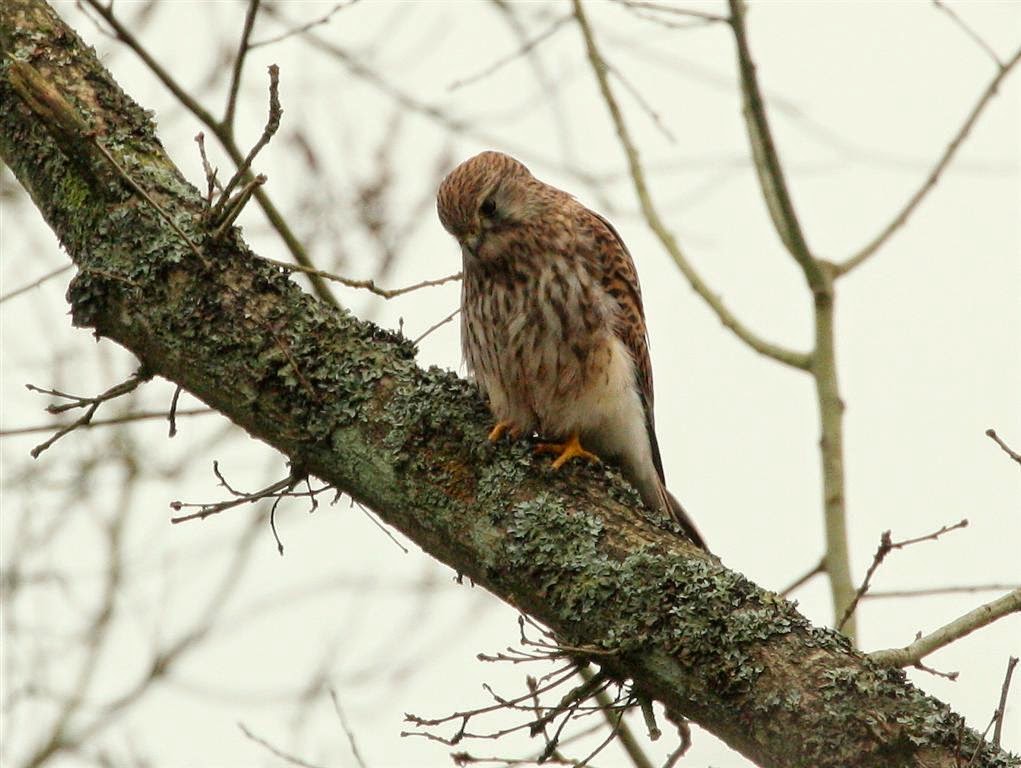

I spotted this (juvenile or female) Kestrel perched in a tree close to one of the main paths and watched it surveying the ground below for a possible meal. After a few minutes it flew to another perch to continue its vigil before eventually flying away.


One Black-headed Gull has taken up residence on the main pond and regularly takes flight when another interloper flies in and chases off any competition!


My patch tally for January has now reached 40 species and you can view the full list on my Bird Sightings page. FAB.

Linking to Saturday's Critters hosted by Eileen.

Wednesday, 28 May 2014

Great Spotted Woodpecker Nest Update.

To follow up my earlier post on the Great Spotted Woodpecker I have made a couple of revisits to the nest site during this past week to check on the activity.


On both occasions the conditions; an overcast sky, windy with the constant threat of rain in the air; were not entirely favourable for getting quality images so I had to ramp up the ISO and here are a few of the images that didn't end up in the recycle bin.

As on my previous encounter the youngsters were very vocal but this time they occasionally made a brief appearance prior to one of the parents returning from their lengthy foraging flights.

Unlike their parents the juveniles have red foreheads that are replaced by black as they moult in the autumn. It is difficult to estimate how many are in the nest as different individuals force their way to the entrance to be fed. 
This species has a single brood with usually a clutch of between 4-6 eggs and fledging takes 20-24 days. The current trend of wet weather may well have reduced the number of available insects and I noted that the time between the adults visits was distinctly longer than my first observation at the nest site.


The final look says it all ... "When will they be back with more?"

I will certainly try to revisit them next week to check on progress again.  FAB.

Wednesday, 30 May 2012

Broad-bodied Chaser.


During a wander around the common today I stopped at a small stagnant pool where there was at least six male Broad-bodied Chasers (Libellula depressa) darting hither and thither as they all attempted to seek out what appeared to be a single female while also vigorously defending their individual territories.

It took me a little time to work out where certain individuals where likely to perch and then it was just a matter of waiting patiently and hoping they would sit still long enough.

Unfortunately the female was constantly on the wing and my attempts to catch her while ovipositing where unsuccessful .... maybe next time.  FAB.

Saturday, 3 March 2012

Local Patch YTD Update.

It has been a while since I posted anything about my local patch walks, mainly around Epsom Common Ponds and the surrounding woodlands, so here is an update including images of some of the regular winter species.

The woodland area around the car park has so far produced Robin, Wren, Blackbird, Song Thrush, Mistle Thrush, Jay, Magpie, Carrion Crow, Jackdaw, Chaffinch, Dunnock, Collared Dove, Rose-ringed Parakeet, Starling, Nuthatch, Treecreeper, Goldcrest, Lesser Redpoll, Great Spotted Woodpecker, Blue Tit, Great Tit, Long-tailed Tit, Coal Tit plus one sighting of a Marsh Tit. On 16 February I was very fortunate to find a single Firecrest (a patch tick) but no sightings of Lesser Spotted Woodpecker so far this year.
 Long-tailed Tit (Aegithalos caudatus) taking a brief rest from feeding.

Long-tailed Tit enjoying the sunshine.

Treecreeper (Certhia familiaris) starting its upward climb.

The other main inhabitants around the woodland edge during the winter are the visiting thrushes, Redwing and Fieldfare. Throughout January the numbers for each species were around 50 - 80 but in the last two weeks the numbers have fallen dramatically as they have stripped the berries from the ivy and probably moved on to a better feeding area.

Fieldfare (Turdus pilaris) keeping a watchful eye out for predators

During the last month Woodpigeon numbers have increased dramatically and I estimate a minimum of 250 in and around the woodland. They are pretty skittish and fly into the air at the slightest disturbance and are providing a welcome daily meal for the resident Sparrowhawks which regularly glide over the treetops. The Crows get their daily exercise by mobbing the local Common Buzzards or chasing off a hunting Kestrel.

The main inhabitants of the small Stew Pond are the Mallard and Moorhens.
One of the resident Grey Herons (Ardea cinerea) can be found at one of their favourite fishing locations and usually tease me by allowing me to just get within range of the lens before flying over to the other side!
You will know from previous posts that I can usually find a Cormorant (Phalacrocorax carboresting on the Great Pond. This individual is an older adult in courtship plumage (evidenced by a white thigh patch ... hidden by its wing in this shot and the extensive white on the head and neck).
Or occasionally flying overhead.

Canada Geese numbers fluctuate throughout the year but at least two or three pairs will probably stay to breed. I like the way that one adult always stands on guard while its companion is feeding or takes a rest. A male Tufted Duck made an appearance in early January but hasn't stayed. (A pair did stop and breed last year so maybe they will return now that the water is unfrozen.)

On 31 January, 15 male Mandarin Ducks (Aix galericulata) circled the pond and briefly dropped into an unfrozen area before flying away again. The following week I counted 5 males and 1 female but last week I could only spot one pair lurking in the shade of the main island. Hopefully they will stay to breed as in previous years.

Another infrequent winter visitor to the Great Pond is the Northern Shoveler (Anus clypeata). Two males and a female turned up on 23 February but I don't anticipate that they will stay much longer. Other species seen are Stock Doves, Goldfinch, House Sparrow, Green Woodpecker and Black-headed Gull plus on the 28 February I located 13 Lapwing on the fields at Rushett Farm (Last year for the same week the count was 14!).

During the last two weeks as I skirted the farm fields I have listened to the beautiful song of the Skylarks (Alauda arvensis) that have returned to breed. This photo is one from the archives.    FAB.

Thursday, 5 May 2011

Non Birdie Patchwalk.

Whilst I enjoyed the very vocal songs of the Common Whitethroat and Garden Warbler yesterday my patch walk at Epsom Common today didn't produce anything new so I headed over onto Ashtead Common to check out for signs of any other life around The Rye ... a small stream that meanders through the grassland and woodland.

 Initially it all seemed very quiet but a few flutters soon appeared including this Speckled Wood ...

.... and then a Holly Blue trying to remain hidden amongst the grasses.

I saw a Broad-bodied Chaser (Libellula depressa) flying frantically around one of the muddy shallow pools just over a week ago but failed to get any pics. Today the conditions were much less windy and I watched a single male busily patrolling its territory and waited for it to perch.

Typical of this species as soon as you try to get too close (even from behind) they fly away. Anyway my patience eventually paid off although the strong overhead sunshine was rather harsh and he was soon off again chasing and catching up with a female.

The female hovered briefly just above the water and constantly dipped as she oviposited on the underwater vegetation and then promptly disappeared
.
Another find was this recently emerged teneral male Large Red Damselfly (Pyrrhosoma nymphula).

A Black and Red Froghopper (Ceropis vulnerata) paid a brief visit close to where I was resting. The froghopper is very conspicuous, its black body with red markings acting as a warning to predators that it is distasteful.
A few of the Flag Iris (I. pseudacorus) provided some additional colour to end my stroll.   FAB.

Thursday, 7 April 2011

Sunny Patchwalk.

Yesterday (Wednesday) I returned to Epsom and Ashtead Commons in search for something new.


For nearly two hours up to midday I trekked slowly around Epsom Common Pond and across the grassland heath. Initially the bird song was prolific and on two separate occasions I heard the wistful song of Willow Warbler in the background but couldn't locate them in the tree canopy. I did however just manage a shot of a Chiffchaff (above bottom right) as it took a break from singing to glean some food from the brambles. Great Spotted Woodies were chasing one another, a pair of Blue Tits were spotted copulating and the insects were also in the same frame of mood (above top right). The usual incumbents were on the water; Canada Geese, the various pairs occasionally having a tiff with one another; Coot, Moorhen, Mallard and a single male Tufted Duck. The only species amongst the gorse was a Dunnock so maybe the Whitethroats have still to arrive. 

On my way back to the car for refreshments I switched into stealth mode and slowly crept up on a Grey Heron doing a single leg balancing act while watching the water for a possible meal at the Stew Pond.

After a packed lunch I headed off and traversed the various tracks throughout Ashtead Common. With the sun pushing up the temperature to around 22C it was good to find some dappled shade while admiring the Primroses and the natures own sculptural art in the form of the dying veteran trees that litter this landscape. A brief detour out onto the fields to catch up with the displaying Lapwings and a decent view through the bins of two Skylark while the farmer was watering various dry patches where the seed has not fully germinated.

Nearly at the end of my walk I again heard a WILLOW WARBLER singing and this individual  
tried my patience as it only presented a rear view shot while fluttering its wings and tail feathers so I'll dedicate this image to Dave Lewis of Birds from Behind.

Anyway I waited and eventually it provided a couple of slightly better views before disappearing. 


A lot of effort for one new patch tick but being out in the sunshine made up for the lack of migrants. FAB.

Saturday, 19 March 2011

Sunshine Stroll.

As the sun was shining at long last I decided to make a relatively early start on my local patch and was soon watching a flock of 20 plus Lesser Redpoll actively feeding directly above my head. 

 I never find it easy to photograph pointing directly upwards and this was the best I could do while trying to
 focus on an individual that might show the distinctive red cap.

Although the sun was shining it is still very damp underfoot. Limited activity on the ponds with only Mallard, Coot, Moorhen, Grey Heron, Canada Geese plus overflying Cormorant and Parakeet. No sign of the Mandarin or Teal but I suspect they were well hidden away.

 Grey Heron lurking on the pond margin.

Through the woodlands I watched six Nuthatch busily feeding and chasing one another; several pairs of Great Spotted Woodpeckers displaying plus brief sightings of a Goldcrest and various Tits including the Long-tailed. The usual Corvids, Blackbird, Song Thrush, Robin, Wren and Lapwing  were also seen. Hearing a distant but distinctive mewing call helped me to locate a pair of Common Buzzard (another patch first for 2011) perched in trees on the farm fields just before they took flight and headed north-west. Soon after they departed the birds started singing again including the Skylarks.

 Final photo-op was a confiding Blue Tit before heading home for a cuppa and lunch.    FAB.

LinkWithin

Related Posts with Thumbnails