Showing posts with label Swallow. Show all posts

Sunday, 10 July 2016

Pagham North Wall.

A week ago we decided to drive to the south coast and took a very leisurely stroll along the North Wall overlooking the expansive waters of Pagham Harbour.

One of a number of Swallows taking a rest from chasing insects above the horse paddock behind the harbour wall. Other insect feeders on the wing were Sand and House Martins plus a few Swifts high in the sky.

Unfortunately our arrival coincided with the high tide so most of the bird life was somewhat distant but we managed to spot various waders including Oystercatcher, Curlew, Dunlin, Turnstone and Grey Plover.

A few areas of vegetation remain visible at high tide and one held 26 Little Egrets waiting for the waters to recede.
It is interesting to remember that back in the 1980's I would have been fortunate to catch sight of just one of these delightful birds anywhere around the harbour; such has been their breeding success during the last 25 years.

One Little Egret was still working the reed edge for food on one of the inland pools. We heard the distinctive call of Cetti's Warbler and followed its flight from one hidden perch to another deep within the field edge vegetation where a Common Whitethroat (below) was also located.

 Common Whitethroat.

While listening to the calls of Reed Bunting and Sedge Warblers, that typically failed to show themselves, we watched a number of Grey Herons (above) erupt from their heronry site before resettling a few minutes later followed shortly thereafter with the fly past of a Little Egret (below).

The final photo capture on our return walk was of a Roe Buck in the field beyond the harbour wall. Despite the distance between us he was very aware of our presence.

Linking to:

I'D-Rather-B-Birdin'
Wild Bird Wednesday.

Saturday, 30 April 2016

Surprises in Priest's Field.


On Thursday I arose just before sunrise and above was the scene that greeted me at Thursley Common an hour later. Bitterly cold and a veiled mist hanging over the silent, watery landscape.

Fortunately with a cloudless sky it didn't take long for the sun to perk things up providing some opportunities to store some reflective shots for the archives.


The first bird to catch my attention was a lonesome [Barn] Swallow taking a rest on the overhead cable line after its long northerly journey from Africa.


As I gingerly trod along the slippery, frost covered boardwalk I was accompanied by the twitterings of several small groups of Goldfinch moving from tree to tree.

While listening to a Chiffchaff singing a Curlew (see below) erupted noisily from the bog and made a very high circuit of the heath. Over the next 20 minutes two other individuals joined in this early morning excursion. 


My main quarry on this particular morning was to hopefully get some more snaps of the Common Redstarts but as I neared Priest's Field my attention was distracted by the call of a male Cuckoo and then an unmistakable shape flew into the trees bordering the field. I approached as stealthily as possible and caught sight of a Cuckoo on the ground and just had time for a distant record shot before it flew back into the trees to join its partner.

The mass of small branches made it difficult to focus on the other half of this partnership. After a few minutes they flew off together with the male uttering a brief 'sore throat' call. Strangely over the next two hours I never heard the male call again.


As topping on the cake, so to speak, I then heard a Tree Pipit calling while I watched a Meadow Pipit plus two Woodlark feeding in the field. Then nearby another year tick appeared; a male Northern Wheatear in his breeding finery.


This chap was stocking up before he continues his way northwards to breed. After all these distractions I did see seven Redstart but none came within reasonable range of the lens!

Linking to:
Saturday's Critters
I'D-Rather-B-Birdin'
Through My Lens

Tuesday, 5 August 2014

Random Mix for WBW.

For this weeks edition of Wild Bird Wednesday a few random images taken in the garden and elsewhere.

Male House Sparrow staking his claim above the feeder.

Juvenile House Sparrow getting to grips with the food larder.

Starling ... probably wondering why the feeder is empty!


The ultimate 'shake down'.

Swallow .. checking out the wind direction.

A young Grey Heron doing what it does best ... standing very still.


And finally ... it's time to fly away!  FAB.

Tuesday, 2 July 2013

A Wander at Wicken Fen (Part 3)

Continuation from the previous posts ... Early Start in Suffolk and Fenland with friends.

After consuming our late lunch we jointly decided to drive over to Wicken Fen and as I couldn't locate the co-ordinates for Keith to use on his SatNav I offered to lead the way using the back roads ... but was that such a good idea! After a couple of minor routing hiccups we arrived unscathed.

Unfortunately my suggestion to follow a southerly path on the reserve proved to be almost devoid of any avian activity although we did add two Little Egrets and Lesser Black-backed Gull to the day list and then our attention turned to a totally different animal.

Wicken Fen NNR is one of the last remaining fragments of undrained fenland covering an area of 754 hectares of which the major percentage is former arable land. Ten years ago they introduced Konik ponies (an Eastern European pony breed) and Highland cattle as a means of practically managing the landscape by grazing. They started with six breeding Konik ponies in 2003 and these were supplemented by a further five plus two young males in 2004.


The herd we encountered numbered well in excess of 30 individuals with at least six youngsters born earlier this year. The Wicken Fen Conservation Grazing Project using Konik Ponies and Highland Cattle by Carol Laidlaw (Grazing Manager at Wicken Fen) can be viewed by visiting this link.

The Konik breed are a very sociable animal. The stallions live alongside other stallions, colts and even geldings without any real conflict. They are free to roam wherever they want although there are some fences to protect specific areas on the reserve. Their diet is rich and varied and they are constantly on the move. The ponies receive very little in terms of management (no hoof care, vaccinations etc.) but their welfare is monitored on a daily basis. Having said this we did spot one youngster lying down who initially didn't appear to be moving and we wondered if it had a problem but after a while there was some movement of its tail and its head .... then after a few more minutes it rose to its feet and joined the herd.

  Konik ponies.


Elsewhere on the reserve we watched this pair of Swallows feeding their nestlings at a nest they had built inside one of the hides. This is also an excellent location to find around 18 species of Dragonflies and Damselflies but I only saw 3 species during our brief afternoon visit .... it was fairly breezy!

A Four Spotted Chaser took a rest above one of the water channels.

 My final photos for the day were this obliging House Sparrow.


So after ten hours together it was time for me to start my lengthy journey home. On this occasion, the number of species logged during the day was irrelevant, it was the healthy banter in the company of  two other friendly wildlife watchers that made a grand day out. Many thanks Keith and Trevor.  Cheers ... FAB.

Friday, 29 July 2011

Some Summer Sights.


Swallow.


Silver-washed Fritillary
My father has been housebound since his release from hospital as it is now very difficult for him to walk so tomorrow we are taking Mum and Dad out for a drive somewhere and hoping for some decent weather. If we can get his new wheelchair into the boot of my car then I'll definitely get some exercise providing I can find somewhere reasonably level.

Wherever you are ... have a great wildlife watching weekend.   FAB.

Monday, 28 June 2010

Norfolk Review (Part 3) - Cley Marshes

On day 4 we met up with our friends Tony and Jean for an anti-clockwise walk around Cley Marshes.
At least the sun shone for most of our walk although again there was no protection from the strong north-easterly wind except for when we dived into two of the hides to view the usual ducks but very few waders.
Male Marsh Harrier. (Circus aeruginosus)
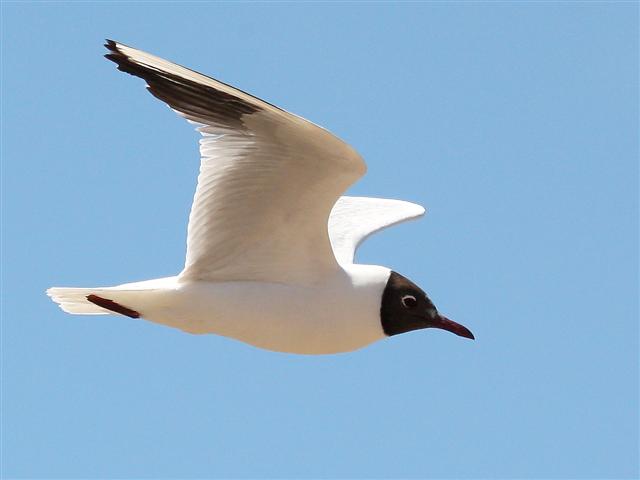
Black-headed Gull. (Chroicocephalus ridibundus)
Distant shot of a male Bearded (Tit) Reedling. (Panurus biarmicus)
Happy family of Mute Swans.
I need more shade Mummy!
Common Tern. (Sterna hirundo)
Barn Swallow (Hirundo rustica) taking a brief rest from catching insects.
No apologies for posting another (Pied) Avocet. (Recurvirostra avosetta)
Painted Lady. (Vanessa cardui) looking a little worn.
After a late lunch [I had a baked tatty with cheese and a mixed salad] in the eco-friendly Information Centre we headed off to to CleySpy in Glandford for some retail therapy. Tony wanted to look for a new harness for his bins but we both ended up buying a new hat to shade us from the sun....or the rain!
Anita and I took a short walk through the model village, built by Sir Alfred Jodrell a century ago, admiring the reddish-pink waves of Valerian; the buildings including the Shell Museum, (regretfully closed)  built using local Norfolk red brick and flint with Flemish gables.We then headed down to the River Glaven, overlooked by the watermill (built in 1907), and then onto the water meadows.....
......where I finally got a chance to capture a resting male Orange Tip (Anthocharis cardamines).....FAB.

LinkWithin

Related Posts with Thumbnails