Showing posts with label Fieldfare. Show all posts

Saturday, 3 March 2012

Local Patch YTD Update.

It has been a while since I posted anything about my local patch walks, mainly around Epsom Common Ponds and the surrounding woodlands, so here is an update including images of some of the regular winter species.

The woodland area around the car park has so far produced Robin, Wren, Blackbird, Song Thrush, Mistle Thrush, Jay, Magpie, Carrion Crow, Jackdaw, Chaffinch, Dunnock, Collared Dove, Rose-ringed Parakeet, Starling, Nuthatch, Treecreeper, Goldcrest, Lesser Redpoll, Great Spotted Woodpecker, Blue Tit, Great Tit, Long-tailed Tit, Coal Tit plus one sighting of a Marsh Tit. On 16 February I was very fortunate to find a single Firecrest (a patch tick) but no sightings of Lesser Spotted Woodpecker so far this year.
 Long-tailed Tit (Aegithalos caudatus) taking a brief rest from feeding.

Long-tailed Tit enjoying the sunshine.

Treecreeper (Certhia familiaris) starting its upward climb.

The other main inhabitants around the woodland edge during the winter are the visiting thrushes, Redwing and Fieldfare. Throughout January the numbers for each species were around 50 - 80 but in the last two weeks the numbers have fallen dramatically as they have stripped the berries from the ivy and probably moved on to a better feeding area.

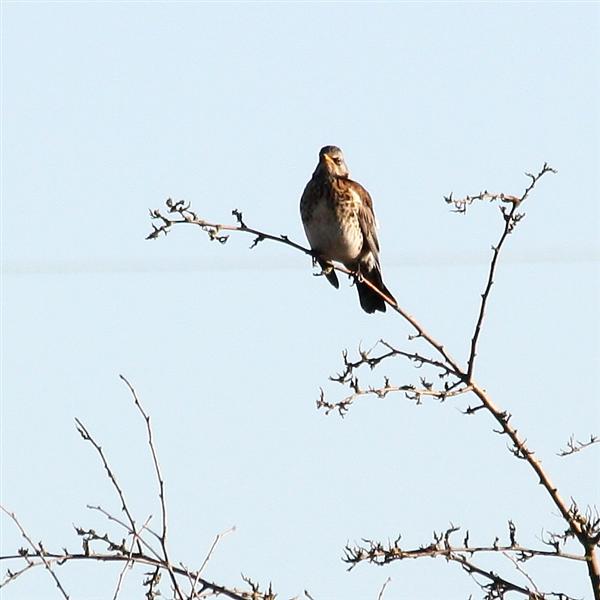
Fieldfare (Turdus pilaris) keeping a watchful eye out for predators

During the last month Woodpigeon numbers have increased dramatically and I estimate a minimum of 250 in and around the woodland. They are pretty skittish and fly into the air at the slightest disturbance and are providing a welcome daily meal for the resident Sparrowhawks which regularly glide over the treetops. The Crows get their daily exercise by mobbing the local Common Buzzards or chasing off a hunting Kestrel.

The main inhabitants of the small Stew Pond are the Mallard and Moorhens.
One of the resident Grey Herons (Ardea cinerea) can be found at one of their favourite fishing locations and usually tease me by allowing me to just get within range of the lens before flying over to the other side!
You will know from previous posts that I can usually find a Cormorant (Phalacrocorax carboresting on the Great Pond. This individual is an older adult in courtship plumage (evidenced by a white thigh patch ... hidden by its wing in this shot and the extensive white on the head and neck).
Or occasionally flying overhead.

Canada Geese numbers fluctuate throughout the year but at least two or three pairs will probably stay to breed. I like the way that one adult always stands on guard while its companion is feeding or takes a rest. A male Tufted Duck made an appearance in early January but hasn't stayed. (A pair did stop and breed last year so maybe they will return now that the water is unfrozen.)

On 31 January, 15 male Mandarin Ducks (Aix galericulata) circled the pond and briefly dropped into an unfrozen area before flying away again. The following week I counted 5 males and 1 female but last week I could only spot one pair lurking in the shade of the main island. Hopefully they will stay to breed as in previous years.

Another infrequent winter visitor to the Great Pond is the Northern Shoveler (Anus clypeata). Two males and a female turned up on 23 February but I don't anticipate that they will stay much longer. Other species seen are Stock Doves, Goldfinch, House Sparrow, Green Woodpecker and Black-headed Gull plus on the 28 February I located 13 Lapwing on the fields at Rushett Farm (Last year for the same week the count was 14!).

During the last two weeks as I skirted the farm fields I have listened to the beautiful song of the Skylarks (Alauda arvensis) that have returned to breed. This photo is one from the archives.    FAB.

Tuesday, 17 January 2012

Winter Ducks.

On Monday I drove over the county boundary to Wraysbury Gravel Pits in the hope of seeking out a few of the migrant species that often frequent the various large lakes formed after the extraction of gravel to build the M25 motorway.

As I climbed over the style to access the footpath that would take me alongside the New Hythe Pit I was initially greeted with a flurry of activity as various species including Blue Tit, Great Tit, Chaffinch,  Blackbird and Redwing dived for cover while overhead I could hear the distinctive chattering 'shack-shack-shack' calls from a number of Fieldfare. Both the Redwing and Fieldfare are winter visiting Thrushes and typically vary wary of any intruders so I had to wait patiently for them to settle high above me in order to snap a cropped record shot of both in the frame together.


Moving on I scanned the open water only to find that most of the ducks were typically too far away for the lens on the farthest side of he pit but I was delighted to spot that my quarry including 3 drake Smew and 8 Goosanders plus a number of Goldeneye were in fact on site together with the usual Mallard, Coot, Tufted Duck, Pochard, Grey Heron, Cormorants, Mute Swans, and Great Crested Grebes.  

I eventually managed to capture a male Goosander (Mergus merganser) which had been drifting close to the bank but out of my sight and promptly decided to swim away to join its distant companions. The next two species, Goldeneye and Pochard were fortunately a little more obliging.

Male Common Goldeneye (Bucephala clangula)

Male Common Pochard (Aythya ferina)

A few other species kept me company during my stroll including a small flock of Long-tailed Tits, Great Tits (constantly uttering their scolding call as I walked by) and the very noisy Rose-ringed Parakeets whose piercing screams nearly drowned out the constant background sounds from the nearby motorway!

My final quarry was the extremely shy and one of the smallest sawbills, the Smew. The males are often referred to as the 'White Nun' due to their distinctive white and black streaked plumage.
Male Smew (Mergellus albellus).
Every winter this dainty species migrates southwards from its northern boreal breeding grounds in Finland, Sweden and Russia. Small numbers can usually be found at regular overwintering sites from December until March throughout the southern counties of the UK. Unfortunately I couldn't get any decent views so had to dig out an image taken during a visit to this site from just a year ago.  FAB.

Click here to link to WORLD BIRD WEDNESDAY for more images from around the globe.

Monday, 10 January 2011

Ashtead Common Patchwalk.

Another afternoon patch walk around Ashtead Common today. Not a massive species count but I did notch up some additions to the year list: 
Coal Tit (3), Marsh Tit, Fieldfare (5), Sparrowhawk, Treecreeper (3), Starlings and two seperate flocks of Lesser Redpolls (approx 40 in all) flitting about high over the birches plus another sighting of a Lesser Spotted Woodpecker. Unfortunately the light and constant movement of most of the birds as they fed furiously did not help me getting many photos.
 Lesser Redpolls
 A very flighty Goldcrest. One of 3 travelling with a flock of 20 Long-tailed Tits.
 The quick climbing Treecreeper.
 Fieldfare.

So that brings the patch list total up to 29 for two brief visits.  FAB.

Friday, 11 December 2009

A Mixed Week.


I'm not sure where the first part of the week went but on Wednesday I decided it was time to get out and stretch my legs. First stop was a very brief walk at Epsom Great Pond. A pair of Mistle Thrushes were having a verbal argument above me in the car park. The only inhabitants on the water were Moorhen and Cormorants. The light was poor but I tried a few shots of this individual perched on a wooded sculpture of a dragonfly. It twisted its head in all directions following my movements. A Grey Heron, Blue Tits and a Goldcrest elluded the camera.

Main location for the next few hours, after a sprint around the M25 (in the car!) , was to Wraysbury Gravel Pits. As often happens as soon as I turn up everthing moves to the far side of the water.

Even this immature Mute Swan decided to move away but the crafty 'Early Birder' waited patiently and got some more pics that I will share with you in a forthcoming post.

Scanning the water with bins and then the scope produced masses of Coot, Great Crested Grebes, Tufted Ducks, Mallard, Wigeon, Pochard, and Shovellers hiding way away under the far bank. Then this beauty popped up way out in the middle of the pit.....a male Goldeneye.  Sorry for the poor quality but digiscoped in poor light and shaking hands...yes it was cold!

Scanned around but no sign of any Smew yet but did find the resident Cormorants perched on the bare branches between the pits.


As I continued my stroll along the waterside, with the read heads waving in the increasing breeze, I disturbed a hidden Grey Heron who promptly flew away. A flock of 20 plus Long-tailed Tits signalled their presence as they foraged through the trees together with Blue and Great Tits. Chaffinch, Greenfinch, Blackbird, Jay and Crow plus a single over-wintering Chiffchaff were also present.

Further along the path I could hear the unmistakeable calls  from both Redwing and Fieldfare high in the tree tops as they constantly moved from perch to perch.

Above are two long distance shots of Fieldfare. The Redwing didn't hang around for a photo call!

In addition to the constant skwarking calls from Rose-ringed Parakeets flying around this location has a number of other noisy interuptions....the passing trains plus the planes taking off from the nearby Heathrow Airport ..... that bombard the eardrums just at the very moment I am trying to latch onto the calls of Goldfinch.

My walk takes me over a bridge where I stop to listen and look for Kingfisher and Water Rail without any luck on this visit.

As it is well past lunch time I parked myself overlooking this view across another pit and while enjoying some much needed refreshments I continued to scan around but nothing new showed itself.

The return walk back to the car produced Dunnock, Black-headed Gulls and of course it wouldn't be a birding day without a Robin Redbreast, would it!


The remainder of my week centred around dealing with A's car failing to start again on Thursday morning! Battery totally dead, so jump start, ring 'Muz' our friendly mechanic who says bring it over now and I'll fix it. True to his word we picked the car up a few hours later with a new battery plus the brakes adjusted and another minor dent in the plastic card but at least A could now safely drive to meet her friends for a pleasant evening meal.

Today has been another lazy day; foggy and overcast; so decided to refresh all the bird feeders, tidy up the patio and wrap up a few pots to protect the contents from any forthcoming frosts. The House Sparrows are continuing to use the trough planter as a dust bath, creating deeper craters each visit. I've also seen two individuals picking up feathers and dead foliage to line a roosting nest somewhere? A Blue Tit was also seen disappearing into one of the nest boxes...early nest prospecting or just looking for somewhere to roost through the winter maybe. Other visitors were Blackbird, Greenfinches, Dunnocks, Robin Great Tits and Magpie plus fly overs by Starling, Black-headed Gulls and Parakeets.    FAB

Monday, 9 November 2009

Last early am pre-work walk?

Last Thursday I made my last pre-work walk around part of the gardens at RHS Wisley with the moon still showing above the trees in the cold sky.
My first stop was at the rear of one of the model gardens as there appeared to be some avian activity nearby. In the trees high above came the rattling calls from two Mistle Thrushes, plus the 'kick..kick' call from a Great Spotted Woodpecker. These were soon joined by a Jay, Magpie, Starlings, Fieldfare and a small group of Greenfinches. Down at eye level a Robin briefly posed for me.
A Redwing dropped into a nearby tree but swiftly departed without partaking of the abundant fruits. (Not a brilliant shot but it will have to do until I can get closer.)
The signs of autumnal change were everywhere and as I headed for the Arboretum Goldfinches 'twittered' as they flew purposely overhead.
A view from the 'Fruit Mound' looking down the Piet Oudolf borders towards the Bi-Centenary Glasshouse. (Please follow this link to see what is inside this structure)
An attempt to capture a rainbow indicating that there is damp in the air.
In a recent post 'Hunt for Thrushes and Finches' I failed to get any photos of the recently arrived Fieldfare. I didn't fare much better on this visit but believe me the following shot is not leaves on this tree!
These are Fieldfare (I just need a bigger lens and a steadier hand!)
Other sightings included Blue, Great and Long Tailed Tits, Rose-ringed Parakeets, Woodpigeon, Crows, Jackdaws and this single Mute Swan circled overhead.
On the ground I was surprised to find some 'windfalls' as in recent years all the fallen fruit has been promptly cleared up in order to keep pathways tidy. Let's hope they stay there for the resident and winter migrant birds and the local mammal population to enjoy throughout the coming colder months.

LinkWithin

Related Posts with Thumbnails