Showing posts with label Goldcrest. Show all posts

Friday, 18 July 2014

Hillside Wander.

For this weeks edition of Good Fences (hosted by TexWisGirl) why not follow my journey as the boots take another leisurely wander around Denbies Hillside on the North Downs.

From my starting point the path drops steeply downwards across Steers Field, with a view of the South Western Weald stretching out way below, to the first of many gateways beyond which I enjoy the sight of many Chalkhill Blues and Marbled Whites. Most of them were males on the wing hunting for a female but a few stopped for either a rest or a top up of nectar.


I think about taking a rest in the shade by the gate that leads into the woodland but there are far too many distractions such as lots of Cobweb Spiders including a Funnel Weaver waiting at the entrance to its lair hidden within the shaded brambles, plus Six-spot Burnet and Skippers perched nearby in the sunshine.


After an hour or so in the sunshine with the temperature rising to around 28 deg C I decide to rest awhile about two thirds of the way along the downward slope, amongst the grasses and wild flowers, and soak in the view southeastwards as the clouds slowly drifted in that direction.

At the foot of the slope I pass through a small shaded copse with two more gates to negotiate and then get a reverse view of hillside route I have just descended.


As I turn eastwards I am serenaded by the song of a Goldfinch while a tiny Goldcrest underneath the light green beach canopy checks out the 'watcher' before continuing its late morning search for insects.


So finally I'm on level ground on an ancient track that follows the boundary of the original iron Denbies Estate fence. Erected in the 1890's and definitely built to last.


I am quite surprised by the view ahead with large patches of tall growing Narrow-leaved Everlasting Pea (Lathyrus sylvestris) adorning the track side verges and being visited by various flutters including the Chalkhill Blue and a number of Brimstone and Gatekeepers.


Blooms reaching high above the fence wire.

The trackway eventually enters some welcome shade and I turn north to climb very slowly back up the hillside. After 60 steps and another gate the view opens up to the final grassy slope that needs to be conquered for me to reach the the beginning and the end of my hillside wander.


I hope you managed to keep up with me .. no apologies for the length of this post.  FAB. 

For this months images of Birds, Butterflies and Odonata please check out my photo blog.

Monday, 10 January 2011

Ashtead Common Patchwalk.

Another afternoon patch walk around Ashtead Common today. Not a massive species count but I did notch up some additions to the year list: 
Coal Tit (3), Marsh Tit, Fieldfare (5), Sparrowhawk, Treecreeper (3), Starlings and two seperate flocks of Lesser Redpolls (approx 40 in all) flitting about high over the birches plus another sighting of a Lesser Spotted Woodpecker. Unfortunately the light and constant movement of most of the birds as they fed furiously did not help me getting many photos.
 Lesser Redpolls
 A very flighty Goldcrest. One of 3 travelling with a flock of 20 Long-tailed Tits.
 The quick climbing Treecreeper.
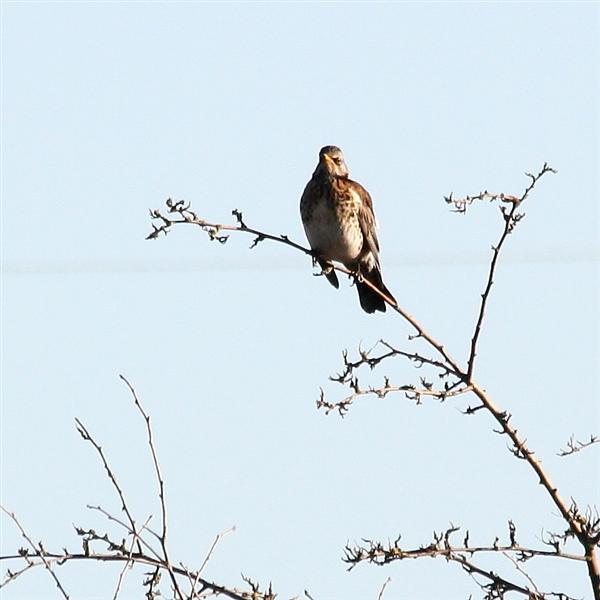
 Fieldfare.

So that brings the patch list total up to 29 for two brief visits.  FAB.

Saturday, 14 February 2009

Valentines Day - Another garden 1st.

I ventured out into the garden early this morning to refill all the feeders and was greeted by a Dunnock proudly singing from the top of a nearby conifer who was quickly joined by his partner and they flew off together. Next the Robin added his tuneful voice to the still cold air. The next job was to repair the netting on the roof of the fruit cage (now used for other purposes) which was damaged by the weight of snow that we recently experienced. As I inserted new clips with frozen fingers I heard the unmistakable call of a PIED WAGTAIL. It was perched right on top of the birch tree - great a garden first - although they are regularly seen in the immediate locality I do not recall ever seeing one stop in my garden before, but could I get a photo?
Blackbird perched briefly on the privet hedge and gave me the eye!

Not long after I returned indoors the birds decided to return and gorge themselves on the available food; Collared Doves (4), Feral Pigeons (2), Starlings (5); Great Tits (2), Blue Tits (2) plus evidence of courtship with food passing from beak to beak; Blackbirds (2); Magpies (2) but didn't stop long thankfully; Greenfinches (6); Long-tailed Tits (2) - same pair returning regularly; Robin (2); Goldcrest (1); Rose-ringed Parakeets (2); House Sparrows (male & female) and the pair of Dunnocks also returned. A definite pattern here on Valentines Day!

Goldcrest on Osmanthus & Fat Feeder

Saturday, 7 February 2009

Long-tailed Tits & Goldcrest staying alive.

After a brief trip into Kingston the cold kept me indoors today but I was rewarded with more visits by a returning Goldcrest and a pair of Long-tailed Tits. Unfortunately taking photos thro' double glazing is not producing the sharpness & quality that I would prefer to post but as 'garden' record shots these will have to do for now.
The Long-tailed Tit (Aegithalos caudatus 'europaeus') is closely related to true tits (Parus) but classified in a seperate family. 13-15cm long and in flight, skipping with short undulations, it looks like a tiny ball with a long tail (7-9cm). Family parties are usually seen in in mixed or deciduous woodland with occassional brief visits to gardens as they quickly pass through. Today a pair visited on several ocassions to top up their reserves on the new fat cake feeder but always at the same time as the Goldcrest - Have they been talking to one another?
I never tire of watching their accrobatics as they often feed hanging upside down from the ends of tiny branches, bouncing around like a yo-yo. I also remember being shown their nest some years ago, made mainly from moss held together by spiders' webs - a closed oval shape that cleverly expands as the chicks grow bigger & bigger prior to fledging.

FABirder fact: Members of the Tit family are accrobatic & regularly feed upside down BUT have you ever noticed that later in the day they DONT do this. The reason is that as their weight increases with the intake of food they are not so agile so adopt an upright position to feed.
The Goldcrest (Regulus regulus) is the smallest breeding bird in Europe. It occupies a niche location, only shared with the Firecrest, where its tiny thin bill is adept at locating small insects from the spiky leaves amoungst the branches of thick conifers, mainly spruce & fir. To maintain its body weight & internal temperature in order to survive they constantly feed all day long, particularly in these cold conditions and will often be sighted within mixed Tit flocks. When two rivals meet they ruffle their crown feathers to show off the yellow & orange stripe on the head - a similar scene is witnessed during a courtship display between male & female.


Monday, 19 January 2009

Garden Update....a new visitor.

Activity in the garden over the weekend was fairly normal with visits from:
  • Blackbirds (male & female)
  • Blue Tits & a single Great Tit
  • House Sparrows
  • Collared Doves (quickly emptying one of the feeders!)
  • Starlings
  • Goldfinches
  • a pair of Robins (displaying)
  • Dunnock
  • Parakeets (flying over)
and then very late yesterday afternoon I noticed a much smaller visitor on the fatball feeder - a Goldcrest so I quickly set up my scope in the upstairs back bedroom and waited and waited.........Finally in the fading light it returned for another quick snack and I just managed a record digi-scoped shot before it disappeared again - someone is going to have to clean the windows!

LinkWithin

Related Posts with Thumbnails