Showing posts with label Thursley Common. Show all posts

Tuesday, 31 July 2018

There be Dragons here.


Many of my readers will know of my regular visits, throughout the seasons, to the acidic heathland, bog, ponds and woodlands at Thursley Common National Nature Reserve  for its wealth of wildlife, notably its special birds and a habitat that also supports over 20 species of Odonata.

A carved sign alongside the boardwalk depicts some of the delights that can be found here and this post serves to illustrate the dragon species I have seen here during the past month.

Four-spotted Chaser (Libellula quadrimaculata).

Four-spotted Chaser (Above and below)


Black-tailed Skimmer (Orthetrum cancellatum) [Male above - Female below]


Keeled Skimmer (Orthetrum coerulescens) [Male above - Female below]


Keeled Skimmer - Mating pair.

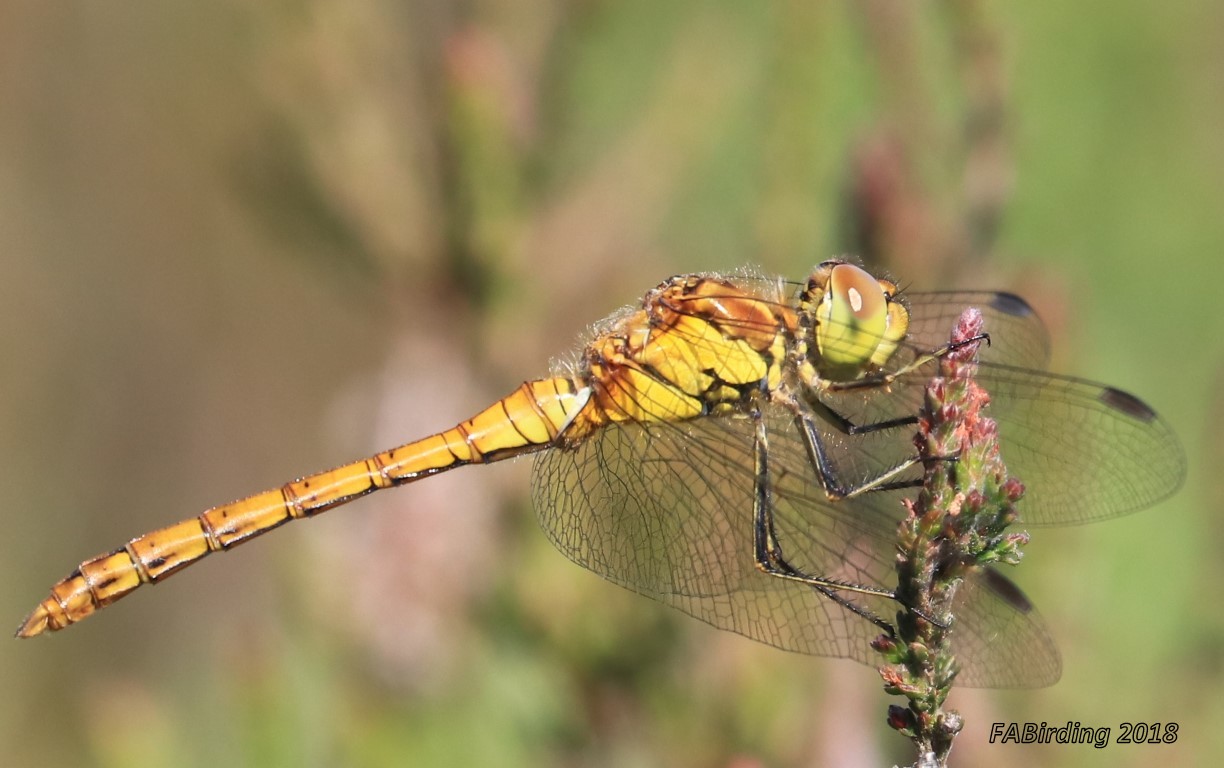
Common Darter (Sympetrum striolatum) [Male above - Female below]


Black Darter (Sympetrum danae) [Male above - Female below]


The Damsels will feature in a future post.

Friday, 8 June 2018

Thursley Common - Residents and Migrants.


From late April into May I made several visits to Thursley Common NNR to check out both the resident and migrant species that inhabit this very important lowland site with its mix of heathland, acidic bog, pools and woodland.

A resident male Stonechat on sentry duty.

Over the years the population of Dartford Warbler (above) has ebbed and flowed due to the occasional severe winters and the devastating fires that have ruined their breeding habitats from time to time. Currently their numbers seem fairly stable and any opportunity to get a shot of an adult in its glorious breeding plumage is a bonus.

On one early morning visit I was fortunate to come across five Northern Wheatear (above) that had dropped in to refuel on their migratory northward journey from Africa. With the lack of cover I had to be content with a distant shot of just two individuals. 

Hearing the distinctive 'cour-lii' calls of a species that I frequently encounter on the south coast I turned my attention skywards to watch one of a pair of Curlew that regularly inhabit this site from April through to August. 


Moving further across the common to a stand of mixed woodland I found one of several male [Common] Redstart (below) that had just arrived from Africa and were setting up territories in preparation for the slightly later arrival of the females.


I spent some time in this spot watching the males chase one another and eventually grabbed a shot of one male that came a little closer, perching briefly, before continuing its aerial antics. 


Another Summer visitor from Africa is the Tree Pipit (above) typically vocalising from a high open perch.

Other species seen and or heard have included Blue, Great, Long-tailed and Coal Tits, Goldfinch, Meadow Pipit, Linnet, Skylark, Woodlark, Great-spotted Woodpecker, Swallow, Kestrel, Common Buzzard, Hobby plus several views of single and pairs of Cuckoo. 

I often end any visit by returning to the boardwalk overlooking Pudmore Pond in order to catch a glimpse of one of any number of Hobby, (above) another migrant from Africa, hawking for their prey. I hope to share more images of this consummate aerial acrobat in a future post. 

Linking to:
Saturday's Critters
I'D-Rather-B-Birdin'
Nature Notes
Wild Bird Wednesday


Monday, 28 May 2018

Four Spotted Chaser.


During a visit to Thursley Common N.N.R. last week I came across this fairly confiding immature male  Four Spotted Chaser (Libellula quadrimaculata) well away from any water on the edge of a wood next to the heath.


Later on around the acidic pools, their typical habitat, I watched several males aggressively chasing one another in territorial flight and managed to capture one taking a very brief rest.

I saw several other species of Damselfly so I will definitely be revisiting in the near future. FAB.

Thursday, 28 July 2016

Landscape Enhancement.

For as far back as I can remember; that is from the late 1960's; the heathland landscape at Thursley NNR was dominated by 11 metal pylons carrying thirty three thousand volt overhead power lines plus twice as many wooden electricity poles carrying eleven thousand volts.

From my perspective they never detracted from the wealth of wildlife seen here over many years. The metal structures, all individually numbered, provided perching places for many bird species and sighting records often mentioned the pylon number as an aid to finding a particular bird for local and visiting birders.

The views have now dramatically changed.

After a two year-long £400,000 project funded by a special allowance granted by industry regulator Ofgem, completed last November, involving Natural England, Surrey Hills Area of Outstanding Natural Beauty (AONB) and Southern Electric Power Distribution (SEPD) over three kilometres of overhead power lines have now been placed underground, with the intention of restoring and enhancing Surrey’s rare, historic heathland landscape and re-creating a sense of partial wilderness rarely found in South East England.


During my most recent visit I noticed that a sculpture has been erected, paying homage to Pylon 36, and when completed will feature a dragonfly perched on top of the structure. I'll have to wait and see which species they decide on.

Throughout the project I understand that every effort was made to avoid areas used by rare nesting birds such as Woodlark and Dartford Warbler and to protect the Reserve’s varied habitats. Here are just some of the wildlife species I encountered during the past week.

Stonechat.

A male Keeled Skimmer.

A juvenile Green Woodpecker.

Common Lizard.

Common Darter.
 
A male Black Darter.

Other bird species seen included Woodlark, Dartford Warbler, Common Redstart, Goldfinch, Swift, Swallow and Kestrel. Butterfly species recorded were Large White, Brimstone, Red Admiral, Comma, Gatekeeper and Small Copper. The Reserve is well known for the abundance of Odonata and apart from the three images above I also saw Emerald, Blue-tailed together with Small and Large Red Damselflies plus a few other dragonfly species, namely Emperor, Four-spotted Chaser and Ruddy Darter. (Some of these varied species will feature in future posts both here and on my photo blog.)  

A location I will never tire of visiting at any time of the year for its varied wildlife. FAB.

Linking to:
Saturday's Critters 

Sunday, 24 July 2016

Black Darters.

Once the temperature increased following a very early morning wander around Thursley Common yesterday I spent a little time hunting down the Black Darters (Sympetrum danae) alongside the boardwalk. 

While plenty were seen unfortunately very few individuals were perched within range of the lens but here are a few reasonable images.

A mature male Black Darter.

A pair in the classic 'mating wheel'
.
 A female Black Darter.

Another mature male with a damaged wing.

An immature male Black Darter.

Just before I decided to leave these delightful small dragons in peace a mature male was located against an uncluttered background.
 
Linking to:

Saturday, 30 April 2016

Surprises in Priest's Field.


On Thursday I arose just before sunrise and above was the scene that greeted me at Thursley Common an hour later. Bitterly cold and a veiled mist hanging over the silent, watery landscape.

Fortunately with a cloudless sky it didn't take long for the sun to perk things up providing some opportunities to store some reflective shots for the archives.


The first bird to catch my attention was a lonesome [Barn] Swallow taking a rest on the overhead cable line after its long northerly journey from Africa.


As I gingerly trod along the slippery, frost covered boardwalk I was accompanied by the twitterings of several small groups of Goldfinch moving from tree to tree.

While listening to a Chiffchaff singing a Curlew (see below) erupted noisily from the bog and made a very high circuit of the heath. Over the next 20 minutes two other individuals joined in this early morning excursion. 


My main quarry on this particular morning was to hopefully get some more snaps of the Common Redstarts but as I neared Priest's Field my attention was distracted by the call of a male Cuckoo and then an unmistakable shape flew into the trees bordering the field. I approached as stealthily as possible and caught sight of a Cuckoo on the ground and just had time for a distant record shot before it flew back into the trees to join its partner.

The mass of small branches made it difficult to focus on the other half of this partnership. After a few minutes they flew off together with the male uttering a brief 'sore throat' call. Strangely over the next two hours I never heard the male call again.


As topping on the cake, so to speak, I then heard a Tree Pipit calling while I watched a Meadow Pipit plus two Woodlark feeding in the field. Then nearby another year tick appeared; a male Northern Wheatear in his breeding finery.


This chap was stocking up before he continues his way northwards to breed. After all these distractions I did see seven Redstart but none came within reasonable range of the lens!

Linking to:
Saturday's Critters
I'D-Rather-B-Birdin'
Through My Lens

LinkWithin

Related Posts with Thumbnails