Showing posts with label Wren. Show all posts

Monday, 9 May 2016

Troglodytes troglodytes.


On any of my walks it would be very unusual not to encounter this small active brown bird with its cocked tail often just announcing its presence with its loud voice before promptly disappearing into deep cover.

The [Eurasian] Wren (Troglodytes troglodytes), otherwise known as 'Jenny Wren' is our commonest UK breeding bird, although it does suffer declines during prolonged, severely cold winters. Currently the local population is in very healthy.

The scientific name is taken from the Greek word "troglodytes" (from "trogle" a hole, and "dyein" to creep), meaning "cave-dweller", and refers to its habit of disappearing into cavities or crevices whilst hunting arthropods or to roost.

Click below to check out its remarkably loud voice: 


If there are any problems with the sonogram here is the direct link: http://www.xeno-canto.org/313805


This individual was very obliging during a recent early morning stroll around Castle Hill LNR.

Linking to:
Through My Lens
image-in-ing
Wild Bird Wednesday

Thursday, 28 April 2016

Castle Hill LNR.

Just a 20 minute walk from home is Castle Hill LNR. Castle Hill has been designated as an Ancient Monument and is thought to be the site of a medieval moated farmstead dating from the 13th century known as Brettgrave. The area is now dominated by mature deciduous woodland but over the past few years active management by coppicing is helping to keep the under-story open thereby encouraging more wildlife.

At this time of year, apart from the typical woodland bird life, the main attraction is the swathes of our native Bluebells (Hyacinthoides non-scripta) competing with a green carpet of Cleavers (Bedstraw) beneath an open canopy that is very slowly greening up.

A Song Thrush perches high overhead taking a rest from proclaiming its territory with its characteristic repetitive song.

The reserve boundary is dominated by an old iron fence that in many places is showing the test of time!


Other 'regulars' during my early morning stroll were Robin (above) and the tiny [Winter] Wren (below) with the big voice.


And finally a collage showing a few of the wild flowers that have appeared during the past couple of weeks including the invasive Three-cornered Garlic growing amongst the Bluebells, Red Dead-nettle, Greater Stitchwort, Green Alkanet and Bedstraw.

Linking to:

Wednesday, 6 May 2015

Troglodytes troglodytes.


During my wanderings I am often spied upon by one of our tiniest residents, the Wren (Troglodytes troglodytes) and on a recent chilly early morning stroll this individual was lit up by the rising sun

For a very tiny bird, just 9-10.5 cm in length, it produces one of the loudest songs.


Whether uttered from deep cover or out in the open there is no mistaking the presence of a Wren.  FAB.

Friday, 22 August 2014

A New Transect for 2015.

Adjacent to my regular patch circuit around Epsom Common Ponds is Ashtead Common National Nature Reserve, extending over 500 acres of ancient woodland owned and managed by the City of London Corporation. In the 1870's the City was concerned that access to the open countryside was being threatened, and as a result promoted two Acts of Parliament to enable it to acquire and protect various open spaces from development.

Last month during a walk with one of the Wardens I offered my services to carry out Butterfly recording over a new fixed route (transect) starting in April 2015. I have walked the proposed route on several occasions recently and this post provides an insight to the varied wildlife I have already encountered.
 
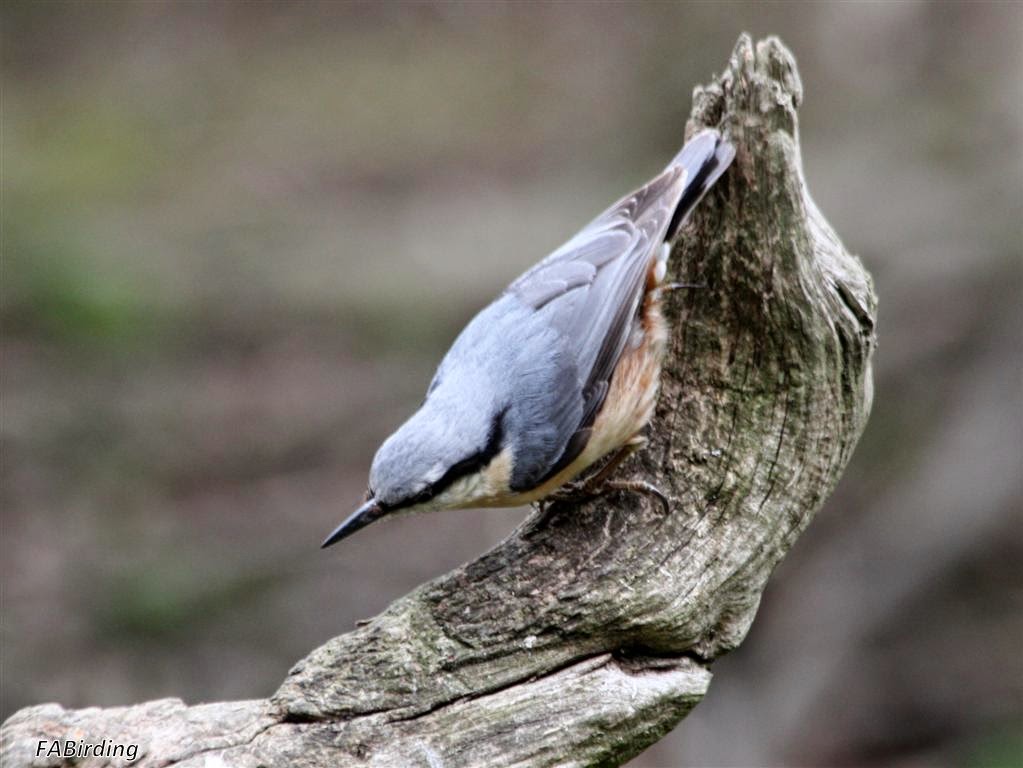
The start of the transect begins at 'Chessington View' overlooking the fields above Rushett Farm, a good spot to listen to Skylarks in the Spring and to locate Nuthatch at almost any time of the year. During the winter large flocks of Redwing and Fieldfare congregate in the trees in between their feeding forays onto the nearby fields. Carrion Crows, Jackdaws and Magpies are fairly numerous throughout most of the year.
 
[Eurasian] Nuthatch. (Sitta europaea)

The route climbs gently upwards following one of the main rides through the woodland passing an area that was cleared some time ago and the coppiced Hazel was protected by woven rustic barriers to prevent it being browsed by Deer and it appears to have been sucessful.

This 1st section has already produced recent sightings of Brimstone, Green-veined White, Speckled Wood, Meadow Brown, Comma and Silver-washed Fritillary. Bird species seen or heard here include Great-spotted Woodpecker, Robin, Blackbird, Song Thrush, Blackcap, Chiffchaff, Chaffinch, Treecreeper, Blue, Great and Long Tailed Tits, Goldcrest and the very noisy Ring-necked Parakeets.

Speckled Wood.


Section 2 is over similar terrain and passes a very muddy coloured pool called Flag Pond where all three species of Newt; Common, Palmate and Great crested have been recorded.

This is a good place to search for Dragonflies and Damselflies.
Ruddy Darter. (Sympetrum sanguineum)

There are over 2,300 ancient pollarded Oaks across the common which play host to an amazing variety of wildlife; bugs, insects and nesting opportunities for many species of birds. A year ago I noticed that some of the Birch trees had been 'ring-barked' which prevents the sap flowing upwards and now a few have felled themselves ... just one of the many simple and natural methods employed in managing the woodlands.

The woodlands can often be surprisingly quiet until the peace is shattered by the very distinctive loud burst of song from one of the many resident Wrens.

A juvenile Wren. (Troglodytes troglodytes)

My route then passes around an area of archeological significance, the site of a 1st and 2nd Century AD Roman Villa, Bath House with adjacent tile works.

Excavations were first carried out between 1924 to 1929 and again in 1966, 2006 and more recently during August to September 2013 by the Surrey Archaeological Society. As expected nature has very quickly recolonized the diggings with grasses, nettles, ferns and brambles providing dense ground cover.


The open area below the 'King Oak' should be a very good spot for butterfly species. I have already logged Meadow Brown, Ringlet, Gatekeeper, Small and Large Skippers, Comma and Peacock. This part of the common with its mix of Oaks and Sallows is also an excellent place to see Purple Hairstreak and the handsome Purple Emperor.


As my boots brushed past the grasses lining the narrow path numerous Grasshoppers of different sizes and colours hopped from stem to stem.

I don't know if this is typical but every time the lens got close they all tried to move around the grass stem to hide!
 

A young Roe Deer patiently watched my progress before heading off into the undergrowth.


There are a number of seats along my route providing convenient spots to rest awhile and watch the wildlife. 

Sometime I find someone has also used it for other purposes ... the remains of a recent Hazelnut snack by a Grey Squirrel.


At the end of section 6 close to my rest stop I spotted a Hornet and a resting Migrant Hawker.

Various gates and fences are encountered all over the common and many of the latter form the boundaries to specific areas that are grazed by cattle on a rotation basis to maintain this special landscape.

Some of the main open rides are designated bridleways but access to many other pathways is restricted by the use of natural Birch filled barriers that need to be regularly topped up during the year. 

Silver-washed Fritillary.

The final two sections of the transect follow part of the north-western  boundary overlooking Rushett Farm where it is not uncommon for me to find a Common Buzzard, which nest in the adjacent wood, perched on one of the old Oaks or soaring above the fields.

If all goes well with the arrangements for next year I'll look forward to providing weekly wildlife updates between April and September from this interesting location.  FAB.

I'm linking this post to:
Saturday's Critters hosted by Eileen
Camera Critters hosted by Misty
I'D-Rather-B-Birdin' hosted by Anni

Thursday, 1 May 2014

Recent Wildlife.

I will be off-line for a while hopefully putting the new lens and a another camera to good use in a totally different environment. After sifting through the archives here are some images taken during March and April.

The first set is from my wanderings around the lake in Bushy Park in March.

 Egyptian Goose with its early brood of youngsters.

One little gosling was very hesitant about getting its feet wet!

Red-crested Pochard (male)

Red-crested Pochard (female)

A young Grey Heron following its parents advice .... 'always stand very still'.

The next set is from a very recent stroll at Riverside Country Park, on the outskirts of Guildford.


 Tufted Duck (male)
Taken with the new lens ... I'm very pleased with the improved clarity and detail.

 Green-veined White (Pieris napi)

Cormorant resting.

 A very fluffed-up Robin.

 Inquisitive Wren.

The under-wing pattern on a Green-veined White (Pieris napi) taken just a few days ago with a new Cannon PowerShot SX50 HS.

And finally my early morning alarm chorister, the Blackbird.

So in about 30 hours time it will be ....... Arrivederci. Durante la prossima settimana speriamo di essere godendo un gelato e una vista sulle coste del Lago di Garda. FAB.

Friday, 28 June 2013

Early start in Suffolk.

In my previous post I made reference to a return trip to Suffolk. In the early, dark hours of Tuesday morning I drove northwestwards into Cambridgeshire and then headed east into Suffolk for a 6am rendezvous with two other wildlife watchers.

 Dawn breaking over the Suffolk countryside.

On arriving at my destination after a three hour journey I take a short walk with the sounds of Crows and Jackdaws erupting from their overnight roost behind me and a heavy dew lingering on the grassland.

The low lying early morning mist quickly dissipates as the sun rises over a Suffolk wetland.
 
The view over 'The Flash' with two Mute Swans still fast asleep and totally oblivious to the songs of Reed and Sedge Warblers emanating from deep within the vegetation all around me.

I return to my car for a caffeine fix and await the arrival of my 'blogger' friends as a Wren serenades me from its nearby perch and I wonder what wildlife will grace our time here. (More to follow)   FAB.

Linking to Skywatch Friday.

LinkWithin

Related Posts with Thumbnails