Showing posts with label Large Red Damselfly. Show all posts

Friday, 22 June 2018

Transect Update - Week 12.


When I commence my weekly transect there is always a feeling of hope and anticipation about the species that might be seen. Having previously reviewed last years sightings and numbers plus reasonable weather conditions; 20 deg. C but a little cooler in the shade with some cloud cover being pushed along by a fairly brisk westerly wind; there was the prospect of a decent recording session. 

Section 1 produced 5 different species starting with this Large Skipper (above) plus Speckled Wood (2), Meadow Brown (3), Ringlet (2) and White Admiral (6).

White Admiral (above) would eventually feature in 7 out of the 8 sections on the transect producing a total of 14 individuals seen and the highest count for any of the four years I have carried out this survey.


Flag Pond produced the usual Broad-bodied Chaser (above) and Large Red Damselfly (below) with Meadow Brown and Ringlet being the main flutters in this section.


Section 3 produced five species (previously recorded) but not an anticipated Silver-washed Fritillary,  however a pair of White-legged Damselflies [male above and female below] put in an appearance.

Section 4, the largest open area of grassland that is slowly being swamped by bracken, produced one new species, a Small Skipper and a total of 25 Meadow Browns.


Meadow Browns eventually appeared in every section of the transect with a total of 44 individuals recorded. 

So my initial anticipation was rewarded with 8 species logged including Large White and Green-veined White culminating in an overall total of 77 individual sightings; again the highest 'Week 12' for the past four years.

Linking to:

Saturday, 25 June 2016

Ashtead Common Transect.

After the torrential storms on Thursday which flooded our rear garden I anticipated that even beneath a partially sunny sky late on Friday morning the underfoot conditions for my planned butterfly transect walk at Ashtead Common would require waterproof footwear. All the ditches were brimming full of water that was still seeping off the hillside and the main rides were very boggy so the Muck Boots were definitely the right choice.

The dominant species recorded was Meadow Brown (17) plus Speckled Wood (2), Large Skipper (5) and a single Red Admiral. As expected, due to the weather conditions, the overall numbers for the last 13 weeks of the survey period are down by at least 15% compared to last year.

Fortunately during my walk there were a few other interesting encounters mainly centered around the very muddy Flag Pond including more sightings of several male White-legged Damselflies, an Emperor dragonfly ovipositing, two male and one female Broad-bodied Chaser plus Blue and Large Red Damselflies.

 A female Large Red Damselfly (Phrrhosoma nymphula).


The largest open woodland pasture now has a few clumps of foxgloves but is quickly being dominated by the overbearing bracken but the time I spent here produced a few day flying moth species.


Brown Silver-line (Petrophora chlorosata).


One of the varied number of micro Grass Moths (Crambidae family).


I also disturbed at least half a dozen Silver Y (Autographa gamma) but getting a clear focus deep within their grassy hideaway was a real challenge!

The most unexpected find was this immature Black-tailed Skimmer (above) probably displaced by the windy weather. Below is just one of the five Large Skipper recorded throughout the transect.

Tuesday, 23 June 2015

Thursley Common N.N.R.

During a recent visit to Thursley Common on another windy day I was surprised to locate a pair of (Eurasian) Teal, feeding and paddling just yards from the boardwalk, and totally oblivious to my presence.
 
Usually I would expect them to immediately take flight at the slightest hint of any human presence so close by so I took this opportunity to gather a few shots, mainly of the male with his very distinctive head pattern, as his partner managed to keep out of view beneath the overhanging vegetation.


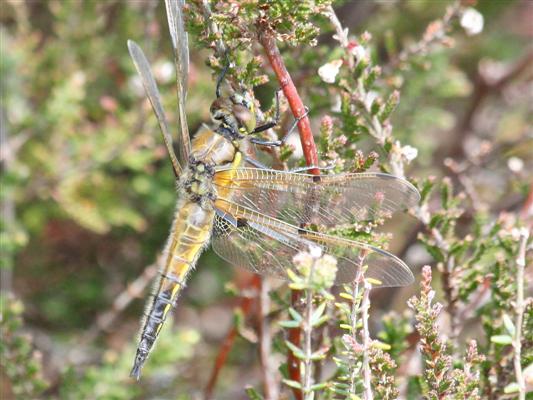
Unfortunately this quiet encounter didn't last very long as the pair sensed the intrusion of some noisy walkers approaching from upwind and they promptly took flight. My attention then turned to seeking out a Four Spotted Chaser (Libellula quadrimaculata) taking a rest below my feet in the watery shadows.


I had seen very few dragonflies or damselflies, probably due to the slightly cooler but windy conditions, so I was delighted to spot a Hobby dashing low across the pools and then land in a distant tree.

I waited for quite some time before this individual took flight to seek out more food and it was eventually joined by three more Hobby but attempting to get any quality images of this very fast flying species with my zoom lens (fully extended) was certainly a challenge. I've no doubt the other two photographers on the boardwalk with their very expensive gear had much more success.


After about ten minutes the Hobbies disappeared and on my reverse route I stopped to take a few more shots of the basking Common Lizards (images saved for a future post) and then spotted a resting Large Red Damselfly (Phrrhosoma nymphula) amoungst the heather.


Linking to Nature Notes, Wordless (on Tuesday), and Wild Bird Wednesday.

Wednesday, 21 May 2014

Wildlife on Thursley Common.

I made another outing to Thursley Common last Thursday to check out the wildlife. 

As usual I entered the common via the boardwalk and stopped by one of the acid pools to see if there was any Odonata activity. It soon became obvious that there were a number of Chasers skimming over the water so just a matter of waiting for one to settle somewhere.


While I waited a Large Red Damselfly perched close by for a photo call with several others in tandem seeking a place to settle whilst being harried by other uncoupled individuals.
Eventually a Four Spotted Chaser (Libellula quadrimaculata) landed nearby to take a rest.

Nice to see them with their pristine wings before all the battles take a toll. The sexes are very much alike and their brown abdomen becomes much darker as they mature. They often fall prey to the Emperor Dragonfly which patrols the water at a similar height of 70cm.

As on a previous visit (please click the link to view earlier images) I saw at least four male Redstart but they were typically always singing from fairly high perches so I had to crop the images taken so that you can appreciate their stunning colours.


This male was singing with from the same location for some ten minutes in direct competition with another male not too far away.
You can listen to it's song here.


Further over on the heath I noticed at least two spotty looking young birds flitting about the track side foliage and eventually managed a quick photo as I wasn't sure of the species ID at the time.

Having now cropped the image and looked more closely at its markings; including the rufous rump; I'm now fairly sure that it is a juvenile Stonechat.

I was also hearing the calls of several Common Whitethroat and just my luck one male perched briefly enabling a shot through a gap in the young birch growth.

Other species seen included Willow Warbler, Chiffchaff, Chaffinch, Mistle Thrush, Robin, Wren, Blackbird, Crow, Jackdaw, Magpie, Mallard, Tufted Duck, Canada Geese, Curlew, Great-spotted Woodpecker, Common Buzzard (6), Cuckoo and Skylark.

One of the many Common Lizards sunning itself on the boardwalk. I'll be going back when there are more species of Odonata on the wing and hopefully spend some time watching their predator, the Hobby.  FAB.

Tuesday, 22 April 2014

First Damsel of the season.


During a brief patch walk at Epsom Common this morning I spotted my first damsel of the season, a female Large Red Damselfly (Pyrrhosoma nymphula) and took the opportunity to test out my recently acquired upgraded lens (EF70-300mm f44-5.L IS) . All these shot are cropped.


The black legs and broad yellow antehumeral stripes (red on a male) help to distinguish the Large Red from the similar Small Red Damselfly.

Back at home the lilac behind the shed is just starting to come into flower, the buds dripping with moisture after yesterdays rain.


Garden Bird Update: Compared to last year there has been very little activity around the bird feeders. Very few sightings of any House Sparrows so we suspect that their nest site on another property has been abandoned or destroyed. A pair of Goldfinches regularly fly in but don't hang around for a photo call. From our recent observations it now appears that two of the three nest boxes are being used by Blue Tits ... Anita has heard youngsters calling in one box located in the tall birch tree and I saw another adult entering the very old box on the back wall of the shed. No pictures yet.  FAB.
Linking to Nature Notes.

Saturday, 1 June 2013

Dragon Chaser.


I visited two locations today. Whilst the first, Fresham Little Pond didn't produce any avian photo opportunities, I was serenaded by numerous Reed Warblers, Garden Warbler, Blackcap, Wren, Blackbird, Nuthatch and Willow Warbler. I also had resonable views of a pair of Great Crested Grebes and three Common Terns that have taken up residence on the 'tern raft'. The only butterflies on the wing were Brimstone and Orange Tip.
As the sun was shining I then decided to head over to Thursley Common in the hope that there might be the chance to capture images of  another species.


Since my very recent wander around the bog at Thursley Common the vegetation has got a little higher. Again not much activity on the water.

The resident Tufted Ducks were resting ... but high overhead I noticed the distinctive shape and aerial acrobatics of a number of 'dragon chasers', but would they come low enough for my lens?

Well I wasn't to be disappointed as eventually one or two individuals decided to hunt their desired prey at a slightly lower level. The HOBBY is a consummate predator, often gliding around relatively slowly before turning up the speed to chase, catch and eat its prey on the wing.

Both images are cropped and one day I might get a shot of it actually capturing its dinner ... but won't hold my breath!

Although it was quite breezy at ground level there were two species of Odonata in reasonable numbers flitting in and out of the waterside vegetation.
An immature Four-spotted Chaser (Libellula quadrimaculata)

 Large Red Damselfly (Pyrrhosoma nymphula) resting on gorse.  FAB.

Thursday, 5 May 2011

Non Birdie Patchwalk.

Whilst I enjoyed the very vocal songs of the Common Whitethroat and Garden Warbler yesterday my patch walk at Epsom Common today didn't produce anything new so I headed over onto Ashtead Common to check out for signs of any other life around The Rye ... a small stream that meanders through the grassland and woodland.

 Initially it all seemed very quiet but a few flutters soon appeared including this Speckled Wood ...

.... and then a Holly Blue trying to remain hidden amongst the grasses.

I saw a Broad-bodied Chaser (Libellula depressa) flying frantically around one of the muddy shallow pools just over a week ago but failed to get any pics. Today the conditions were much less windy and I watched a single male busily patrolling its territory and waited for it to perch.

Typical of this species as soon as you try to get too close (even from behind) they fly away. Anyway my patience eventually paid off although the strong overhead sunshine was rather harsh and he was soon off again chasing and catching up with a female.

The female hovered briefly just above the water and constantly dipped as she oviposited on the underwater vegetation and then promptly disappeared
.
Another find was this recently emerged teneral male Large Red Damselfly (Pyrrhosoma nymphula).

A Black and Red Froghopper (Ceropis vulnerata) paid a brief visit close to where I was resting. The froghopper is very conspicuous, its black body with red markings acting as a warning to predators that it is distasteful.
A few of the Flag Iris (I. pseudacorus) provided some additional colour to end my stroll.   FAB.

LinkWithin

Related Posts with Thumbnails